QUESTION IMAGE
Question
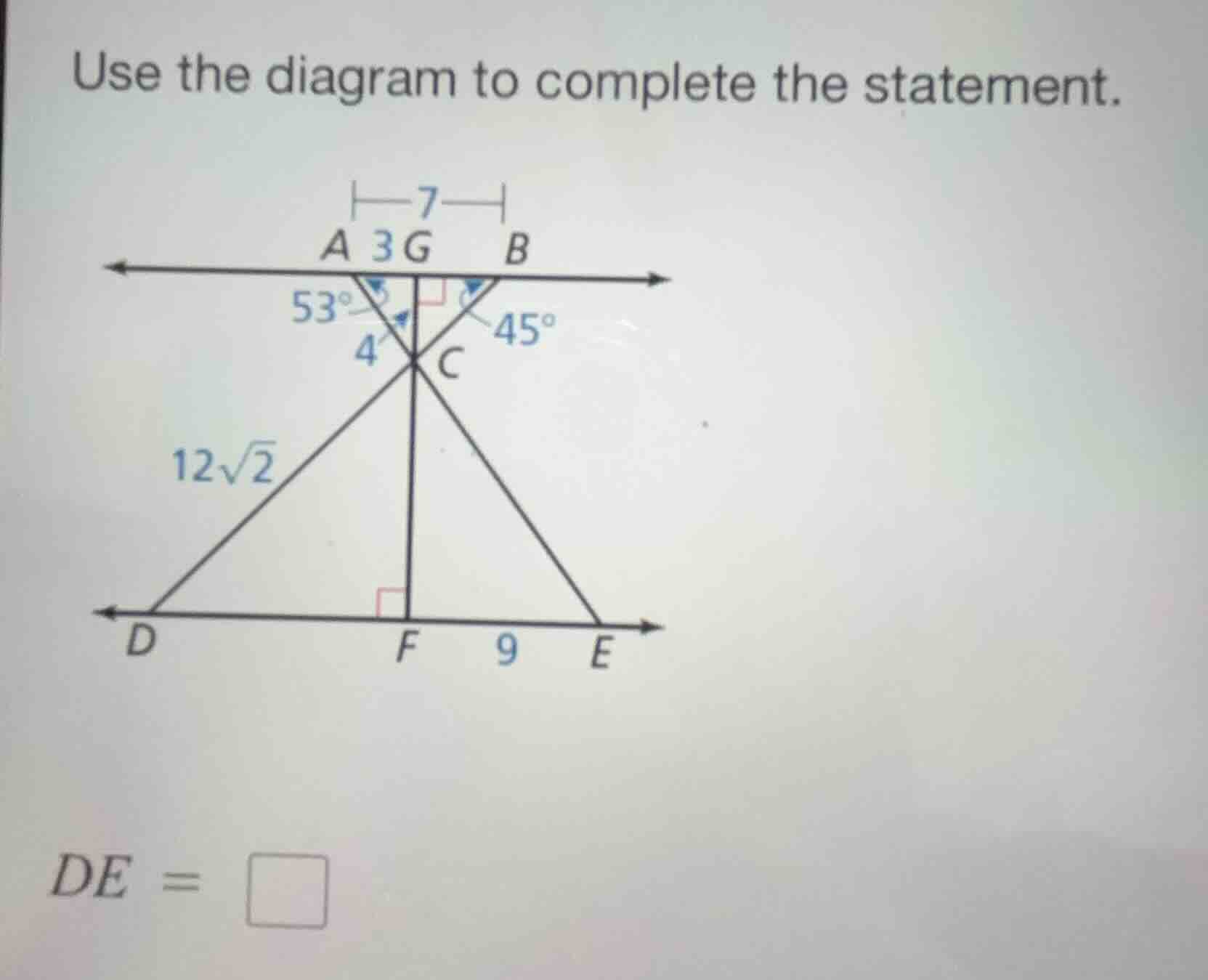
use the diagram to complete the statement.
de = \square
Step1: Analyze triangle CFE
In triangle \( CFE \), \( \angle CFE = 90^\circ \) and \( \angle CBE = 45^\circ \), so triangle \( CFE \) is an isosceles right triangle. Thus, \( CF = FE = 9 \)? Wait, no, wait. Wait, let's check triangle \( CDE \)? Wait, no, first, let's find \( DF \). Wait, \( CD = 12\sqrt{2} \), and triangle \( CDF \) is a right triangle? Wait, \( \angle DFC = 90^\circ \), and \( \angle DCF = 53^\circ \)? Wait, no, maybe we can find \( CF \) first. Wait, in triangle \( CGB \), \( \angle CGB = 90^\circ \), \( \angle CBG = 45^\circ \), so \( CG = GB \). Wait, \( AB = 7 \), \( AG = 3 \), so \( GB = AB - AG = 7 - 3 = 4 \)? Wait, no, \( AG = 3 \), \( AB = 7 \), so \( GB = 7 - 3 = 4 \). Then in triangle \( CGB \), right - angled at \( G \), \( \angle CBG = 45^\circ \), so \( CG = GB = 4 \)? Wait, no, the length from \( G \) to \( C \) is 4? Wait, the diagram has \( CG = 4 \)? Wait, maybe \( CF = CG = 4 \)? No, wait, let's look at triangle \( DFC \). \( CD = 12\sqrt{2} \), \( \angle DFC = 90^\circ \), and if we consider the right triangle \( DFC \), maybe we can find \( DF \). Wait, alternatively, let's look at triangle \( CFE \): since \( \angle E = 45^\circ \) (because \( \angle CBE = 45^\circ \) and \( AB \parallel DE \), so alternate interior angles), and \( \angle CFE = 90^\circ \), so \( CF = FE \). Wait, \( FE = 9 \)? No, the length of \( FE \) is 9? Wait, the diagram shows \( FE = 9 \). Wait, no, maybe \( CF = 9 \)? Wait, no, let's re - examine. Wait, in triangle \( CGB \), \( \angle CGB = 90^\circ \), \( \angle CBG = 45^\circ \), so \( CG = GB \). \( GB = AB - AG = 7 - 3 = 4 \)? Wait, no, \( AG = 3 \), \( AB = 7 \), so \( GB = 7 - 3 = 4 \), so \( CG = 4 \)? But then in triangle \( CFE \), if \( \angle E = 45^\circ \), \( \angle CFE = 90^\circ \), then \( CF = FE \). Wait, maybe \( CF = 9 \)? No, this is confusing. Wait, let's look at triangle \( DFC \): \( CD = 12\sqrt{2} \), and if \( \angle DCF = 45^\circ \)? No, wait, \( \angle ACD = 53^\circ \), maybe not. Wait, another approach: \( DE = DF + FE \). We know \( FE = 9 \), we need to find \( DF \). In right triangle \( DFC \), \( CD = 12\sqrt{2} \), and if we can find that \( \angle DCF = 45^\circ \), then \( DF = CF \), and by Pythagoras, \( DF^{2}+CF^{2}=CD^{2} \), so \( 2DF^{2}=(12\sqrt{2})^{2}=144\times2 = 288 \), so \( DF^{2}=144 \), \( DF = 12 \). Then \( DE = DF + FE = 12 + 9 = 21 \). Wait, let's check: if \( CD = 12\sqrt{2} \), and \( DF = CF = 12 \), then \( DF^{2}+CF^{2}=144 + 144 = 288=(12\sqrt{2})^{2} \), which works. And \( FE = 9 \), so \( DE = 12 + 9 = 21 \).
Step2: Calculate DE
We found that \( DF = 12 \) (from the isosceles right triangle \( DFC \) with hypotenuse \( CD = 12\sqrt{2} \)) and \( FE = 9 \). Then \( DE=DF + FE=12 + 9 = 21 \).

Snap & solve any problem in the app
Get step-by-step solutions on Sovi AI
Photo-based solutions with guided steps
Explore more problems and detailed explanations
\( 21 \)