QUESTION IMAGE
Question
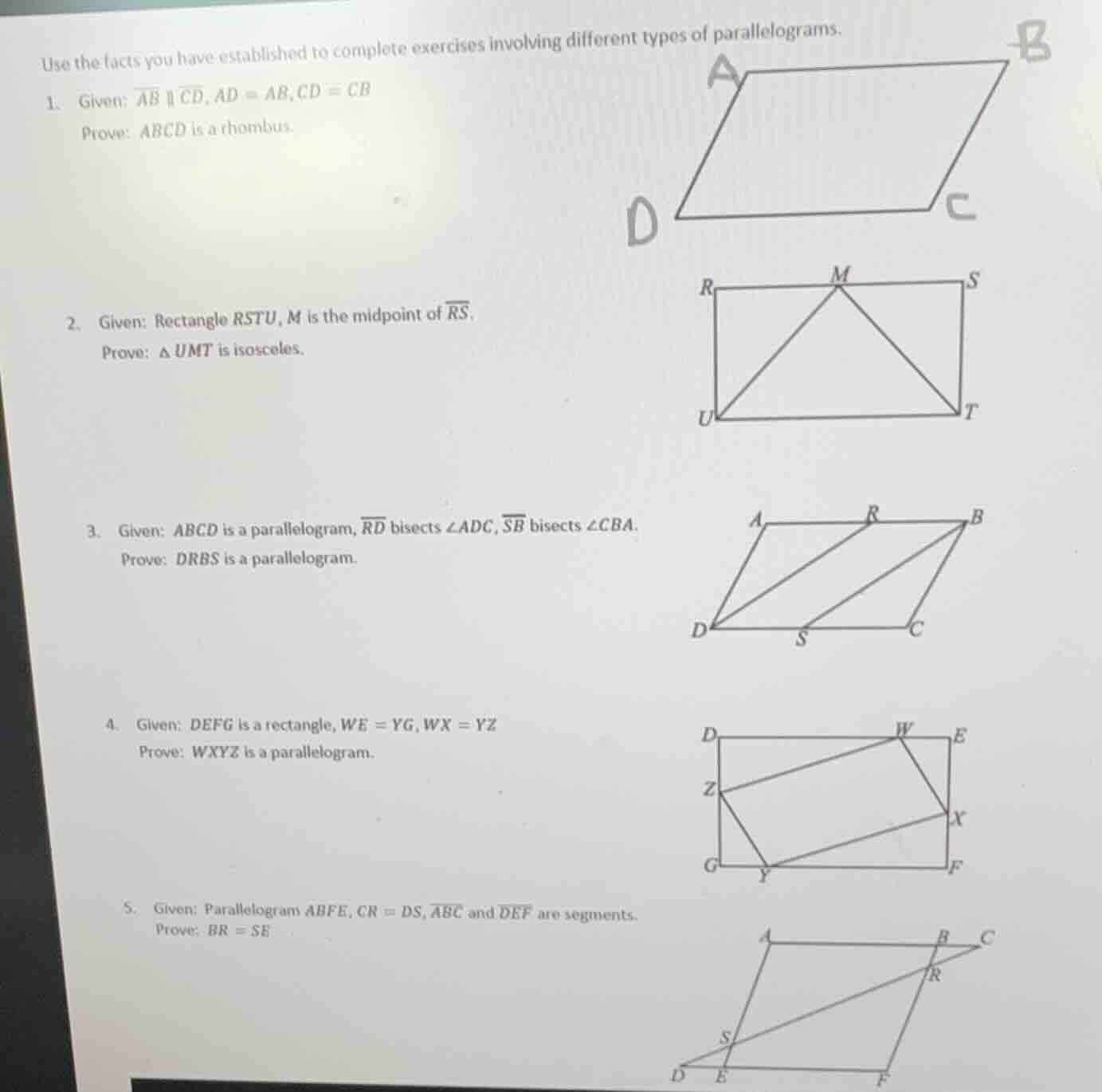
use the facts you have established to complete exercises involving different types of parallelograms.
- given: $overline{ab} \parallel overline{cd}, ad = ab, cd = cb$
prove: $abcd$ is a rhombus.
- given: rectangle $rstu$, $m$ is the midpoint of $overline{rs}$.
prove: $\triangle umt$ is isosceles.
- given: $abcd$ is a parallelogram, $overline{rd}$ bisects $\angle adc$, $overline{sb}$ bisects $\angle cba$.
prove: $drbs$ is a parallelogram.
- given: $defg$ is a rectangle, $we = yg, wx = yz$
prove: $wxyz$ is a parallelogram.
- given: parallelogram $abfe, cr = ds, \overline{abc}$ and $\overline{def}$ are segments.
prove: $br = se$
Problem 1: Prove \(ABCD\) is a rhombus
Step 1: Recall parallelogram from parallel sides
Given \(\overline{AB} \parallel \overline{CD}\), and in a quadrilateral, if one pair of sides is parallel and equal, it’s a parallelogram. First, show \(AB = CD\) (or \(AD = BC\))? Wait, given \(AD = AB\) and \(CD = CB\). Also, since \(AB \parallel CD\), and \(AD\) and \(BC\) are sides. Wait, in a parallelogram, opposite sides are equal. But here, \(AD = AB\) and \(CD = CB\). Let's start:
- Since \(\overline{AB} \parallel \overline{CD}\), and if we can show \(AB = CD\) and \(AD = BC\), but given \(AD = AB\) and \(CD = CB\). Wait, first, prove \(ABCD\) is a parallelogram. Wait, \(AB \parallel CD\), and we need \(AB = CD\) or \(AD \parallel BC\). Wait, maybe:
- Given \(AD = AB\) and \(CD = CB\). Also, since \(AB \parallel CD\), \(\angle ABD = \angle CDB\) (alternate interior angles). But maybe better: In a quadrilateral with \(AB \parallel CD\) and \(AD = AB\), \(CD = CB\), we can show all sides equal.
Wait, let's structure:
- Prove \(ABCD\) is a parallelogram:
- \(\overline{AB} \parallel \overline{CD}\) (given).
- Need to show \(AB = CD\) or \(AD \parallel BC\). Wait, maybe using the given \(AD = AB\) and \(CD = CB\). Wait, maybe first, since \(AB \parallel CD\), and if we can show \(AD = BC\) and \(AB = CD\). Wait, \(AD = AB\) (given), \(CD = CB\) (given). If we can show \(AB = CD\), then \(AD = AB = CD = CB\), so all sides equal, hence rhombus.
- Show \(AB = CD\):
- Wait, maybe \(AB \parallel CD\) implies \(\angle BAD + \angle ADC = 180^\circ\) (consecutive interior angles). But maybe another approach: Since \(AD = AB\) and \(CD = CB\), and if \(ABCD\) is a parallelogram, then \(AB = CD\) and \(AD = BC\). So \(AD = AB\) implies \(AB = AD\), and \(CD = CB\) implies \(CD = CB\). If \(ABCD\) is a parallelogram, then \(AB = CD\) and \(AD = BC\), so \(AB = AD = CD = BC\), hence rhombus.
Wait, let's correct:
- Step 1: Prove \(ABCD\) is a parallelogram.
- \(\overline{AB} \parallel \overline{CD}\) (given).
- Now, show \(AB = CD\) (or \(AD \parallel BC\)). Wait, maybe using the given \(AD = AB\) and \(CD = CB\). Wait, maybe:
- Since \(AB \parallel CD\), \(\angle BAC = \angle DCA\) (alternate interior angles), but maybe not. Wait, perhaps the key is:
- Given \(AD = AB\) and \(CD = CB\), and \(AB \parallel CD\). Let's assume \(AB = CD\) (need to prove). Wait, maybe:
- In \(\triangle ABD\) and \(\triangle CDB\):
- \(AD = AB\) (given), \(CD = CB\) (given), \(BD = BD\) (common side).
- So \(\triangle ABD \cong \triangle CDB\) (SSS).
- Thus, \(\angle ABD = \angle CDB\) (corresponding parts), so \(AD \parallel BC\) (alternate interior angles equal).
- Now, \(AB \parallel CD\) and \(AD \parallel BC\), so \(ABCD\) is a parallelogram (both pairs of opposite sides parallel).
- Step 2: Prove all sides equal.
- In parallelogram \(ABCD\), \(AB = CD\) and \(AD = BC\) (opposite sides of parallelogram).
- Given \(AD = AB\), so \(AB = AD = CD = BC\) (since \(AB = CD\) and \(AD = BC\), and \(AD = AB\)).
- A parallelogram with all sides equal is a rhombus.
Problem 2: Prove \(\triangle UMT\) is isosceles (Rectangle \(RSTU\), \(M\) midpoint of \(\overline{RS}\))
Step 1: Recall properties of rectangle
- \(RSTU\) is a rectangle, so \(RU = ST\) (opposite sides of rectangle), \(\angle R = \angle S = 90^\circ\) (all angles in rectangle are right angles).
- \(M\) is the midpoint of \(\overline{RS}\), so \(RM = MS\) (definition of midpoint).
Step 2: Prove \(\triangle RUM \cong \triangle STM\)
- In \(\triangle RUM\) and \(\triangle STM\):
- \(RU = ST\) (opposite sides of rectangle),
- \(\angle R = \angle S = 90^\circ\) (rectangle angles),
- \(RM = MS\) (midpoint),
- By SAS congruence, \(\triangle RUM \cong \triangle STM\).
Step 3: Conclude \(UM = TM\)
- Corresponding parts of congruent triangles are equal, so \(UM = TM\).
Step 4: Define isosceles triangle
- A triangle with two equal sides is isosceles. Since \(UM = TM\), \(\triangle UMT\) is isosceles.
Problem 3: Prove \(DRBS\) is a parallelogram (Parallelogram \(ABCD\), \(\overline{RD}\) bisects \(\angle ADC\), \(\overline{SB}\) bisects \(\angle CBA\))
Step 1: Recall parallelogram properties
- \(ABCD\) is a parallelogram, so \(AB \parallel CD\), \(AD \parallel BC\), \(\angle ADC = \angle CBA\) (opposite angles equal), \(AB = CD\), \(AD = BC\).
Step 2: Use angle bisectors
- \(\overline{RD}\) bisects \(\angle ADC\), so \(\angle ADR = \angle RDC = \frac{1}{2}\angle ADC\).
- \(\overline{SB}\) bisects \(\angle CBA\), so \(\angle CBS = \angle SBA = \frac{1}{2}\angle CBA\).
- Since \(\angle ADC = \angle CBA\) (opposite angles of parallelogram), \(\frac{1}{2}\angle ADC = \frac{1}{2}\angle CBA\), so \(\angle RDC = \angle SBA\).
Step 3: Prove \(DR \parallel SB\) and \(DB \parallel RS\) (or \(DR \parallel SB\) and \(DR = SB\))
- Since \(AB \parallel CD\) (parallelogram \(ABCD\)), \(\angle RDC = \angle ADR\) (alternate interior angles? Wait, \(AB \parallel CD\), so \(\angle ADR = \angle DRB\) (alternate interior angles) if \(DR\) is a transversal. Wait, maybe:
- \(\angle RDC = \angle SBA\) (from angle bisectors and equal opposite angles), and \(AB \parallel CD\), so \(\angle SBA = \angle BSC\) (alternate interior angles). Wait, maybe better:
- Since \(ABCD\) is a parallelogram, \(AB \parallel CD\) and \(AD \parallel BC\).
- \(\overline{RD}\) bisects \(\angle ADC\), so \(\angle ADR = \angle RDC\). Since \(AD \parallel BC\), \(\angle ADR = \angle DRB\) (alternate interior angles), so \(\angle RDC = \angle DRB\), hence \(DR \parallel SB\) (wait, no, \(SB\) bisects \(\angle CBA\), so \(\angle CBS = \angle SBA\). Since \(AB \parallel CD\), \(\angle SBA = \angle BSC\) (alternate interior angles). Wait, maybe:
- Prove \(DR \parallel SB\) and \(DB \parallel RS\):
- \(AB \parallel CD\) (given, \(ABCD\) is parallelogram), so \(RB \parallel DS\) (since \(R\) is on \(AB\), \(S\) is on \(CD\), so \(RB \subset AB\), \(DS \subset CD\), hence \(RB \parallel DS\)).
- Now, prove \(DR \parallel SB\):
- \(\angle ADC = \angle CBA\) (opposite angles of parallelogram).
- \(\overline{RD}\) bisects \(\angle ADC\), so \(\angle RDC = \frac{1}{2}\angle ADC\).
- \(\overline{SB}\) bisects \(\angle CBA\), so \(\angle SBA = \frac{1}{2}\angle CBA\).
- Thus, \(\angle RDC = \angle SBA\).
- Since \(AB \parallel CD\), \(\angle SBA = \angle BSC\) (alternate interior angles), and \(\angle RDC = \angle BSC\), hence \(DR \parallel SB\) (corresponding angles equal).
- Now, \(RB \parallel DS\) and \(DR \parallel SB\), so \(DRBS\) is a parallelogram (both pairs of opposite sides parallel).
Problem 4: Prove \(WXYZ\) is a parallelogram (Rectangle \(DEFG\), \(WE = YG\), \(WX = YZ\))

Snap & solve any problem in the app
Get step-by-step solutions on Sovi AI
Photo-based solutions with guided steps
Explore more problems and detailed explanations
Step 1: Recall parallelogram properties
- \(ABFE\) is a parallelogram, so \(AB = EF\), \(AB \parallel EF\), \(\angle A = \angle F\), \(\angle ABE = \angle FEB\).
Step 2: Use \(CR = DS\) to show \(BC = DE\)
- \(\overline{ABC}\) and \(\overline{DEF}\) are segments, so \(AB + BC = AC\) and \(DE + EF = DF\)? Wait, no: \(CR = DS\) (given), and \(AB = EF\) (parallelogram), \(AD = BE\) (parallelogram \(ABFE\) has \(AB \parallel EF\) and \(AB = EF\), so \(AD \parallel BE\) and \(AD = BE\)? Wait, maybe:
- \(CR = DS\) (given), so \(CD - CR = CD - DS\) (subtract \(CR\) and \(DS\) from \(CD\)), so \(DR = CS\)? No, wait, \(ABC\) and \(DEF\) are segments, so \(BC = AB + BC - AB\)? Wait, maybe:
- Since \(ABFE\) is a parallelogram, \(AB = EF\) and \(AB \parallel EF\), so \(\angle ABC = \angle DEF\) (corresponding angles, since \(AB \parallel EF\) and \(BC\) and \(DE\) are transversals).
- Given \(CR = DS\), so \(BC = DE\) (since \(CR = DS\) and \(AB = EF\), so \(AB + BC = EF + DE\)? Wait, no, \(CR = DS\) implies \(BC = DE\) (because \(AC = DF\) as \(ABFE\) is parallelogram, so \(AC - AB = DF - EF\), hence \(BC = DE\)).
Step 3: Prove \(\triangle BCR \cong \triangle DES\)
- \(BC = DE\) (from above), \(\angle BCR = \angle DES\) (since \(AB \parallel EF\), corresponding angles), \(CR = DS\) (given).
- By SAS congruence, \(\triangle BCR \cong \triangle DES\).
Step 4: Conclude \(BR = SE\)
- Corresponding parts of congruent triangles are equal, so \(BR = SE\).
Final Answers (Summarized for Each Problem):
- \(ABCD\) is a rhombus (proven by showing all sides equal in a parallelogram).
- \(\triangle UMT\) is isosceles (proven via SAS congruence and equal sides).
- \(DRBS\) is a parallelogram (proven by showing both pairs of opposite sides parallel).
- \(WXYZ\) is a parallelogram (proven by showing opposite sides equal via congruence).
- \(BR = SE\) (proven via SAS congruence of triangles).