QUESTION IMAGE
Question
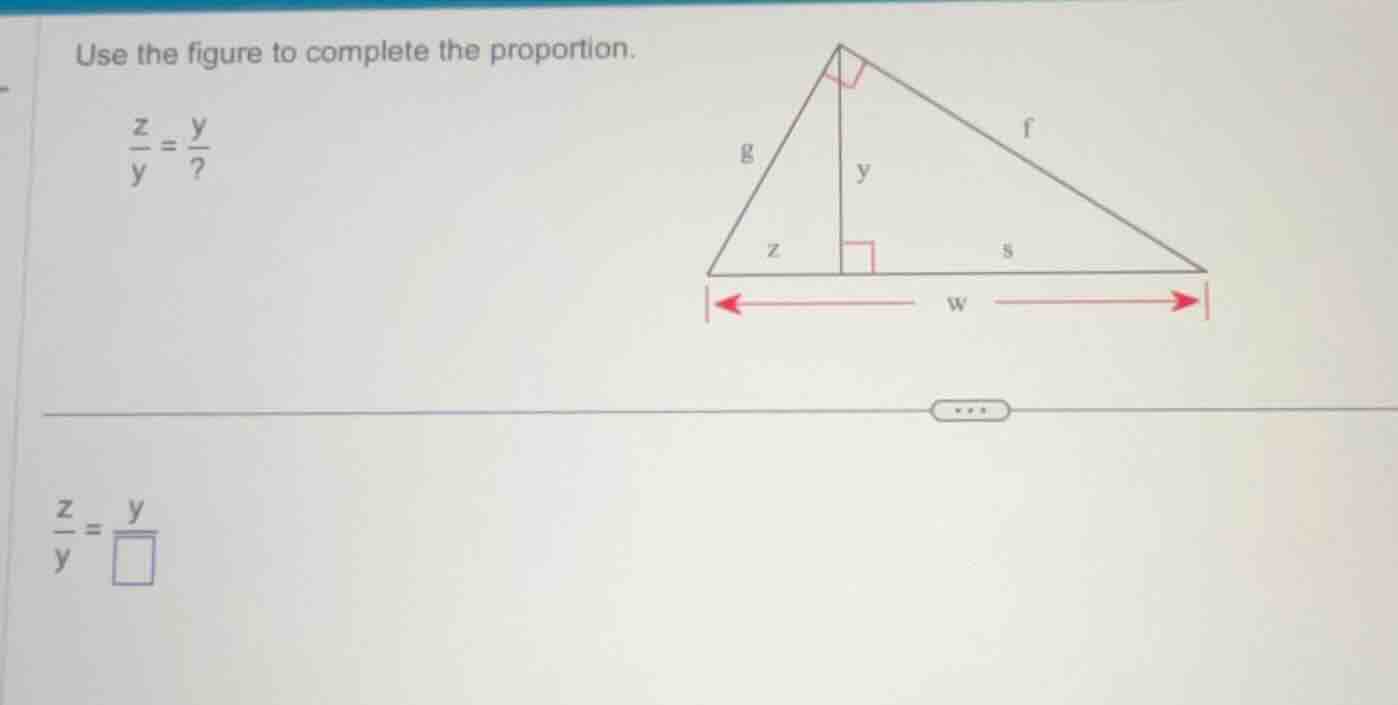
use the figure to complete the proportion.
\\(\frac{z}{y}=\frac{y}{?}\\)
\\(\frac{z}{y}=square\\)
Step1: Recall Geometric Mean Theorem
In a right triangle, when an altitude is drawn to the hypotenuse, the length of the altitude is the geometric mean of the lengths of the two segments of the hypotenuse. Also, each leg of the right triangle is the geometric mean of the hypotenuse and the segment of the hypotenuse adjacent to that leg. Here, the triangles formed are similar: the smaller triangle (with sides \(z\), \(y\), \(g\)) is similar to the triangle with sides \(y\), \(s\), \(f\)) and also to the original triangle (with sides \(w\), \(g\), \(f\)). From the geometric mean (or similar triangles) property, we have the proportion \(\frac{z}{y}=\frac{y}{s}\)? Wait, no, wait. Wait, let's label the segments. The hypotenuse of the original triangle is \(w = z + s\). The altitude is \(y\). The two smaller triangles: one with base \(z\) and height \(y\), and the other with base \(s\) and height \(y\), and the original triangle. By the geometric mean theorem (altitude-on-hypotenuse theorem), the ratio of the leg of a smaller triangle to the altitude is equal to the ratio of the altitude to the other leg of the smaller triangle? Wait, no, more accurately, for similar triangles, corresponding sides are proportional. Let's denote the original triangle as \(\triangle ABC\) with right angle at \(A\), altitude \(AD\) to hypotenuse \(BC\), so \(BC = w\), \(BD = z\), \(DC = s\), \(AD = y\), \(AB = g\), \(AC = f\). Then \(\triangle ABD \sim \triangle CAD \sim \triangle ABC\). So in \(\triangle ABD\) and \(\triangle CAD\), the ratio of \(BD\) (which is \(z\)) to \(AD\) (which is \(y\)) should equal the ratio of \(AD\) (which is \(y\)) to \(DC\) (which is \(s\))? Wait, no, wait: \(\triangle ABD \sim \triangle CAD\), so corresponding sides: \(BD/AD = AD/CD\), so \(z/y = y/s\)? Wait, but the problem is \(\frac{z}{y}=\frac{y}{?}\). Wait, maybe I mixed up. Wait, let's check the labels again. The figure has \(z\) as the segment adjacent to \(g\), \(s\) adjacent to \(f\), \(w = z + s\), \(y\) is the altitude. So the two smaller triangles: one with sides \(z\), \(y\), \(g\) and the other with sides \(s\), \(y\), \(f\), and the original with \(w\), \(g\), \(f\). So \(\triangle (z,y,g) \sim \triangle (y,s,f)\)? Wait, no, \(\triangle (z,y,g) \sim \triangle (w,g,f)\) and \(\triangle (s,y,f) \sim \triangle (w,f,g)\), and \(\triangle (z,y,g) \sim \triangle (s,y,f)\) because both are similar to the original. So in \(\triangle (z,y,g)\) and \(\triangle (s,y,f)\), the ratio of \(z\) to \(y\) (from first triangle) should equal the ratio of \(y\) to \(s\) (from second triangle)? Wait, no, let's do the proportion. If \(\triangle ABD \sim \triangle CAD\), then \(AB/CA = BD/AD = AD/CD\). Wait, maybe the correct proportion is \(z/y = y/s\), but the problem is \(\frac{z}{y}=\frac{y}{?}\), so the missing term should be \(s\)? Wait, but let's confirm. Alternatively, maybe the original triangle's hypotenuse segments: when you have an altitude to the hypotenuse, the length of the altitude is the geometric mean of the two segments. Wait, no, the altitude is the geometric mean of the two segments of the hypotenuse: \(y^2 = z \times s\), so \(z/y = y/s\), which means \(\frac{z}{y}=\frac{y}{s}\). Wait, but the problem is \(\frac{z}{y}=\frac{y}{?}\), so the missing denominator is \(s\)? Wait, but let's check the labels again. The figure has \(s\) as the other segment. Wait, maybe the problem's \(?\) is \(s\)? Wait, no, maybe I made a mistake. Wait, let's re-express. The proportion given is \(\frac{z}{y}=\frac{y}{?}\). From the geometric mean (altitude-on-hypotenuse) theorem, in…

Snap & solve any problem in the app
Get step-by-step solutions on Sovi AI
Photo-based solutions with guided steps
Explore more problems and detailed explanations
\(s\)