QUESTION IMAGE
Question
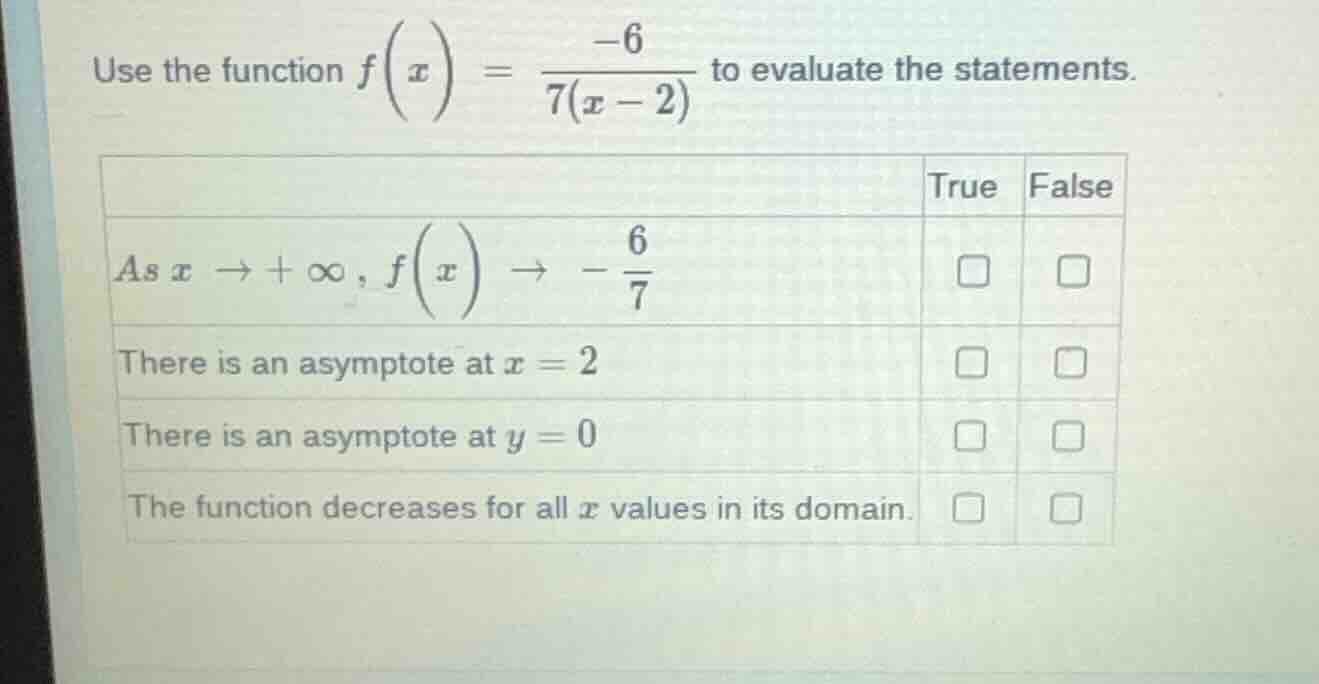
use the function $f\left( x \
ight) = \frac{ -6 }{ 7(x - 2) }$ to evaluate the statements.
| true | false |
|---|
| as $x \to + \infty$, $f\left( x \
ight) \to - \frac{ 6 }{ 7 }$ | $\square$ | $\square$ |
| there is an asymptote at $x = 2$ | $\square$ | $\square$ |
| there is an asymptote at $y = 0$ | $\square$ | $\square$ |
| the function decreases for all $x$ values in its domain. | $\square$ | $\square$ |
Step1: Evaluate limit as $x\to+\infty$
For $f(x)=\frac{-6}{7(x-2)}$, as $x\to+\infty$, $x-2\to+\infty$, so $\lim_{x\to+\infty} f(x)=\lim_{x\to+\infty}\frac{-6}{7(x-2)}=0$.
Step2: Identify vertical asymptote
A vertical asymptote occurs where the denominator is 0 (and numerator is non-zero). Set $7(x-2)=0$, solve for $x$: $x=2$.
Step3: Identify horizontal asymptote
From Step1, $\lim_{x\to\pm\infty} f(x)=0$, so horizontal asymptote is $y=0$.
Step4: Analyze function monotonicity
Rewrite $f(x)=-\frac{6}{7}(x-2)^{-1}$. Take derivative: $f'(x)=-\frac{6}{7}\times(-1)(x-2)^{-2}=\frac{6}{7(x-2)^2}$. Since $(x-2)^2>0$ for all $x$ in domain ($x
eq2$), $f'(x)>0$, so function increases on its domain.

Snap & solve any problem in the app
Get step-by-step solutions on Sovi AI
Photo-based solutions with guided steps
Explore more problems and detailed explanations
- As $x \to +\infty, f(x) \to -\frac{6}{7}$: $\boldsymbol{\text{False}}$
- There is an asymptote at $x=2$: $\boldsymbol{\text{True}}$
- There is an asymptote at $y=0$: $\boldsymbol{\text{True}}$
- The function decreases for all $x$ values in its domain: $\boldsymbol{\text{False}}$