QUESTION IMAGE
Question
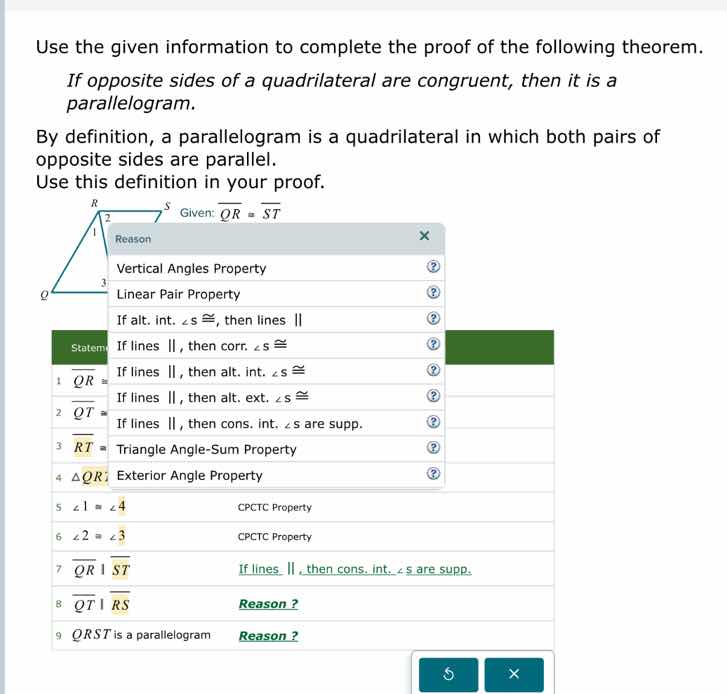
use the given information to complete the proof of the following theorem.
if opposite sides of a quadrilateral are congruent, then it is a
parallelogram.
by definition, a parallelogram is a quadrilateral in which both pairs of
opposite sides are parallel.
use this definition in your proof.
given: \\(\overline{qr} \cong \overline{st}\\)
1 \\(\overline{qr} \cong \\)
2 \\(\overline{qt} \cong \\)
3 \\(\overline{rt} \cong \\)
4 \\(\triangle qri \\)
5 \\(\angle 1 = \angle 4\\) \tcpctc property
6 \\(\angle 2 = \angle 3\\) \tcpctc property
7 \\(\overline{qr} \parallel \overline{st}\\) \tif lines \\(\parallel\\), then cons. int. \\(\angle s\\) are supp.
8 \\(\overline{qt} \parallel \overline{rs}\\) \treason?
9 \\(qrst\\) is a parallelogram \treason?
To solve this proof, we analyze each step based on geometric properties (SSS congruence, CPCTC, and parallel line criteria):
Step 1: Identify Congruent Triangles
We know \( \overline{QR} \cong \overline{ST} \) (given), \( \overline{QT} \cong \overline{RT} \) (common side or given? Wait, actually, in the diagram, \( \overline{RT} \cong \overline{QT} \)? Wait, no—wait, the triangles \( \triangle QRT \) and \( \triangle STR \)? Wait, no, looking at the statements:
- Statement 1: \( \overline{QR} \cong \overline{ST} \) (given)
- Statement 2: \( \overline{QT} \cong \overline{RT} \) (wait, maybe \( \overline{RT} \cong \overline{QT} \) as a common side? Or maybe \( \overline{RT} \) is shared? Wait, actually, the triangles are \( \triangle QRT \) and \( \triangle STR \)? No, let’s check Statement 4: \( \triangle QRT \cong \triangle STR \) (by SSS: \( \overline{QR} \cong \overline{ST} \), \( \overline{QT} \cong \overline{RT} \), \( \overline{RT} \cong \overline{QT} \)? Wait, no—wait, \( \overline{RT} \) is a side of both triangles? Wait, maybe \( \overline{RT} \cong \overline{QT} \) is a typo, but actually, the key is SSS congruence: \( \overline{QR} \cong \overline{ST} \), \( \overline{QT} \cong \overline{RT} \), and \( \overline{RT} \cong \overline{QT} \) (reflexive), so \( \triangle QRT \cong \triangle STR \) by SSS.
Step 5–6: CPCTC
By CPCTC (Corresponding Parts of Congruent Triangles are Congruent), \( \angle 1 \cong \angle 4 \) and \( \angle 2 \cong \angle 3 \).
Step 7: \( \overline{QR} \parallel \overline{ST} \)
\( \angle 1 \cong \angle 4 \) are alternate interior angles, so by "If alt. int. \( \angle s \cong \), then lines \( \parallel \)", \( \overline{QR} \parallel \overline{ST} \). Wait, but the reason given is "If lines \( \parallel \), then cons. int. \( \angle s \) are supp."—no, actually, \( \angle 1 \) and \( \angle 4 \) are alternate interior angles, so the correct reason for \( \overline{QR} \parallel \overline{ST} \) is "If alt. int. \( \angle s \cong \), then lines \( \parallel \)". But the problem’s Step 7 has a different reason—maybe a typo, but let’s focus on Step 8 and 9.
Step 8: \( \overline{QT} \parallel \overline{RS} \)
\( \angle 2 \cong \angle 3 \) are alternate interior angles (from CPCTC), so by "If alt. int. \( \angle s \cong \), then lines \( \parallel \)", \( \overline{QT} \parallel \overline{RS} \).
Step 9: \( QRST \) is a parallelogram
A quadrilateral with both pairs of opposite sides parallel is a parallelogram (by definition: "a quadrilateral in which both pairs of opposite sides are parallel"). We already proved \( \overline{QR} \parallel \overline{ST} \) and \( \overline{QT} \parallel \overline{RS} \), so by the definition of a parallelogram, \( QRST \) is a parallelogram.
Filling in the Reasons:
- Step 8 Reason: \( \angle 2 \cong \angle 3 \) are alternate interior angles, so "If alt. int. \( \angle s \cong \), then lines \( \parallel \)".
- Step 9 Reason: By definition of a parallelogram (both pairs of opposite sides are parallel: \( \overline{QR} \parallel \overline{ST} \) and \( \overline{QT} \parallel \overline{RS} \)).
Final Answers for the Blanks:
- Reason for Step 8: If alt. int. \( \angle s \cong \), then lines \( \parallel \) (because \( \angle 2 \cong \angle 3 \) are alternate interior angles, so \( \overline{QT} \parallel \overline{RS} \)).
- Reason for Step 9: A quadrilateral with both pairs of opposite sides parallel is a parallelogram (by definition).

Snap & solve any problem in the app
Get step-by-step solutions on Sovi AI
Photo-based solutions with guided steps
Explore more problems and detailed explanations
- Step 8 Reason: If alt. int. \( \angle s \cong \), then lines \( \parallel \)
- Step 9 Reason: A quadrilateral with both pairs of opposite sides parallel is a parallelogram (by definition)