QUESTION IMAGE
Question
use the graphing tool to graph the equation.
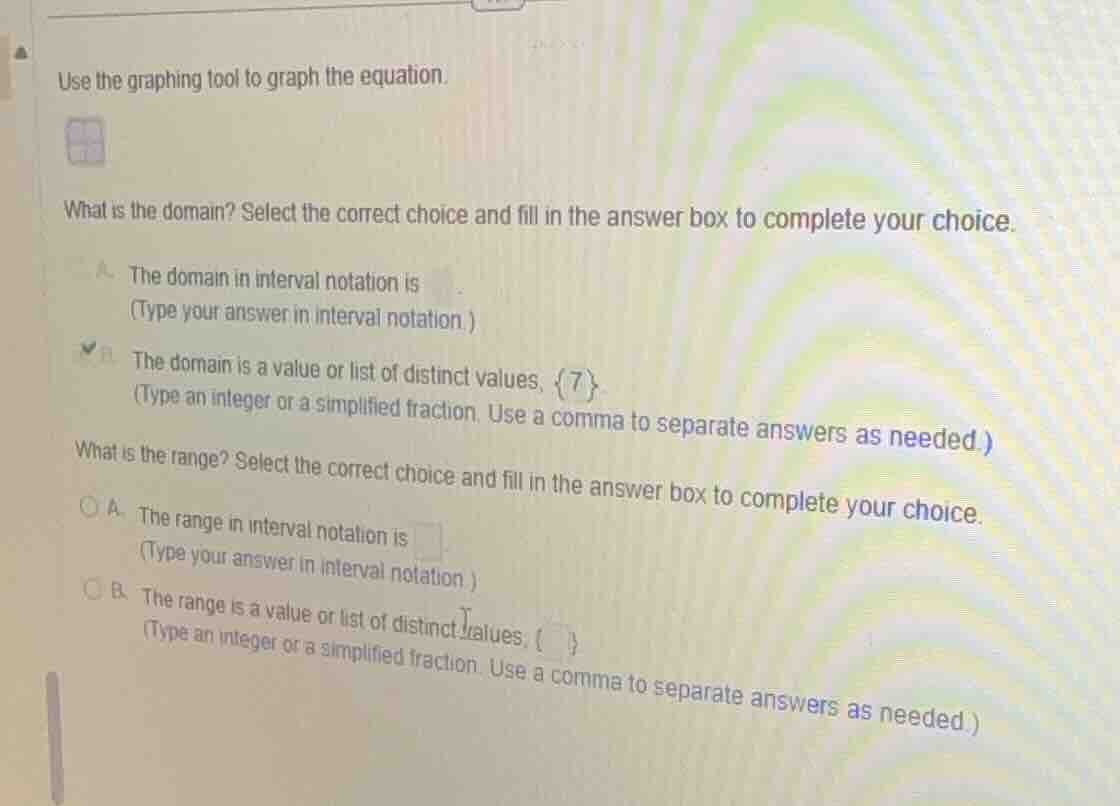
what is the domain? select the correct choice and fill in the answer box to complete your choice.
a. the domain in interval notation is
(type your answer in interval notation.)
b. the domain is a value or list of distinct values, {7}
(type an integer or a simplified fraction. use a comma to separate answers as needed.)
what is the range? select the correct choice and fill in the answer box to complete your choice.
a. the range in interval notation is
(type your answer in interval notation.)
b. the range is a value or list of distinct values, { }
(type an integer or a simplified fraction. use a comma to separate answers as needed.)
To determine the range, we analyze the context. Since the domain is a single value \(\{7\}\), this suggests the equation is likely a vertical line (e.g., \(x = 7\)). For a vertical line \(x = a\) (where \(a\) is a constant), the range is all real numbers because the line extends infinitely up and down, covering every \(y\)-value.
Step-by-Step Explanation:
- Identify the Equation Type: The domain being a single value \(\{7\}\) implies the equation is \(x = 7\) (a vertical line).
- Determine the Range: A vertical line \(x = 7\) extends infinitely in the \(y\)-direction, so the \(y\)-values (range) include all real numbers. In interval notation, this is \((-\infty, \infty)\).
The domain \(\{7\}\) indicates the equation is \(x = 7\) (a vertical line). A vertical line extends infinitely vertically, so the range includes all real numbers.

Snap & solve any problem in the app
Get step-by-step solutions on Sovi AI
Photo-based solutions with guided steps
Explore more problems and detailed explanations
A. The range in interval notation is \((-\infty, \infty)\)