QUESTION IMAGE
Question
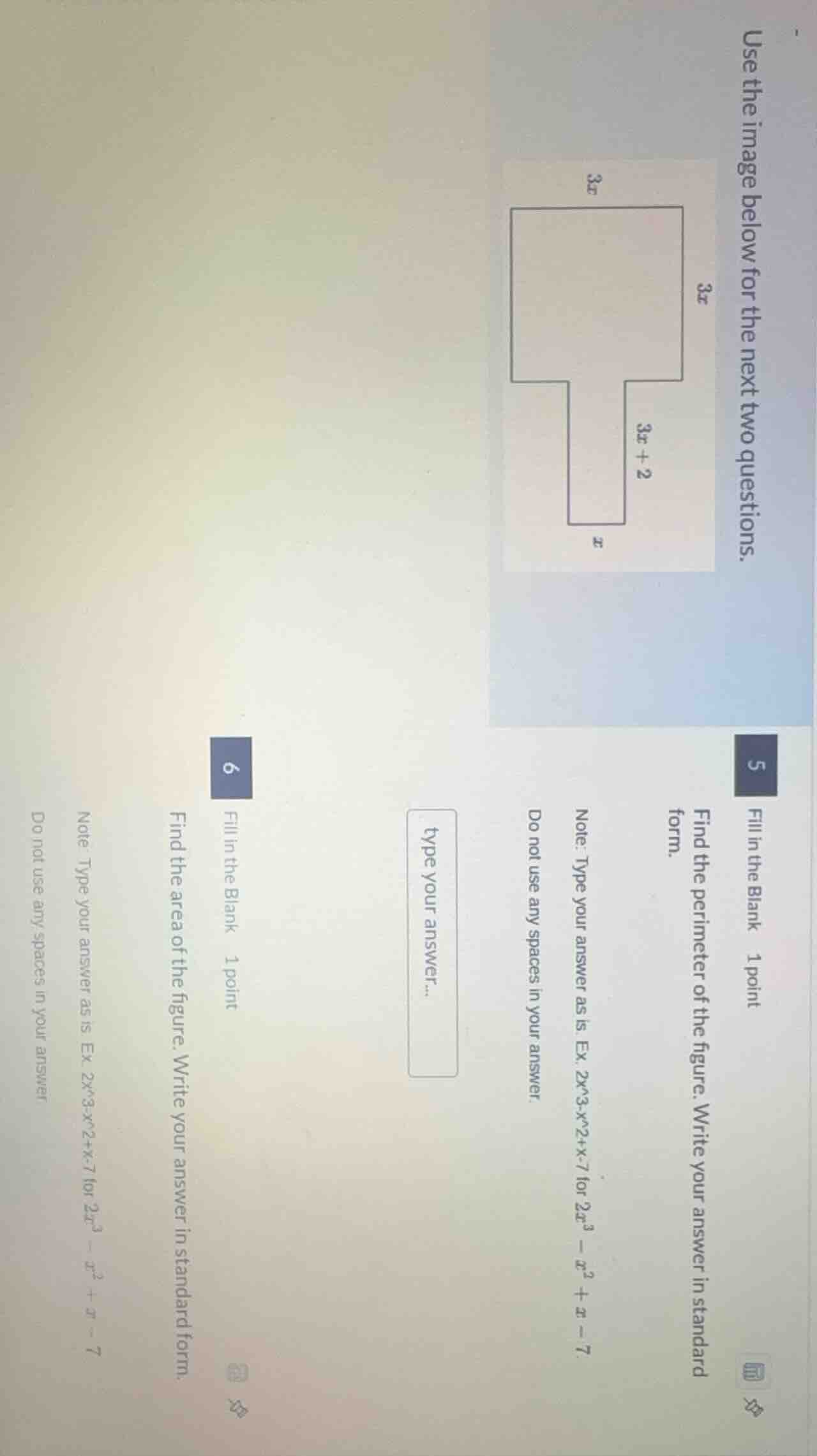
use the image below for the next two questions.
5 fill in the blank 1 point find the perimeter of the figure. write your answer in standard form. note: type your answer as is. ex. 2x^3 - x^2 + x - 7 do not use any spaces in your answer.
6 fill in the blank 1 point find the area of the figure. write your answer in standard form. note: type your answer as is. ex. 2x^3 - x^2 + x - 7 do not use any spaces in your answer.
Question 5: Perimeter Calculation
Step1: Identify all sides
The figure has two sides of length \(3x\) (top and right vertical), a side of \(3x + 2\) (right vertical extension), a side of \(x\) (bottom of the extension), and we need to find the remaining sides by symmetry. The left side of the extension is \(3x + 2\), the bottom of the top rectangle: the total bottom length of the top rectangle should be equal to the top length, which is \(3x\), but the extension is \(x\) wide, so the bottom of the top rectangle (excluding the extension) is \(3x - x=2x\)? Wait, no, let's re - examine.
Wait, the figure is a composite of a square (or rectangle) on top and a rectangle below. The top rectangle has length \(3x\) and width \(3x\)? No, looking at the diagram: the top part is a rectangle with length \(3x\) (horizontal) and height \(3x\) (vertical)? Wait, no, the right side of the top part is \(3x\), the top is \(3x\), then the vertical side on the right of the lower rectangle is \(3x + 2\), the lower rectangle has width \(x\) and height \(3x+2\)? Wait, maybe a better way: to find the perimeter, we sum all the outer sides.
Let's list all the outer sides:
- Top: \(3x\)
- Right - top vertical: \(3x\)
- Right - middle vertical: \(3x + 2\)
- Right - bottom vertical: Wait, no, the lower rectangle has a right side of \(3x + 2\), a bottom side of \(x\), a left side of \(3x + 2\), a top side of \(x\) (but the top side of the lower rectangle is internal? No, no, perimeter is the outer boundary.
Wait, maybe the correct way: when we have a composite figure, the perimeter is calculated by adding all the outer edges. Let's consider the horizontal and vertical components separately.
Horizontal sides:
- Top: \(3x\)
- Bottom: The bottom has two parts: the bottom of the top rectangle (which is \(3x\)) and the bottom of the lower rectangle (\(x\))? No, that's not right. Wait, actually, the horizontal sides: the top is \(3x\), the bottom of the entire figure: the lower rectangle has a width \(x\), and the top rectangle has a width \(3x\), but the lower rectangle is attached to the top rectangle, so the total horizontal length at the bottom: the top rectangle's bottom (excluding the part where the lower rectangle is attached) plus the lower rectangle's bottom. Wait, no, let's use the method of "translating" the sides to find the total horizontal and vertical lengths.
For horizontal sides (left - right):
The total length of horizontal sides: the top is \(3x\), the bottom: the lower rectangle has a width \(x\), and the top rectangle's bottom (the part not covered by the lower rectangle) is \(3x - x = 2x\)? No, this is getting confusing. Let's do it step by step.
Looking at the diagram again (as per the given labels):
- The top horizontal side: \(3x\)
- The right - most vertical side: \(3x+(3x + 2)=6x + 2\)? No, no. Wait, the vertical sides:
On the right: we have two vertical segments: the top part is \(3x\) and the lower part is \(3x + 2\), so total right vertical length: \(3x+(3x + 2)=6x + 2\)
On the left: by symmetry, the left vertical length is also \(6x + 2\)
Horizontal sides:
The top horizontal side: \(3x\)
The bottom horizontal side: the lower rectangle has a width \(x\), and the top rectangle's bottom (the part not covered by the lower rectangle) is \(3x - x=2x\)? No, that's incorrect. Wait, the lower rectangle is attached to the top rectangle. The top rectangle has a horizontal length of \(3x\), and the lower rectangle has a horizontal length of \(x\). So the total bottom horizontal length is \(3x\) (because the lower rectangle is attached to the top rectangle, so the bott…
Step 1: Identify the two rectangles
The figure is composed of two rectangles: the top rectangle and the bottom rectangle.
The top rectangle: length \(l_1 = 3x\) and width \(w_1=3x\) (assuming the top part is a rectangle with length \(3x\) and width \(3x\))
The bottom rectangle: length \(l_2=x\) and width \(w_2 = 3x + 2\)
Step 2: Calculate the area of each rectangle
The area of a rectangle is given by \(A = l\times w\)
Area of top rectangle \(A_1=3x\times3x = 9x^{2}\)
Area of bottom rectangle \(A_2=x\times(3x + 2)=3x^{2}+2x\)
Step 3: Calculate the total area
The total area \(A = A_1+A_2\)
\(A=9x^{2}+3x^{2}+2x=12x^{2}+2x\)

Snap & solve any problem in the app
Get step-by-step solutions on Sovi AI
Photo-based solutions with guided steps
Explore more problems and detailed explanations
\(18x + 4\)