QUESTION IMAGE
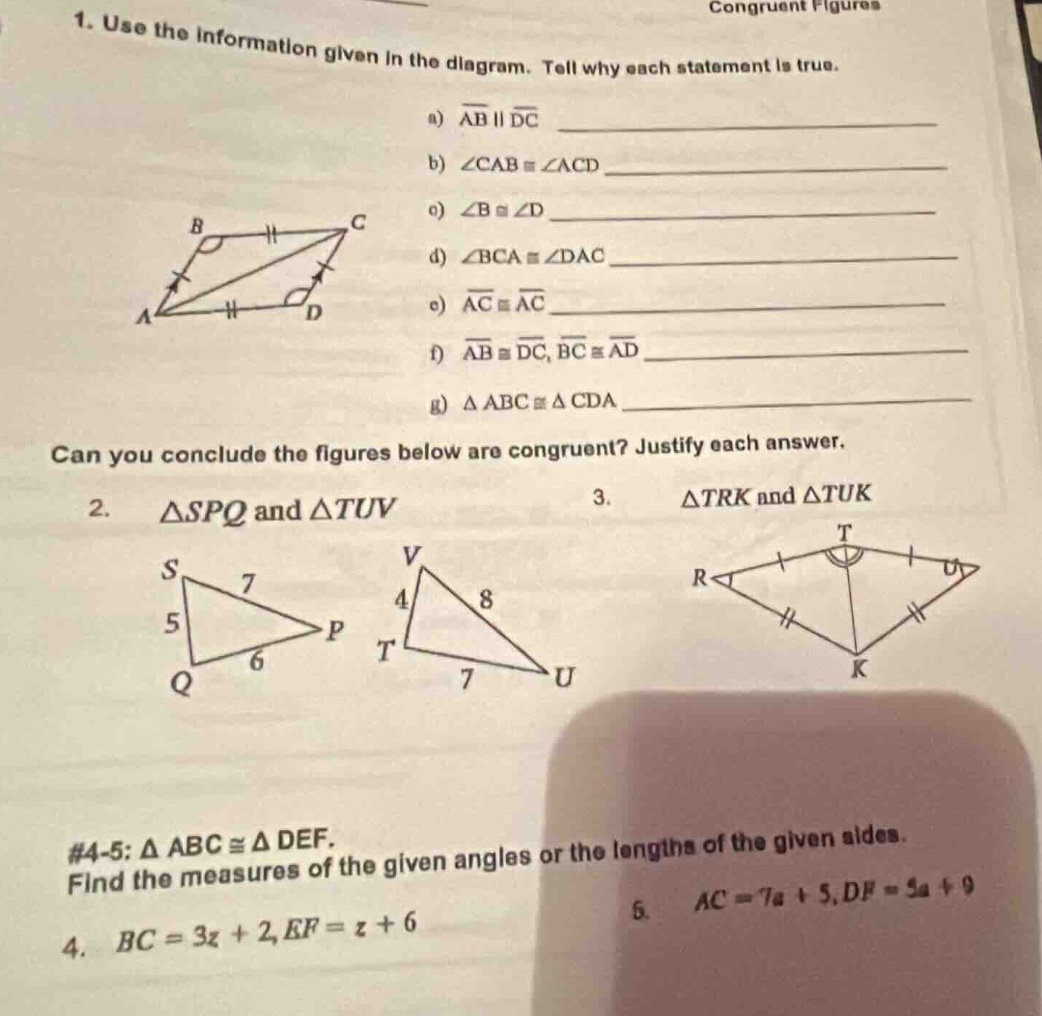
Question
- use the information given in the diagram. tell why each statement is true.
a) $overline{ab} parallel overline{dc}$
b) $angle cab cong angle acd$
c) $angle b cong angle d$
d) $angle bca cong angle dac$
e) $overline{ac} cong overline{ac}$
f) $overline{ab} cong overline{dc}, overline{bc} cong overline{ad}$
g) $\triangle abc cong \triangle cda$
can you conclude the figures below are congruent? justify each answer.
- $\triangle spq$ and $\triangle tuv$
- $\triangle trk$ and $\triangle tuk$
#4 - 5: $\triangle abc cong \triangle def$.
find the measures of the given angles or the lengths of the given sides.
- $bc = 3z + 2, ef = z + 6$
- $ac = 7a + 5, df = 5a + 9$
Problem 1 (a - g)
a) $\overline{AB} \parallel \overline{DC}$
Step1: Identify the figure
The diagram shows a quadrilateral with markings on sides and angles. From the markings (e.g., $\overline{BC} \cong \overline{AD}$ and $\overline{AB} \cong \overline{DC}$ implied by congruent triangles later, or alternate interior angles), we can see it's a parallelogram - like figure. In a parallelogram, opposite sides are parallel. Also, since $\angle CAB \cong \angle ACD$ (alternate interior angles), by the converse of alternate interior angles theorem, $\overline{AB} \parallel \overline{DC}$.
Step1: Identify the lines and angles
$\overline{AB} \parallel \overline{DC}$ (from part a) and $\overline{AC}$ is a transversal. When two parallel lines are cut by a transversal, alternate interior angles are congruent. So $\angle CAB$ and $\angle ACD$ are alternate interior angles, hence $\angle CAB \cong \angle ACD$.
Step1: Recall triangle congruence
From part f, $\overline{AB} \cong \overline{DC}$, $\overline{BC} \cong \overline{AD}$ and $\overline{AC} \cong \overline{AC}$ (part e). So $\triangle ABC \cong \triangle CDA$ (SSS). Corresponding parts of congruent triangles are congruent (CPCTC), so $\angle B \cong \angle D$.

Snap & solve any problem in the app
Get step-by-step solutions on Sovi AI
Photo-based solutions with guided steps
Explore more problems and detailed explanations
By converse of alternate interior angles theorem (since $\angle CAB \cong \angle ACD$), $\overline{AB} \parallel \overline{DC}$