QUESTION IMAGE
Question
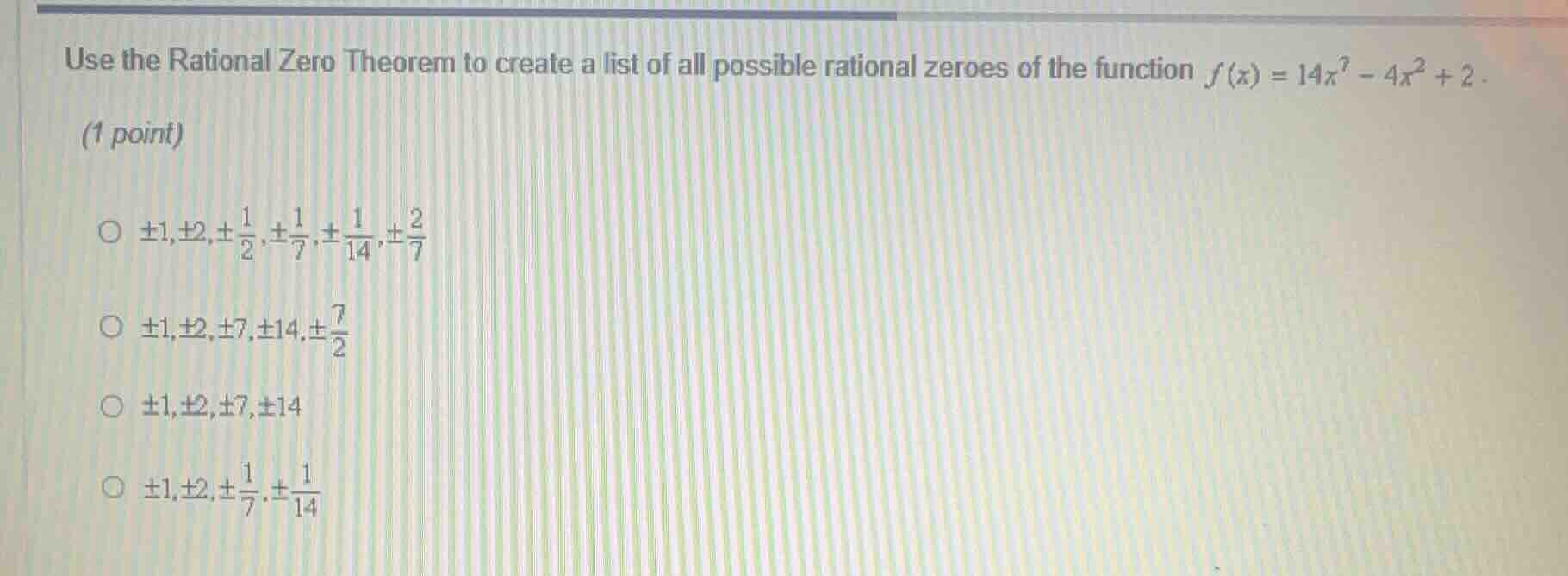
use the rational zero theorem to create a list of all possible rational zeroes of the function $f(x) = 14x^7 - 4x^2 + 2$.(1 point)\\(\pm1,\pm2,\pm\frac{1}{2},\pm\frac{1}{7},\pm\frac{1}{14},\pm\frac{2}{7}\\)\\(\pm1,\pm2,\pm7,\pm14,\pm\frac{7}{2}\\)\\(\pm1,\pm2,\pm7,\pm14\\)\\(\pm1,\pm2,\pm\frac{1}{7},\pm\frac{1}{14}\\)
Step1: Recall Rational Zero Theorem
The Rational Zero Theorem states that if a polynomial \( f(x) = a_nx^n + a_{n - 1}x^{n - 1}+\cdots+a_1x + a_0\) has integer coefficients, then every rational zero, expressed in lowest terms \( \frac{p}{q}\), has \( p\) as a factor of the constant term \( a_0\) and \( q\) as a factor of the leading coefficient \( a_n\).
For the function \( f(x)=14x^7 - 4x^2+2\), the constant term \( a_0 = 2\) and the leading coefficient \( a_n=14\).
Step2: Find factors of constant term (\(p\))
The factors of the constant term \( 2\) are \( \pm1,\pm2\). So \( p\in\{\pm1,\pm2\}\).
Step3: Find factors of leading coefficient (\(q\))
The factors of the leading coefficient \( 14\) are \( \pm1,\pm2,\pm7,\pm14\). So \( q\in\{\pm1,\pm2,\pm7,\pm14\}\).
Step4: Form all possible \(\frac{p}{q}\)
We form all possible fractions \( \frac{p}{q}\) where \( p\) is a factor of \( 2\) and \( q\) is a factor of \( 14\):
- When \( p = \pm1\):
- \( \frac{\pm1}{\pm1}=\pm1\), \( \frac{\pm1}{\pm2}=\pm\frac{1}{2}\), \( \frac{\pm1}{\pm7}=\pm\frac{1}{7}\), \( \frac{\pm1}{\pm14}=\pm\frac{1}{14}\)
- When \( p=\pm2\):
- \( \frac{\pm2}{\pm1}=\pm2\), \( \frac{\pm2}{\pm2}=\pm1\) (already listed), \( \frac{\pm2}{\pm7}=\pm\frac{2}{7}\), \( \frac{\pm2}{\pm14}=\pm\frac{1}{7}\) (already listed)
Combining all unique possible rational zeros, we get \( \pm1,\pm2,\pm\frac{1}{2},\pm\frac{1}{7},\pm\frac{1}{14},\pm\frac{2}{7}\).

Snap & solve any problem in the app
Get step-by-step solutions on Sovi AI
Photo-based solutions with guided steps
Explore more problems and detailed explanations
\(\boldsymbol{\pm1,\pm2,\pm\frac{1}{2},\pm\frac{1}{7},\pm\frac{1}{14},\pm\frac{2}{7}}\) (which corresponds to the first option: \(\pm1,\pm2,\pm\frac{1}{2},\pm\frac{1}{7},\pm\frac{1}{14},\pm\frac{2}{7}\))