QUESTION IMAGE
Question
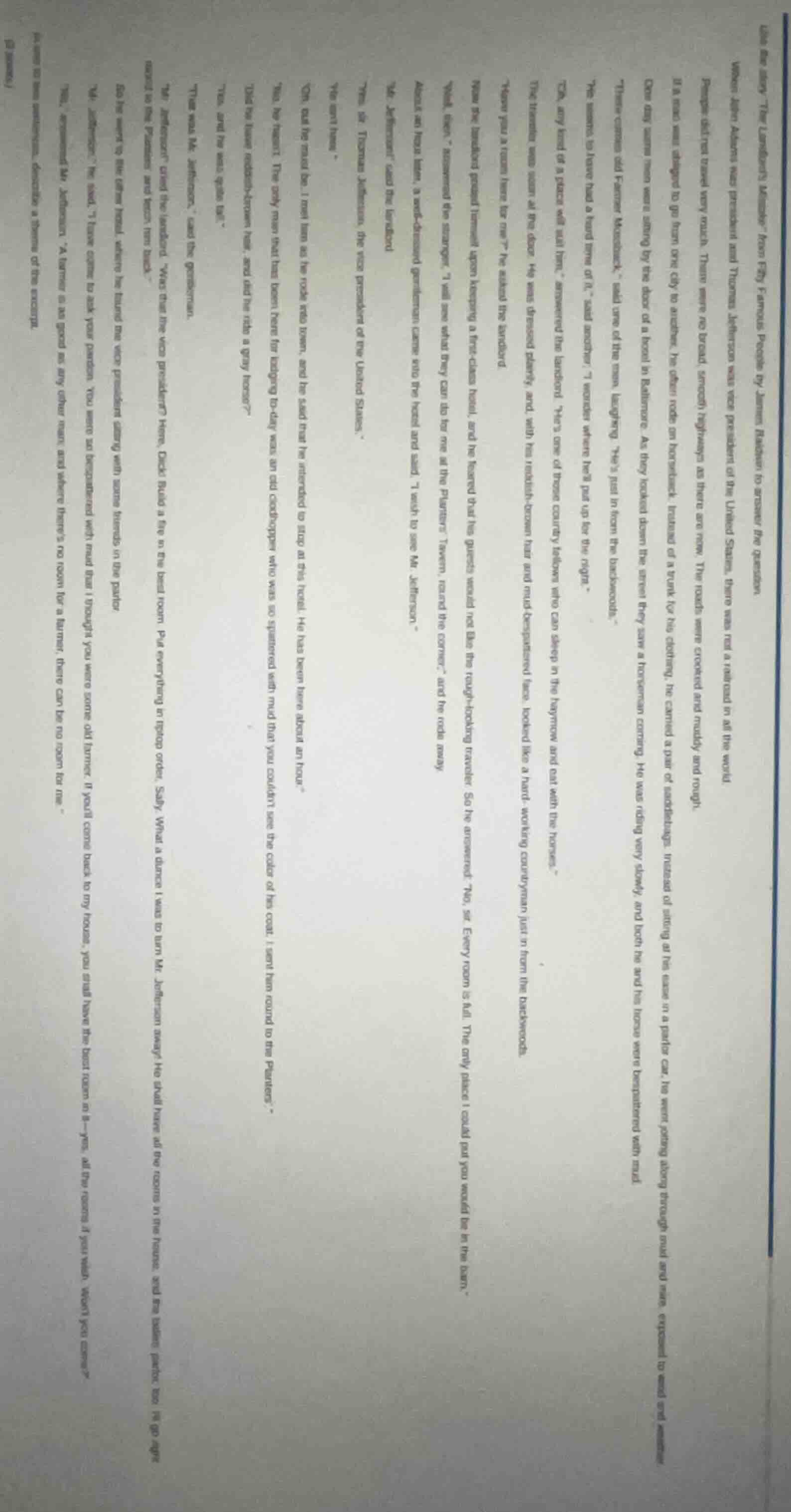
use the story “the landlord’s mistake” from fifty famous people by james baldwin to answer the question.
when john adams was president and thomas jefferson was vice - president of the united states, there was not a railroad in all the world.
people did not travel very much. there were no broad, smooth highways as there are now. the roads were crooked and muddy and rough.
if a man went abroad to go from one city to another, he often rode on horseback. instead of a trunk for his clothing, he carried a pair of saddlebags. instead of sitting at his ease in a palace car, he went jolting along through mud and rain, exposed to wind and sunshine.
one day some men were sitting by the door of a hotel in baltimore. as they looked down the street they saw a horseman coming. he was riding very slowly, and both he and his horse were bespattered with mud.
“here comes old farmer weatherbeek,” said one of the men, laughing. “he’s just in from the backwoods.”
“he seems to have had a hard time of it,” said another. “i wonder where he’s put up for the night.”
“try any kind of a place will suit him,” answered the landlord. “he’s one of those country fellows who can sleep in the haymow and eat with the hogs.”
the horseman was soon at the door. he was dressed plainly, and, with his reddish - brown hair and rud - bespeckled face, looked like a hard - working countryman just in from the backwoods.
“have you a room here for me?” he asked the landlord.
now the landlord prided himself upon keeping a first - class hotel, and he feared that his guests would not like the rough - looking traveler. so he answered, “no, sir. every room is full. the only place i could put you would be in the barn.”
“ah, then,” answered the stranger, “i will see what they can do for me at the planters’ tavern, round the corner.” and he rode away.
about an hour later, a well - dressed gentleman came into the hotel and said, “i wish to see mr. jefferson.”
mr. jefferson? said the landlord.
“yes, sir. thomas jefferson, the vice - president of the united states.”
“oh, that’s the man! i met him as he rode who has been, and he said that he intended to stop at this hotel. he has been here about an hour.”
“was he here? the only man that has been here for lodging to - day was an old clodhopper who was so spattered with mud that you couldn’t see the color of his coat. i sent him round to the planters’.”
did he leave a saddle - bag here, and did he ride a gray horse?
“yes, and he was quite tall.”
that was mr. jefferson, said the gentleman.
mr. jefferson! cried the landlord. “was that the vice - president? how the wicked i have been! what a chance i was to turn mr. jefferson away! he shall have all the rooms in the house, and the best parlor, too, to go into.
so he went to the planters’ hotel, where he found the vice - president sitting with some friends in the parlor.
mr. jefferson, he said, “i have come to ask your pardon. you were so bespattered with mud that i thought you were some old farmer. if you’ll come back to my house, you shall have the best room at a - price. all the rooms if you wish. won’t you come?”
mr. jefferson answered, “a farmer is as good as any other man; and when there’s no room for a farmer, there can be no room for me.”
tell, in your own words, describe a theme of the excerpt.
To answer this, we analyze the story:
Key Elements:
- Characters: Thomas Jefferson (former US President) and a farmer.
- Setting: A rural inn/tavern during Jefferson’s travels.
- Conflict: The innkeeper initially misjudges Jefferson (due to his “rough - looking” appearance) and offers him the barn, but later realizes his identity and tries to rectify the mistake. Jefferson, however, shows respect for the farmer and prefers to stay with him.
- Resolution: Jefferson chooses to stay with the farmer, highlighting the value of humility, respect for ordinary people, and the idea that true worth is not based on appearance.
Theme Identification:
The story contrasts the initial judgment based on outward appearance (the innkeeper’s reaction to Jefferson’s “rough - looking” travel attire) with the eventual recognition of Jefferson’s true character (his humility, respect for a farmer, and refusal to accept special treatment just because of his status). It emphasizes that true greatness lies in humility and respect for all people, regardless of social status or appearance, and that we should not judge others by their outward looks.

Snap & solve any problem in the app
Get step-by-step solutions on Sovi AI
Photo-based solutions with guided steps
Explore more problems and detailed explanations
The theme of the story is that true greatness is marked by humility and respect for others, regardless of their social status or one's own outward appearance; we should not judge people based on their looks.