QUESTION IMAGE
Question
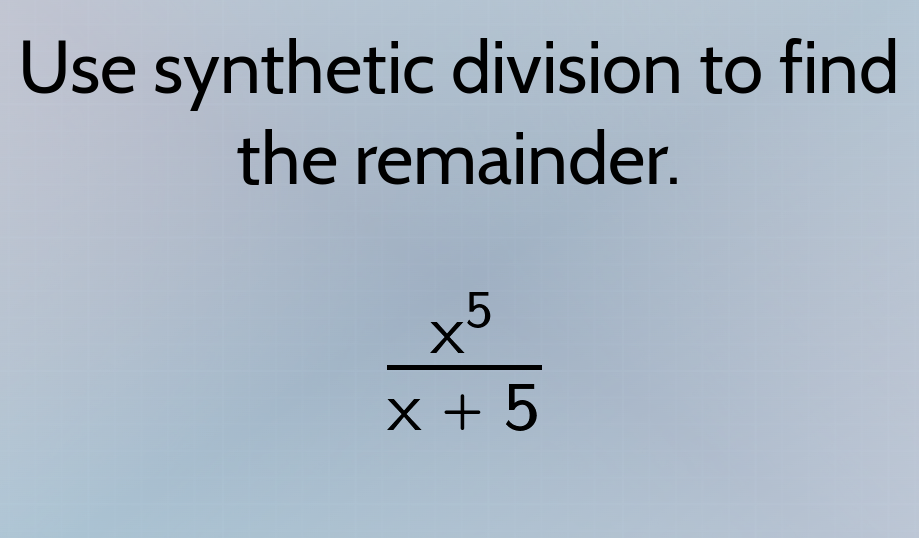
use synthetic division to find the remainder. \\(\frac{x^5}{x + 5}\\)
Step1: Recall the Remainder Theorem and Synthetic Division Setup
The Remainder Theorem states that if a polynomial \( f(x) \) is divided by \( x - c \), the remainder is \( f(c) \). For the divisor \( x + 5 \), we can rewrite it as \( x - (-5) \), so \( c=-5 \). The polynomial \( f(x)=x^5 \) can be written in standard form with all coefficients of missing terms ( \( x^4, x^3, x^2, x, \) constant term) as 0. So the coefficients of \( f(x) \) are \( 1, 0, 0, 0, 0, 0 \) (corresponding to \( x^5, x^4, x^3, x^2, x, x^0 \)).
Step2: Perform Synthetic Division
Set up synthetic division with \( c = -5 \) and the coefficients \( 1, 0, 0, 0, 0, 0 \):
\[
\]
The last number in the bottom row is the remainder. Alternatively, using the Remainder Theorem directly: \( f(-5)=(-5)^5 \).
Step3: Calculate \( (-5)^5 \)
\( (-5)^5=(-5)\times(-5)\times(-5)\times(-5)\times(-5) \). First, \( (-5)\times(-5)=25 \), \( 25\times(-5)= -125 \), \( -125\times(-5)=625 \), \( 625\times(-5)= -3125 \).

Snap & solve any problem in the app
Get step-by-step solutions on Sovi AI
Photo-based solutions with guided steps
Explore more problems and detailed explanations
\( -3125 \)