QUESTION IMAGE
Question
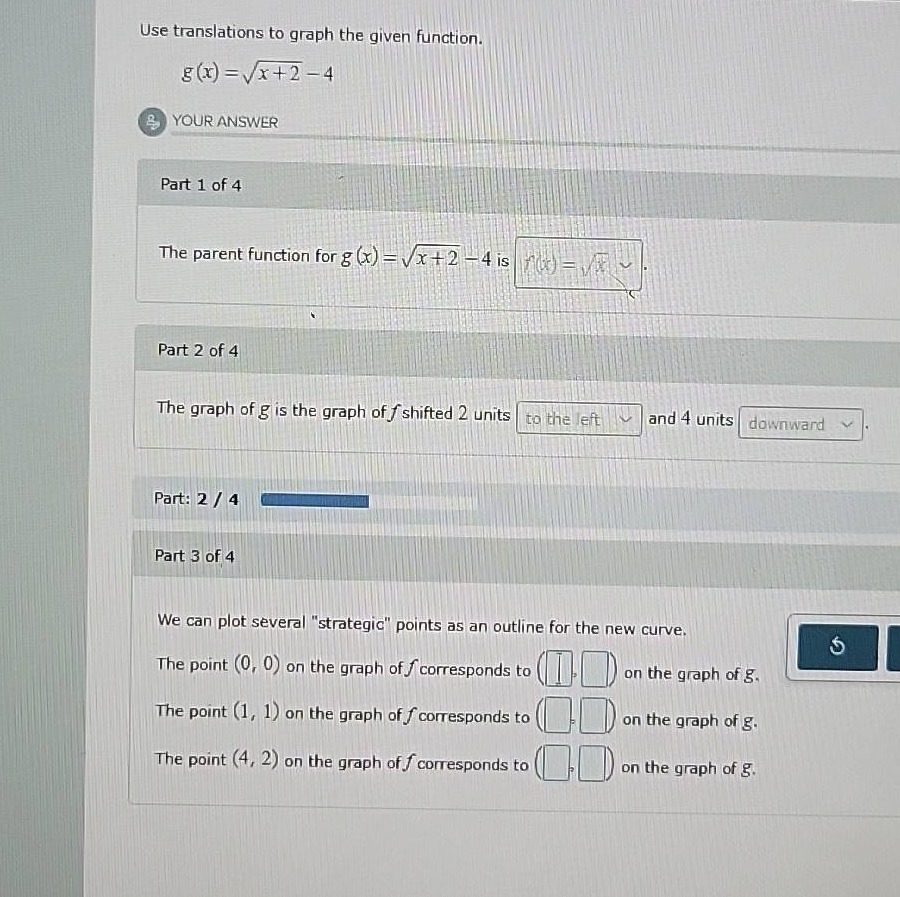
use translations to graph the given function.
$g(x)=\sqrt{x + 2}-4$
your answer
part 1 of 4
the parent function for $g(x)=\sqrt{x + 2}-4$ is $f(x)=\sqrt{x}$.
part 2 of 4
the graph of $g$ is the graph of $f$ shifted 2 units to the left and 4 units downward.
part: 2 / 4
part 3 of 4
we can plot several \strategic\ points as an outline for the new curve.
the point $(0, 0)$ on the graph of $f$ corresponds to $(\square,\square)$ on the graph of $g$.
the point $(1, 1)$ on the graph of $f$ corresponds to $(\square,\square)$ on the graph of $g$.
the point $(4, 2)$ on the graph of $f$ corresponds to $(\square,\square)$ on the graph of $g$.
Step1: Find the corresponding point for (0,0)
To find the corresponding point on \( g(x) \) from \( (0,0) \) on \( f(x) \), we apply the horizontal shift (left 2 units) and vertical shift (down 4 units). For the x - coordinate: \( x = 0 - 2=- 2 \) (wait, no, the horizontal shift for \( g(x)=\sqrt{x + 2}-4=f(x + 2)-4 \), so if \( f(x)=\sqrt{x} \), then to get \( g(x) \), we replace \( x \) with \( x+2 \) in \( f(x) \) and then subtract 4. So for a point \( (x,y) \) on \( f(x) \), the corresponding point on \( g(x) \) is \( (x - 2,y - 4) \)? Wait, no, let's recall the transformation rules. If we have \( y=f(x - h)+k \), the graph is shifted \( h \) units right and \( k \) units up. Here \( g(x)=f(x + 2)-4=f(x-(- 2))+(-4) \), so \( h=-2 \) (shift left 2 units) and \( k = - 4 \) (shift down 4 units). So for a point \( (x,y) \) on \( f(x) \), the corresponding point on \( g(x) \) is \( (x-2,y - 4) \)? Wait, no, let's take \( f(x)=\sqrt{x} \), \( g(x)=\sqrt{x + 2}-4 \). So if \( x = 0 \) in \( f(x) \), then in \( g(x) \), we need \( x+2=0\Rightarrow x=-2 \), and \( y=\sqrt{0}-4=-4 \). Wait, I made a mistake earlier. Let's do it correctly. For the function \( g(x)=f(x + 2)-4 \), to find the \( x \) - value on \( g(x) \) that corresponds to \( x = 0 \) on \( f(x) \), we set \( x+2=0\Rightarrow x=-2 \) (because \( f(x + 2) \) means we substitute \( x \) with \( x + 2 \) in \( f \)). Then the \( y \) - value is \( f(0)-4=0 - 4=-4 \). So the corresponding point is \( (-2,-4) \)? Wait, no, the original point on \( f(x) \) is \( (0,0) \). Let's plug \( x=-2 \) into \( g(x) \): \( g(-2)=\sqrt{-2 + 2}-4=\sqrt{0}-4=-4 \). So the point \( (0,0) \) on \( f(x) \) corresponds to \( (-2,-4) \) on \( g(x) \)? Wait, but the problem says "the graph of \( g \) is the graph of \( f \) shifted 2 units to the left and 4 units downward". Shifting a point \( (x,y) \) 2 units left means \( x'=x - 2 \)? No, shifting left 2 units: if you shift the graph of \( y = f(x) \) 2 units to the left, the new function is \( y=f(x + 2) \), so a point \( (x,y) \) on \( f(x) \) will have a new \( x \) - coordinate \( x'=x-2 \)? Wait, no, let's take an example. Let \( f(x)=\sqrt{x} \), the graph of \( f(x) \) passes through \( (0,0) \), \( (1,1) \), \( (4,2) \). The graph of \( f(x + 2) \) is \( f \) shifted left 2 units, so the point \( (0,0) \) on \( f(x) \) will be at \( x=-2 \) on \( f(x + 2) \) (because \( x+2=0\Rightarrow x=-2 \)), and then we subtract 4 from the \( y \) - value. So \( f(0)=0 \), so \( g(-2)=0 - 4=-4 \). So the point \( (0,0) \) on \( f(x) \) corresponds to \( (-2,-4) \) on \( g(x) \). Wait, but the problem's Part 2 says "shifted 2 units to the left and 4 units downward". Shifting a point \( (x,y) \) 2 units left: \( x'=x - 2 \), and 4 units down: \( y'=y-4 \). So for \( (0,0) \), \( x'=0 - 2=-2 \), \( y'=0 - 4=-4 \). So the corresponding point is \( (-2,-4) \).
Step2: Find the corresponding point for (1,1)
For the point \( (1,1) \) on \( f(x) \), applying the shifts: \( x'=1 - 2=-1 \), \( y'=1 - 4=-3 \). Let's verify with the function \( g(x)=\sqrt{x + 2}-4 \). When \( x=-1 \), \( g(-1)=\sqrt{-1 + 2}-4=\sqrt{1}-4=1 - 4=-3 \). So the corresponding point is \( (-1,-3) \).
Step3: Find the corresponding point for (4,2)
For the point \( (4,2) \) on \( f(x) \), applying the shifts: \( x'=4 - 2 = 2 \), \( y'=2-4=-2 \). Let's verify with \( g(x) \). When \( x = 2 \), \( g(2)=\sqrt{2 + 2}-4=\sqrt{4}-4=2 - 4=-2 \). So the corresponding point is \( (2,-2) \).

Snap & solve any problem in the app
Get step-by-step solutions on Sovi AI
Photo-based solutions with guided steps
Explore more problems and detailed explanations
s for Part 3:
- The point \( (0,0) \) on \( f(x) \) corresponds to \( (-2,-4) \) on \( g(x) \).
- The point \( (1,1) \) on \( f(x) \) corresponds to \( (-1,-3) \) on \( g(x) \).
- The point \( (4,2) \) on \( f(x) \) corresponds to \( (2,-2) \) on \( g(x) \).
So filling in the boxes:
For \( (0,0) \): \((-2,-4)\)
For \( (1,1) \): \((-1,-3)\)
For \( (4,2) \): \((2,-2)\)