QUESTION IMAGE
Question
using the law of sines for the ambiguous case
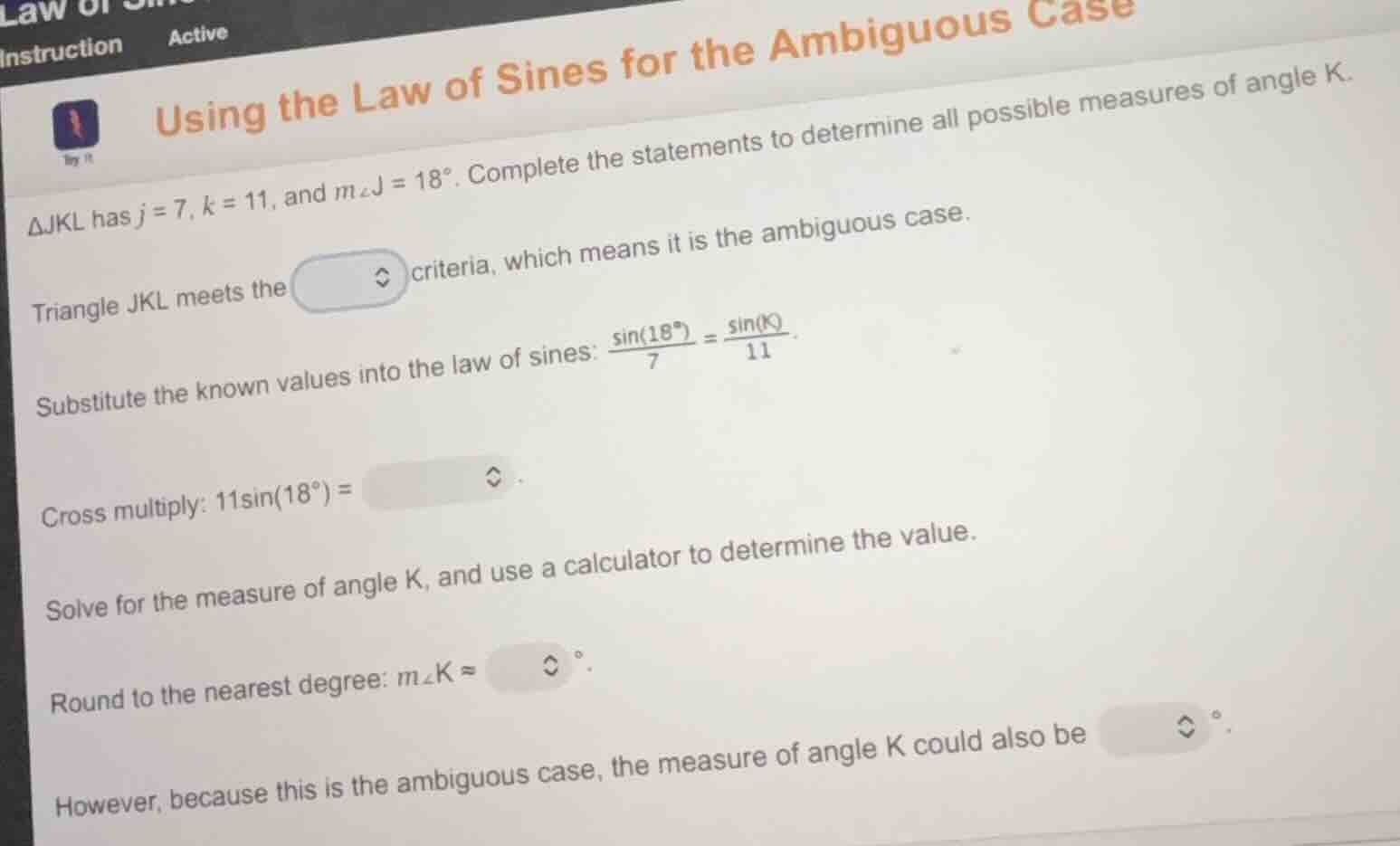
$\triangle jkl$ has $j = 7$, $k = 11$, and $mangle j = 18^{circ}$. complete the statements to determine all possible measures of angle k.
triangle jkl meets the $\boldsymbol{▲}$ criteria, which means it is the ambiguous case.
substitute the known values into the law of sines: $\frac{sin(18^{circ})}{7} = \frac{sin(k)}{11}$.
cross multiply: $11\sin(18^{circ}) = \boldsymbol{▲}$.
solve for the measure of angle k, and use a calculator to determine the value.
round to the nearest degree: $mangle k approx \boldsymbol{▲}^{circ}$.
however, because this is the ambiguous case, the measure of angle k could also be $\boldsymbol{▲}^{circ}$.
Step1: Identify ambiguous case criteria
The triangle has an acute given angle ($m\angle J=18^\circ$), and the side opposite this angle ($j=7$) is shorter than the other given side ($k=11$), so it meets the SSA (Side-Side-Angle) criteria.
Step2: Cross-multiply the Law of Sines
Starting from $\frac{\sin(18^\circ)}{7} = \frac{\sin(K)}{11}$, cross-multiply to isolate the term with $\sin(K)$.
$11\sin(18^\circ) = 7\sin(K)$
Step3: Solve for $\sin(K)$
Rearrange to solve for $\sin(K)$:
$\sin(K) = \frac{11\sin(18^\circ)}{7}$
Calculate the value: $\sin(18^\circ)\approx0.3090$, so $\sin(K)\approx\frac{11\times0.3090}{7}\approx\frac{3.399}{7}\approx0.4856$
Step4: Find first angle K
Use inverse sine to find the acute angle:
$m\angle K \approx \sin^{-1}(0.4856) \approx 29^\circ$
Step5: Find second possible angle K
In the ambiguous case, a second obtuse angle is possible:
$m\angle K \approx 180^\circ - 29^\circ = 151^\circ$
Verify: $18^\circ + 151^\circ = 169^\circ < 180^\circ$, so this is valid.

Snap & solve any problem in the app
Get step-by-step solutions on Sovi AI
Photo-based solutions with guided steps
Explore more problems and detailed explanations
Triangle JKL meets the SSA criteria, which means it is the ambiguous case.
Cross multiply: $11\sin(18^\circ) = 7\sin(K)$
Round to the nearest degree: $m\angle K \approx 29^\circ$
However, because this is the ambiguous case, the measure of angle K could also be $151^\circ$.