QUESTION IMAGE
Question
using a quadratic equation to solve an area problem
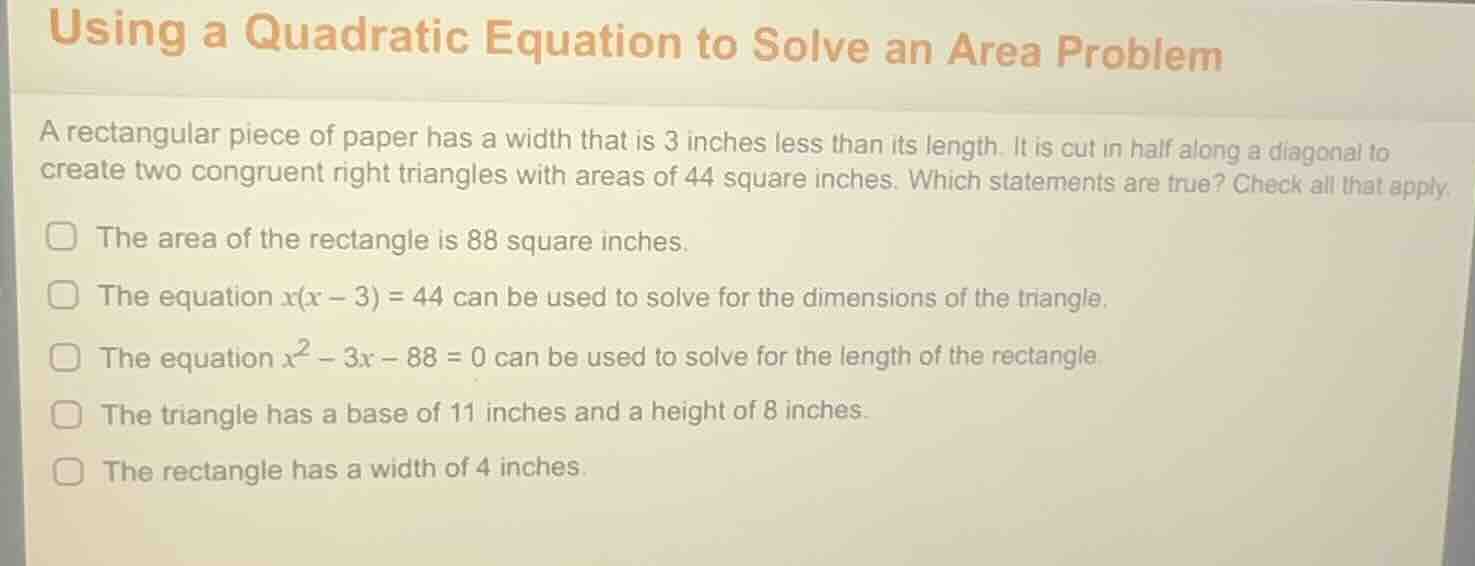
a rectangular piece of paper has a width that is 3 inches less than its length. it is cut in half along a diagonal to create two congruent right triangles with areas of 44 square inches. which statements are true? check all that apply.
- the area of the rectangle is 88 square inches.
- the equation ( x(x - 3) = 44 ) can be used to solve for the dimensions of the triangle.
- the equation ( x^2 - 3x - 88 = 0 ) can be used to solve for the length of the rectangle.
- the triangle has a base of 11 inches and a height of 8 inches.
- the rectangle has a width of 4 inches.
Step1: Analyze the area of the rectangle
Since the rectangle is cut into two congruent right triangles, each with area 44 square inches, the area of the rectangle is the sum of the areas of the two triangles. So, area of rectangle = \( 44\times2 = 88 \) square inches. This makes the first statement true.
Step2: Define variables for length and width
Let the length of the rectangle be \( x \) inches. Then the width is \( x - 3 \) inches (since width is 3 inches less than length). The area of a rectangle is length times width, so area of rectangle = \( x(x - 3) \). But we know the area of the rectangle is 88, and each triangle has area 44. Wait, the area of one triangle is \( \frac{1}{2}\times \text{length}\times \text{width} = 44 \). So \( \frac{1}{2}x(x - 3)=44 \), which is different from \( x(x - 3)=44 \). So the second statement is false.
Step3: Derive the quadratic equation for the rectangle's length
From the area of the rectangle: \( x(x - 3)=88 \) (since area of rectangle is 88). Expanding this, we get \( x^{2}-3x = 88 \), and then \( x^{2}-3x - 88 = 0 \). This equation can be used to solve for the length \( x \) of the rectangle. So the third statement is true.
Step4: Solve the quadratic equation \( x^{2}-3x - 88 = 0 \)
Factor the quadratic: we need two numbers that multiply to -88 and add to -3. The numbers are -11 and 8. So \( (x - 11)(x + 8)=0 \). Solving, \( x = 11 \) or \( x=-8 \). Since length can't be negative, length \( x = 11 \) inches. Then width is \( 11 - 3 = 8 \) inches. The triangle (which is half the rectangle) will have base and height equal to the length and width of the rectangle (or vice versa). So the triangle has a base of 11 inches and height of 8 inches (or base 8 and height 11). So the fourth statement is true.
Step5: Check the width of the rectangle
We found width is \( x - 3 = 11 - 3 = 8 \) inches, not 4 inches. So the fifth statement is false.

Snap & solve any problem in the app
Get step-by-step solutions on Sovi AI
Photo-based solutions with guided steps
Explore more problems and detailed explanations
The true statements are:
- The area of the rectangle is 88 square inches.
- The equation \( x^{2}-3x - 88 = 0 \) can be used to solve for the length of the rectangle.
- The triangle has a base of 11 inches and a height of 8 inches.