QUESTION IMAGE
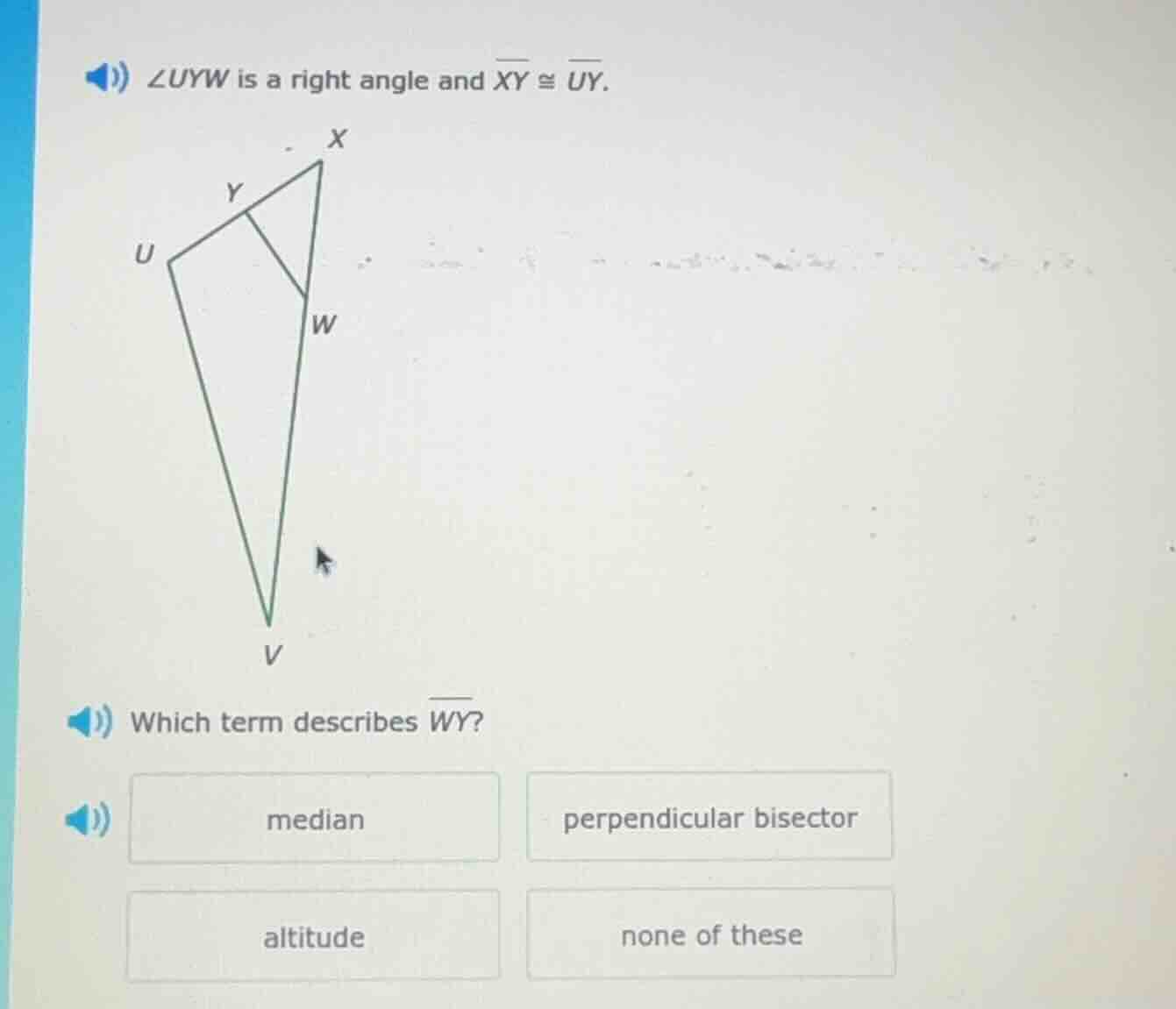
Question
∠uyw is a right angle and \\(\overline{xy} \cong \overline{uy}\\).
which term describes \\(\overline{wy}\\)?
median
perpendicular bisector
altitude
none of these
Brief Explanations
- Recall the definitions:
- Median: A segment from a vertex to the midpoint of the opposite side. But we don't know if \( WY \) connects to a midpoint here.
- Perpendicular Bisector: A line that is perpendicular to a segment and bisects it (intersects at the midpoint). We know \( \angle UYW \) is a right angle (so \( WY \perp UY \)), and \( XY \cong UY \), but we don't know if \( WY \) bisects \( UX \) or another segment at its midpoint. Wait, actually, let's re - examine. Wait, the triangle context: since \( \angle UYW \) is a right angle, \( WY \) is perpendicular to \( UY \), and if we consider triangle \( UXY \) (since \( XY\cong UY \)), but more importantly, an altitude is a perpendicular segment from a vertex to the line containing the opposite side. Wait, no, wait: Wait, the problem is about the segment \( WY \). Wait, let's check the options again. Wait, the key is: \( \angle UYW \) is a right angle, so \( WY \) is perpendicular to \( UY \), and \( XY\cong UY \). But let's recall the definition of altitude: In a triangle, an altitude is a perpendicular segment from a vertex to the opposite side (or its extension). But here, if we consider triangle \( UXY \), \( WY \) is perpendicular to \( UY \), but wait, maybe I made a mistake. Wait, no, the correct approach: Let's analyze each option:
- Median: Connects a vertex to the midpoint of the opposite side. We have no info that \( W \) is a midpoint of any side.
- Perpendicular Bisector: Needs to bisect a segment (i.e., intersect at midpoint) and be perpendicular. We know \( WY \) is perpendicular to \( UY \) (since \( \angle UYW = 90^\circ \)), and \( XY\cong UY \), but does \( WY \) bisect a segment? Wait, if \( XY\cong UY \), and \( WY \) is perpendicular to \( UY \), maybe \( WY \) is the perpendicular bisector? Wait, no, wait. Wait, the segment \( WY \): Let's think again. Wait, the angle \( \angle UYW \) is a right angle, so \( WY\perp UY \). Also, \( XY\cong UY \). So if we consider segment \( UX \), if \( Y \) is the midpoint? Wait, no, the problem says \( XY\cong UY \), not that \( Y \) is the midpoint. Wait, maybe the correct answer is "perpendicular bisector"? Wait, no, wait. Wait, let's recall the definitions again:
- Altitude: A perpendicular segment from a vertex to the line containing the opposite side. But here, \( WY \) is perpendicular to \( UY \), but is \( UY \) a side? Wait, maybe the triangle is \( UVX \) or something else. Wait, the diagram shows \( U \), \( Y \), \( X \) and \( W \) on \( XV \) (assuming). Wait, the key is: \( \angle UYW = 90^\circ \), so \( WY\perp UY \), and \( XY = UY \). So \( WY \) is perpendicular to \( UY \) and since \( XY = UY \), \( Y \) is equidistant from \( U \) and \( X \), and \( WY \) is perpendicular to \( UY \), so \( WY \) is the perpendicular bisector of \( UX \)? Wait, no, maybe I'm overcomplicating. Wait, the options: Let's check each:
- Median: No, because we don't know \( W \) is a midpoint.
- Perpendicular Bisector: A line that is perpendicular to a segment and divides it into two equal parts. Since \( \angle UYW = 90^\circ \) (so perpendicular) and \( XY\cong UY \), if we consider segment \( UX \), \( Y \) is a point such that \( UY = XY \), so \( Y \) is on the perpendicular bisector of \( UX \), but \( WY \): Wait, maybe the correct answer is "perpendicular bisector"? Wait, no, wait. Wait, the angle is \( \angle UYW \), so \( WY \) is perpendicular to \( UY \), and \( XY = UY \), so \( WY \) is the perpendicular bisector of \( UX \)? Wait, maybe. Alt…

Snap & solve any problem in the app
Get step-by-step solutions on Sovi AI
Photo-based solutions with guided steps
Explore more problems and detailed explanations
perpendicular bisector