QUESTION IMAGE
Question
virtual explore:
energy is found in many forms all around you: chemical energy in food, electrical energy in appliances, light energy from lamps, and radiant energy from the sun are all examples. energy is constantly being transformed from one type to another in systems. a system is a group of interacting elements that work together to perform a task. as these types of energy are transformed, energy is not created or destroyed. it is conserved and changes from one form to another. in todays activity, you will explore two different systems and learn how energy is conserved and transformed.
procedure
part i: electric circuit system
- open the simulation, and click the \start\ button. you will first explore how energy is transformed within an electric circuit.
- complete the chart as you explore this part of the simulation.
| location | battery | wire | bulb |
|---|
part ii: food web system
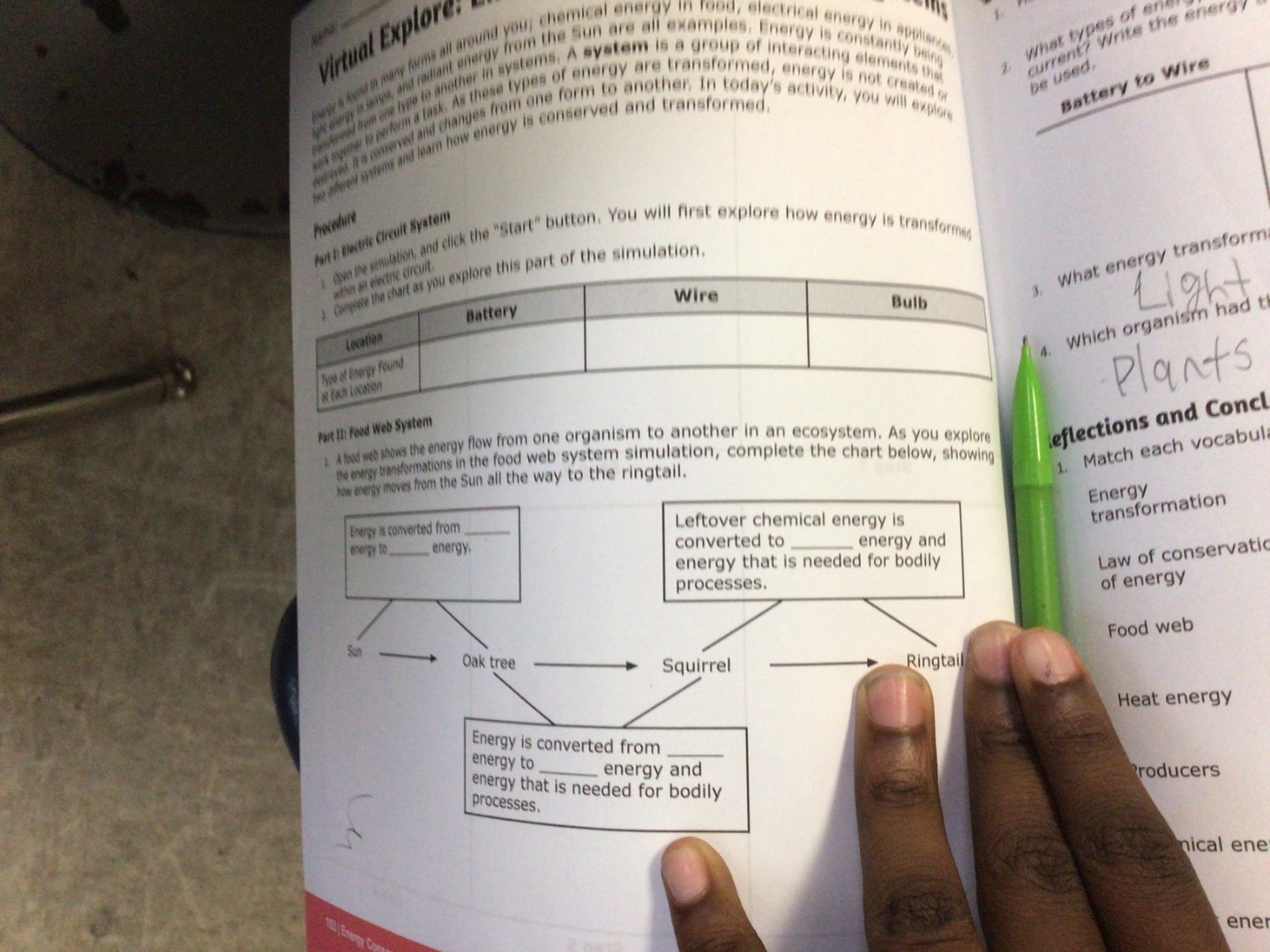
- a food web shows the energy flow from one organism to another in an ecosystem. as you explore the energy transformations in the food web system simulation, complete the chart below, showing how energy moves from the sun all the way to the ringtail.
- energy is converted from ____ energy to ____ energy.
- sun → oak tree
- energy is converted from ____ energy to ____ energy and energy that is needed for bodily processes.
- oak tree → squirrel
- leftover chemical energy is converted to ______ energy and energy that is needed for bodily processes.
- squirrel → ringtail
- what types of energy... (text cut off)
- what energy transform... (text cut off, handwritten: light)
- which organism had t... (text cut off, handwritten: plants)
reflections and concl
- match each vocabul
- energy transformation
- law of conservation of energy
- food web
- heat energy
- producers
- chemical energy
- energy
To solve the energy transformation questions in the food web system:
Part II: Food Web System
1. Sun to Oak Tree
Plants (like the oak tree) perform photosynthesis. During photosynthesis, plants convert radiant (solar) energy from the Sun into chemical energy (stored in glucose).
So, "Energy is converted from \(\boldsymbol{\text{radiant (solar)}}\) energy to \(\boldsymbol{\text{chemical}}\) energy."
2. Oak Tree to Squirrel
When the squirrel eats the oak tree, it breaks down the chemical energy in the plant. This energy is converted into chemical energy (stored in the squirrel’s body) and energy for bodily processes (like movement, metabolism). Some energy is also lost as heat (due to cellular respiration).
So, "Energy is converted from \(\boldsymbol{\text{chemical}}\) energy to \(\boldsymbol{\text{chemical}}\) energy and \(\boldsymbol{\text{heat}}\) energy that is needed for bodily processes."
3. Squirrel to Ringtail
When the ringtail eats the squirrel, it uses the chemical energy stored in the squirrel. This energy is converted into chemical energy (stored in the ringtail’s body) and energy for bodily processes. Leftover energy (not used for growth/repair) is converted to heat (due to respiration) and energy for bodily processes.
So, "Leftover chemical energy is converted to \(\boldsymbol{\text{chemical}}\) energy and \(\boldsymbol{\text{heat}}\) energy that is needed for bodily processes."
Key Concepts Used:
- Photosynthesis: Converts solar (radiant) energy to chemical energy.
- Cellular Respiration: Converts chemical energy to usable energy (for the organism) and releases heat.
- Food Web Energy Flow: Energy moves from producers (plants) to primary consumers (squirrel) to secondary consumers (ringtail), with energy transformations at each step.
Final Answers (Filled in the Blanks):
- Sun → Oak Tree: \(\boldsymbol{\text{radiant (solar)}}\); \(\boldsymbol{\text{chemical}}\)
- Oak Tree → Squirrel: \(\boldsymbol{\text{chemical}}\); \(\boldsymbol{\text{chemical}}\); \(\boldsymbol{\text{heat}}\)
- Squirrel → Ringtail: \(\boldsymbol{\text{chemical}}\); \(\boldsymbol{\text{heat}}\) (Note: The “leftover” chemical energy from the squirrel is converted to chemical energy in the ringtail, plus heat for bodily processes.)

Snap & solve any problem in the app
Get step-by-step solutions on Sovi AI
Photo-based solutions with guided steps
Explore more problems and detailed explanations
To solve the energy transformation questions in the food web system:
Part II: Food Web System
1. Sun to Oak Tree
Plants (like the oak tree) perform photosynthesis. During photosynthesis, plants convert radiant (solar) energy from the Sun into chemical energy (stored in glucose).
So, "Energy is converted from \(\boldsymbol{\text{radiant (solar)}}\) energy to \(\boldsymbol{\text{chemical}}\) energy."
2. Oak Tree to Squirrel
When the squirrel eats the oak tree, it breaks down the chemical energy in the plant. This energy is converted into chemical energy (stored in the squirrel’s body) and energy for bodily processes (like movement, metabolism). Some energy is also lost as heat (due to cellular respiration).
So, "Energy is converted from \(\boldsymbol{\text{chemical}}\) energy to \(\boldsymbol{\text{chemical}}\) energy and \(\boldsymbol{\text{heat}}\) energy that is needed for bodily processes."
3. Squirrel to Ringtail
When the ringtail eats the squirrel, it uses the chemical energy stored in the squirrel. This energy is converted into chemical energy (stored in the ringtail’s body) and energy for bodily processes. Leftover energy (not used for growth/repair) is converted to heat (due to respiration) and energy for bodily processes.
So, "Leftover chemical energy is converted to \(\boldsymbol{\text{chemical}}\) energy and \(\boldsymbol{\text{heat}}\) energy that is needed for bodily processes."
Key Concepts Used:
- Photosynthesis: Converts solar (radiant) energy to chemical energy.
- Cellular Respiration: Converts chemical energy to usable energy (for the organism) and releases heat.
- Food Web Energy Flow: Energy moves from producers (plants) to primary consumers (squirrel) to secondary consumers (ringtail), with energy transformations at each step.
Final Answers (Filled in the Blanks):
- Sun → Oak Tree: \(\boldsymbol{\text{radiant (solar)}}\); \(\boldsymbol{\text{chemical}}\)
- Oak Tree → Squirrel: \(\boldsymbol{\text{chemical}}\); \(\boldsymbol{\text{chemical}}\); \(\boldsymbol{\text{heat}}\)
- Squirrel → Ringtail: \(\boldsymbol{\text{chemical}}\); \(\boldsymbol{\text{heat}}\) (Note: The “leftover” chemical energy from the squirrel is converted to chemical energy in the ringtail, plus heat for bodily processes.)