QUESTION IMAGE
Question
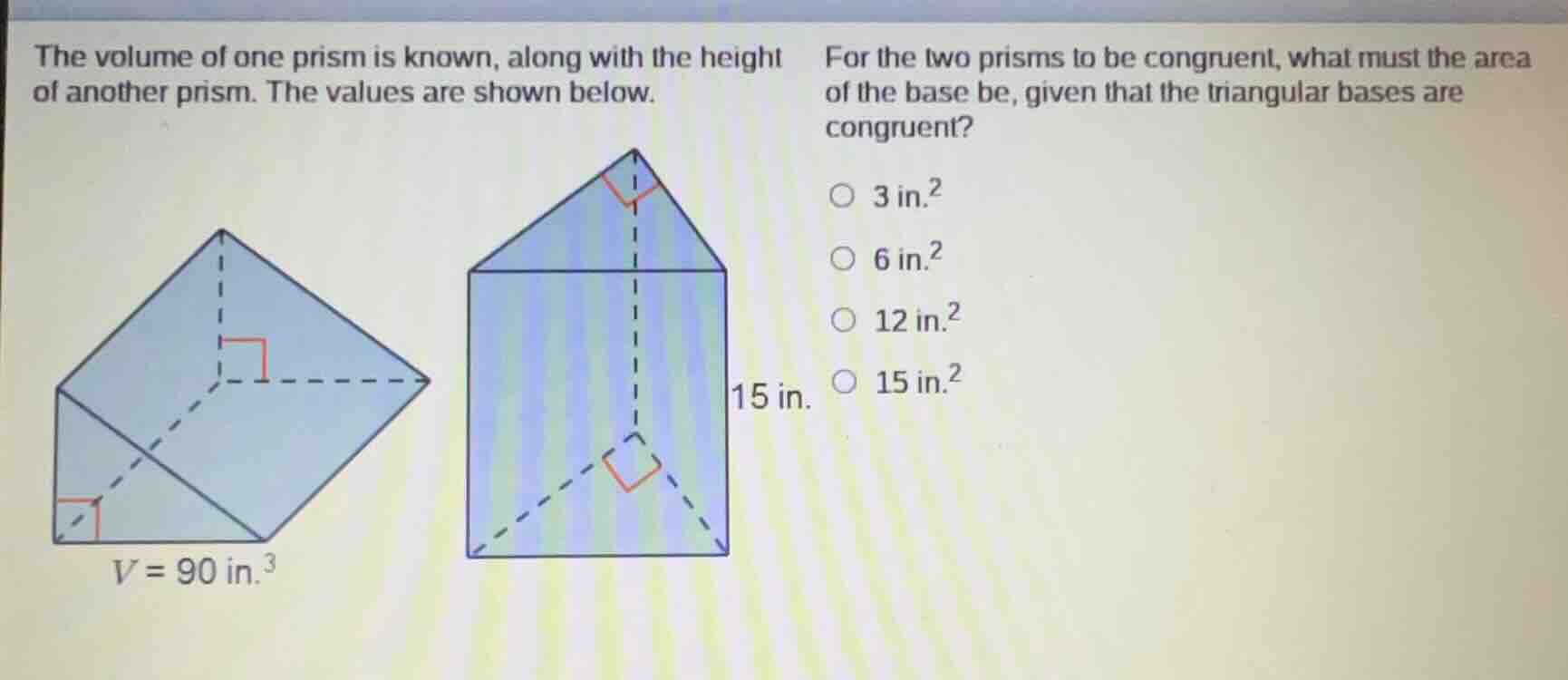
the volume of one prism is known, along with the height of another prism. the values are shown below.
$v = 90\text{ in.}^3$
for the two prisms to be congruent, what must the area of the base be, given that the triangular bases are congruent?
\\(\boldsymbol{3\text{ in.}^2}\\)
\\(\boldsymbol{6\text{ in.}^2}\\)
\\(\boldsymbol{12\text{ in.}^2}\\)
\\(\boldsymbol{15\text{ in.}^2}\\)
15 in.
Step1: Recall the volume formula for a prism
The volume \( V \) of a prism is given by the formula \( V = B \times h \), where \( B \) is the area of the base and \( h \) is the height (or length) of the prism.
Step2: Identify the known values
We know that for the two prisms to be congruent, their volumes must be equal. The volume of the first prism is \( V = 90 \, \text{in}^3 \), and the height of the second prism (which should be equal to the height of the first prism for congruence) is \( h = 15 \, \text{in} \).
Step3: Solve for the base area \( B \)
Using the volume formula \( V = B \times h \), we can solve for \( B \) by rearranging the formula to \( B=\frac{V}{h} \). Substituting the known values \( V = 90 \, \text{in}^3 \) and \( h = 15 \, \text{in} \), we get:
\[
B=\frac{90}{15} = 6
\]

Snap & solve any problem in the app
Get step-by-step solutions on Sovi AI
Photo-based solutions with guided steps
Explore more problems and detailed explanations
\( 6 \, \text{in}^2 \) (corresponding to the option "6 in.²")