QUESTION IMAGE
Question
warm - up: duplicate factors
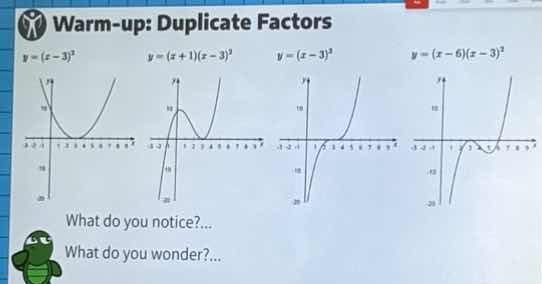
$y=(x - 3)^2$
$y=(x + 1)(x - 3)^2$
$y=(x - 3)^3$
$y=(x - 6)(x - 3)^2$
what do you notice?…
what do you wonder?…
Brief Explanations
- Observations (What do you notice?):
- All functions have a repeated factor of $(x-3)^2$ or $(x-3)^3$, creating a "duplicate root" at $x=3$.
- For the even power duplicate factor $(x-3)^2$ (first, second, fourth graphs): the graph touches the x-axis at $x=3$ and bounces off, without crossing through the axis.
- For the odd power duplicate factor $(x-3)^3$ (third graph): the graph crosses the x-axis at $x=3$, but flattens out at the intercept (resembling a cubic shape at that point).
- Additional linear factors (like $(x+1)$ or $(x-6)$) create other distinct x-intercepts where the graph crosses the axis normally.
- The leading coefficient and degree determine the end behavior: even-degree graphs open upwards/downwards, odd-degree graphs go from $-\infty$ to $+\infty$ or vice versa.
- Questions (What do you wonder?):
- How does the power of a duplicate factor affect the graph's shape at the intercept?
- Can we generalize the behavior of graphs at intercepts with even/odd multiplicities?
- How do additional factors change the overall shape and position of the graph without altering the behavior at the duplicate root?
- What happens with higher powers of duplicate factors, like $(x-3)^4$ or $(x-3)^5$?

Snap & solve any problem in the app
Get step-by-step solutions on Sovi AI
Photo-based solutions with guided steps
Explore more problems and detailed explanations
What do you notice?
- All graphs have a repeated root at $x=3$.
- Graphs with even-powered duplicate factors ($(x-3)^2$) touch and bounce off the x-axis at $x=3$.
- The graph with an odd-powered duplicate factor ($(x-3)^3$) crosses the x-axis at $x=3$ but flattens there.
- Extra linear factors create separate, normal crossing x-intercepts.
- End behavior depends on the polynomial's degree and leading coefficient.
What do you wonder?
- How does the multiplicity (power) of a root affect the graph's curvature at the intercept?
- Can this pattern of even/odd multiplicity behavior apply to all polynomial roots?
- How do multiple duplicate roots interact to change a graph's shape?
- What does the graph look like for very high multiplicities, such as $(x-3)^{10}$?