QUESTION IMAGE
Question
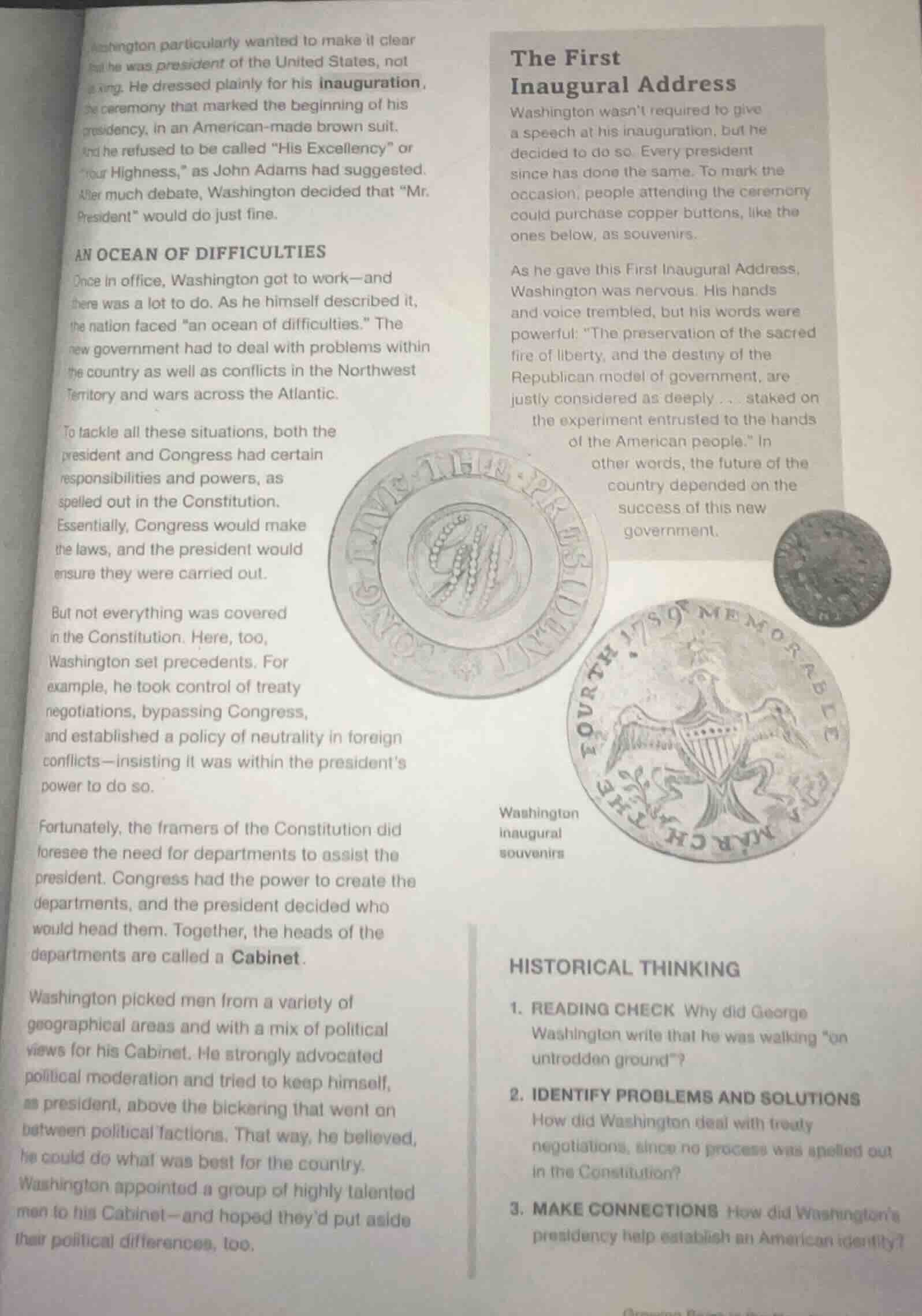
washington particularly wanted to make it clear that he was president of the united states, not a king. he dressed plainly for his inauguration, the ceremony that marked the beginning of his presidency, in an american-made brown suit. and he refused to be called \his excellency\ or \your highness,\ as john adams had suggested. after much debate, washington decided that \mr. president\ would do just fine.an ocean of difficultiesonce in office, washington got to work—and there was a lot to do. as he himself described it, the nation faced \an ocean of difficulties.\ the new government had to deal with problems within the country as well as conflicts in the northwest territory and wars across the atlantic.to tackle all these situations, both the president and congress had certain responsibilities and powers, as spelled out in the constitution.essentially, congress would make the laws, and the president would ensure they were carried out.but not everything was covered in the constitution. here, too, washington set precedents. for example, he took control of treaty negotiations, bypassing congress, and established a policy of neutrality in foreign conflicts—insisting it was within the presidents power to do so.fortunately, the framers of the constitution did foresee the need for departments to assist the president. congress had the power to create the departments, and the president decided who would head them. together, the heads of the departments are called a cabinet.washington picked men from a variety of geographical areas and with a mix of political views for his cabinet. he strongly advocated political moderation and tried to keep himself, as president, above the bickering that went on between political factions. that way, he believed, he could do what was best for the country.washington appointed a group of highly talented men to his cabinet—and hoped theyd put aside their political differences, too.the firstinaugural addresswashington wasnt required to give a speech at his inauguration, but he decided to do so. every president since has done the same. to mark the occasion, people attending the ceremony could purchase copper buttons, like the ones below, as souvenirs.as he gave this first inaugural address, washington was nervous. his hands and voice trembled, but his words were powerful: \the preservation of the sacred fire of liberty, and the destiny of the republican model of government, are justly considered as deeply ... staked on the experiment entrusted to the hands of the american people.\ in other words, the future of the country depended on the success of this new government.washington inaugural souvenirshistorical thinking1. reading check why did george washington write that he was walking \on untrodden ground\?2. identify problems and solutions how did washington deal with treaty negotiations, since no process was spelled out in the constitution?3. make connections how did washingtons presidency help establish an american identity?
- George Washington was the first U.S. president, so there were no existing rules, precedents, or examples for how to carry out the role of the presidency, making his path untested.
- When no constitutional process existed for treaty negotiations, Washington took direct control of them, bypassing Congress, and established this as a presidential precedent.
- Washington established key presidential norms (like the title "Mr. President"), set precedents for executive power, emphasized political moderation, and helped solidify the new U.S. government's identity as a democratic alternative to monarchies, all of which shaped American national identity.

Snap & solve any problem in the app
Get step-by-step solutions on Sovi AI
Photo-based solutions with guided steps
Explore more problems and detailed explanations
- He was the first U.S. president, with no existing precedents or guidelines for the role, so his path was entirely untested.
- He took control of treaty negotiations directly, bypassing Congress, and claimed this as a presidential power, setting a precedent.
- He established presidential norms (e.g., the title "Mr. President"), set precedents for executive authority, promoted political unity, and helped solidify the new democratic government's identity, laying foundational elements of American national identity.