QUESTION IMAGE
Question
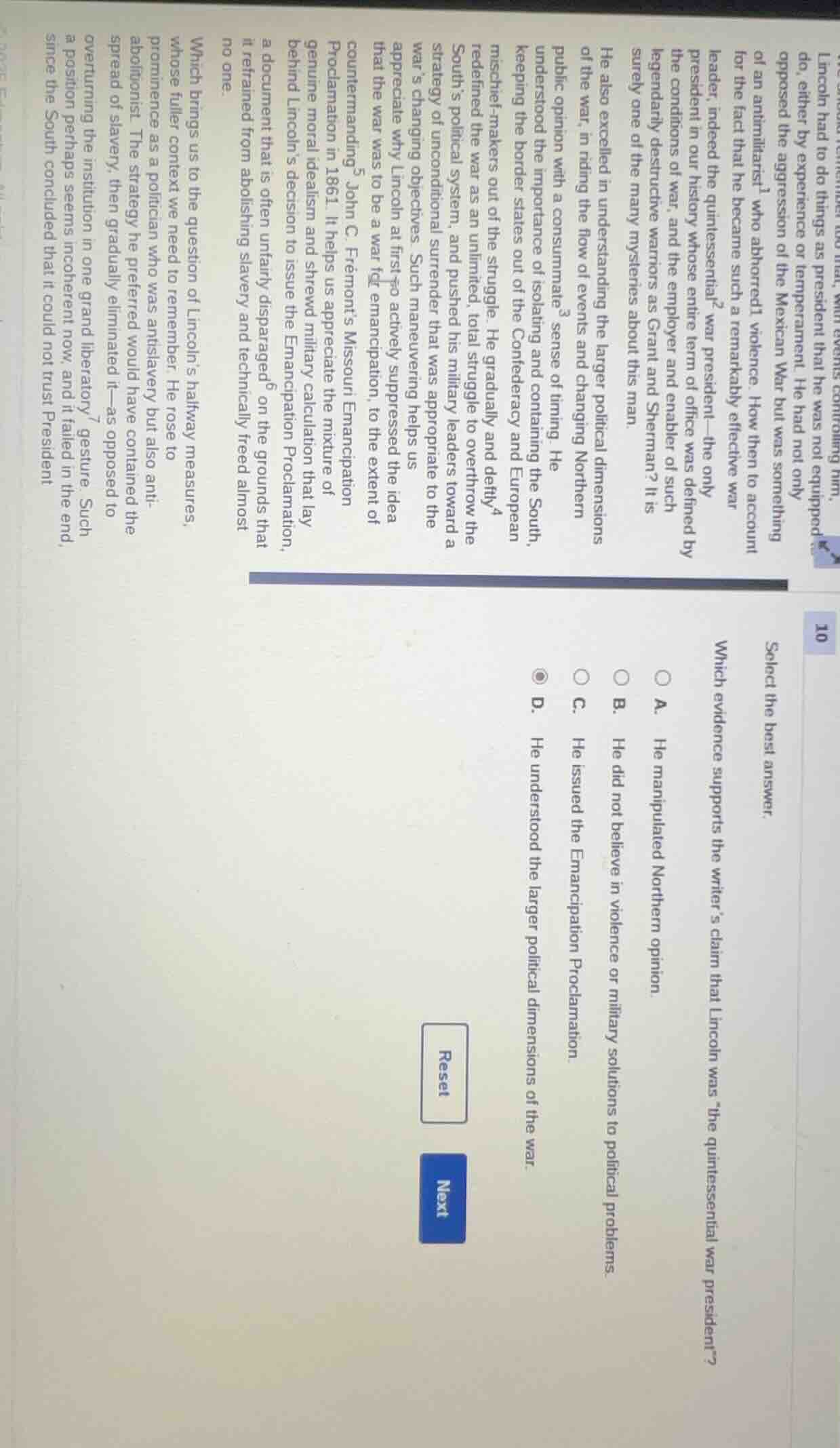
we should remember too that, with events controlling him, lincoln had to do things as president that he was not equipped to do, either by experience or temperament. he had not only opposed the aggression of the mexican war but was something of an antimilitarist¹ who abhorred violence. how then to account for the fact that he became such a remarkably effective war leader, indeed the quintessential² war president—the only president in our history whose entire term of office was defined by the conditions of war, and the employer and enabler of such legendarily destructive warriors as grant and sherman? it is surely one of the many mysteries about this man.
he also excelled in understanding the larger political dimensions of the war, in riding the flow of events and changing northern public opinion with a consummate³ sense of timing. he understood the importance of isolating and containing the south, keeping the border states out of the confederacy and european mischief-makers out of the struggle. he gradually and deftly⁴ redefined the war as an unlimited, total struggle to overthrow the souths political system, and pushed his military leaders toward a strategy of unconditional surrender that was appropriate to the wars changing objectives. such maneuvering helps us appreciate why lincoln at first so actively suppressed the idea that the war was to be a war for emancipation, to the extent of countermanding⁵ john c. frémonts missouri emancipation proclamation in 1861. it helps us appreciate the mixture of genuine moral idealism and shrewd military calculation that lay behind lincolns decision to issue the emancipation proclamation, a document that is often unfairly disparaged⁶ on the grounds that it refrained from abolishing slavery and technically freed almost no one.
which brings us to the question of lincolns halfway measures, whose fuller context we need to remember. he rose to prominence as a politician who was antislavery but also anti-abolitionist. the strategy he preferred would have contained the spread of slavery, then gradually eliminated it—as opposed to overturning the institution in one grand liberatory⁷ gesture. such a position perhaps seems incoherent now, and it failed in the end, since the south concluded that it could not trust president
10
select the best answer.
which evidence supports the writers claim that lincoln was \the quintessential war president\?
○ a. he manipulated northern opinion.
○ b. he did not believe in violence or military solutions to political problems.
○ c. he issued the emancipation proclamation.
◎ d. he understood the larger political dimensions of the war.
The text states Lincoln excelled at understanding the war's political dimensions, managed public opinion with precise timing, isolated the South, redefined the war as a total struggle, and pushed for unconditional surrender—all hallmarks of an effective war president. Option A is incorrect as he shaped, not manipulated, Northern opinion. Option B is wrong because he used military solutions (employing Grant/Sherman). Option C is only one specific action, while Option D encompasses the broader strategic political understanding that defines his success as a war president.

Snap & solve any problem in the app
Get step-by-step solutions on Sovi AI
Photo-based solutions with guided steps
Explore more problems and detailed explanations
D. He understood the larger political dimensions of the war.