QUESTION IMAGE
Question
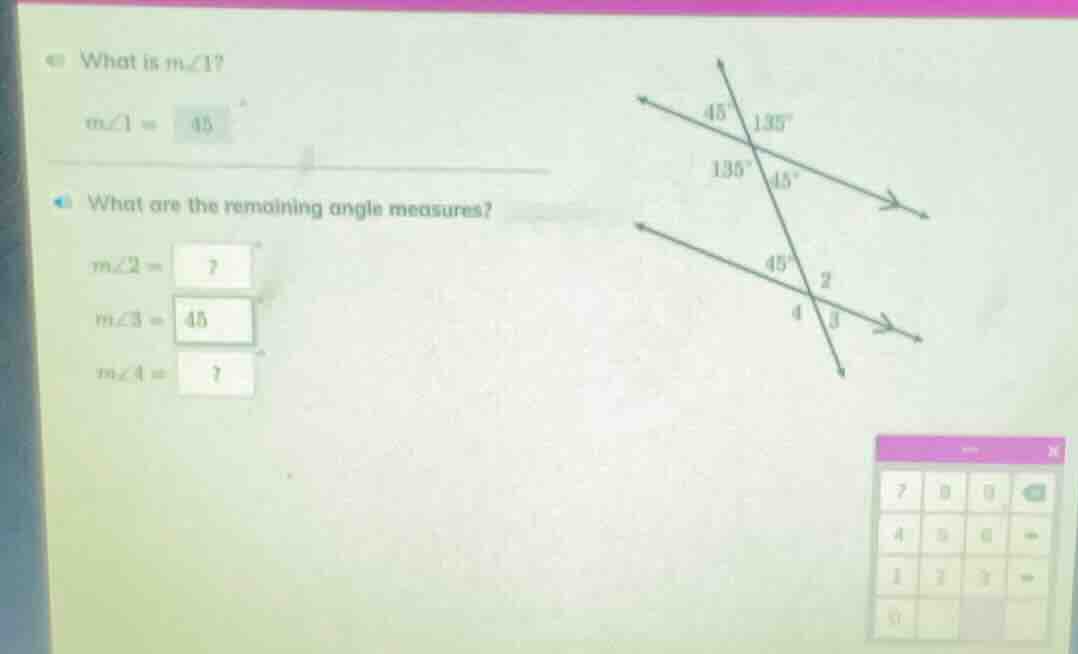
what is m∠1?
m∠1 = 45
what are the remaining angle measures?
m∠2 = ?
m∠3 = 45
m∠4 = ?
Step1: Find \( m\angle2 \)
Angles on a straight line sum to \( 180^\circ \). The angle adjacent to \( 45^\circ \) (above \( \angle2 \)) and \( \angle2 \) form a linear pair. Also, from the top intersection, we see vertical angles and linear pairs. The angle corresponding to the \( 135^\circ \) angle (from the top) will be equal to \( \angle2 \) if we consider parallel lines (since the transversal creates corresponding angles, or linear pairs). Wait, actually, looking at the diagram, the angle next to \( 45^\circ \) (the one that's \( 135^\circ \) in the top intersection) should be supplementary to \( 45^\circ \), but also, \( \angle2 \) and the \( 135^\circ \)-like angle? Wait, no, let's look at linear pairs. The angle above \( \angle2 \) is \( 45^\circ \), so \( \angle2 + 45^\circ = 180^\circ \)? No, wait, the top intersection has angles \( 45^\circ \) and \( 135^\circ \) as supplementary. Now, the bottom intersection: the angle marked \( 45^\circ \) (same as the top) and \( \angle2 \): actually, \( \angle2 \) should be equal to \( 135^\circ \) because it's a linear pair with \( 45^\circ \)? Wait, no, linear pair: \( 45^\circ + m\angle2 = 180^\circ \)? Wait, no, looking at the diagram, the two lines (the slanted ones) are parallel? Wait, the top and bottom intersections: the transversal crosses two lines. The top intersection has angles \( 45^\circ \) and \( 135^\circ \), so the two lines (the ones with arrows) are such that the transversal creates those angles. Now, at the bottom intersection, the angle labeled \( 45^\circ \) is equal to the top \( 45^\circ \) (corresponding angles, if the lines are parallel). Then, \( \angle2 \) is supplementary to \( 45^\circ \), so \( m\angle2 = 180^\circ - 45^\circ = 135^\circ \).
Step2: Find \( m\angle4 \)
\( \angle4 \) and \( \angle2 \) are vertical angles, so they are equal. So \( m\angle4 = m\angle2 = 135^\circ \). Alternatively, \( \angle4 \) is supplementary to \( 45^\circ \) (since \( \angle3 = 45^\circ \) and \( \angle3 + \angle4 = 180^\circ \)? Wait, no, \( \angle3 \) and \( \angle4 \) are a linear pair? Wait, \( \angle3 = 45^\circ \), so \( \angle3 + m\angle4 = 180^\circ \)? No, \( \angle3 \) and \( \angle4 \): if \( \angle3 = 45^\circ \), then \( \angle4 = 180^\circ - 45^\circ = 135^\circ \), which matches the vertical angle with \( \angle2 \).
Wait, let's correct:
For \( m\angle2 \):
Linear pair with \( 45^\circ \): \( m\angle2 = 180^\circ - 45^\circ = 135^\circ \).
For \( m\angle4 \):
\( \angle4 \) is vertical to \( \angle2 \), so \( m\angle4 = m\angle2 = 135^\circ \). Alternatively, \( \angle4 \) is linear pair with \( \angle3 \) (which is \( 45^\circ \)): \( m\angle4 = 180^\circ - 45^\circ = 135^\circ \).

Snap & solve any problem in the app
Get step-by-step solutions on Sovi AI
Photo-based solutions with guided steps
Explore more problems and detailed explanations
\( m\angle2 = 135^\circ \), \( m\angle4 = 135^\circ \)