QUESTION IMAGE
Question
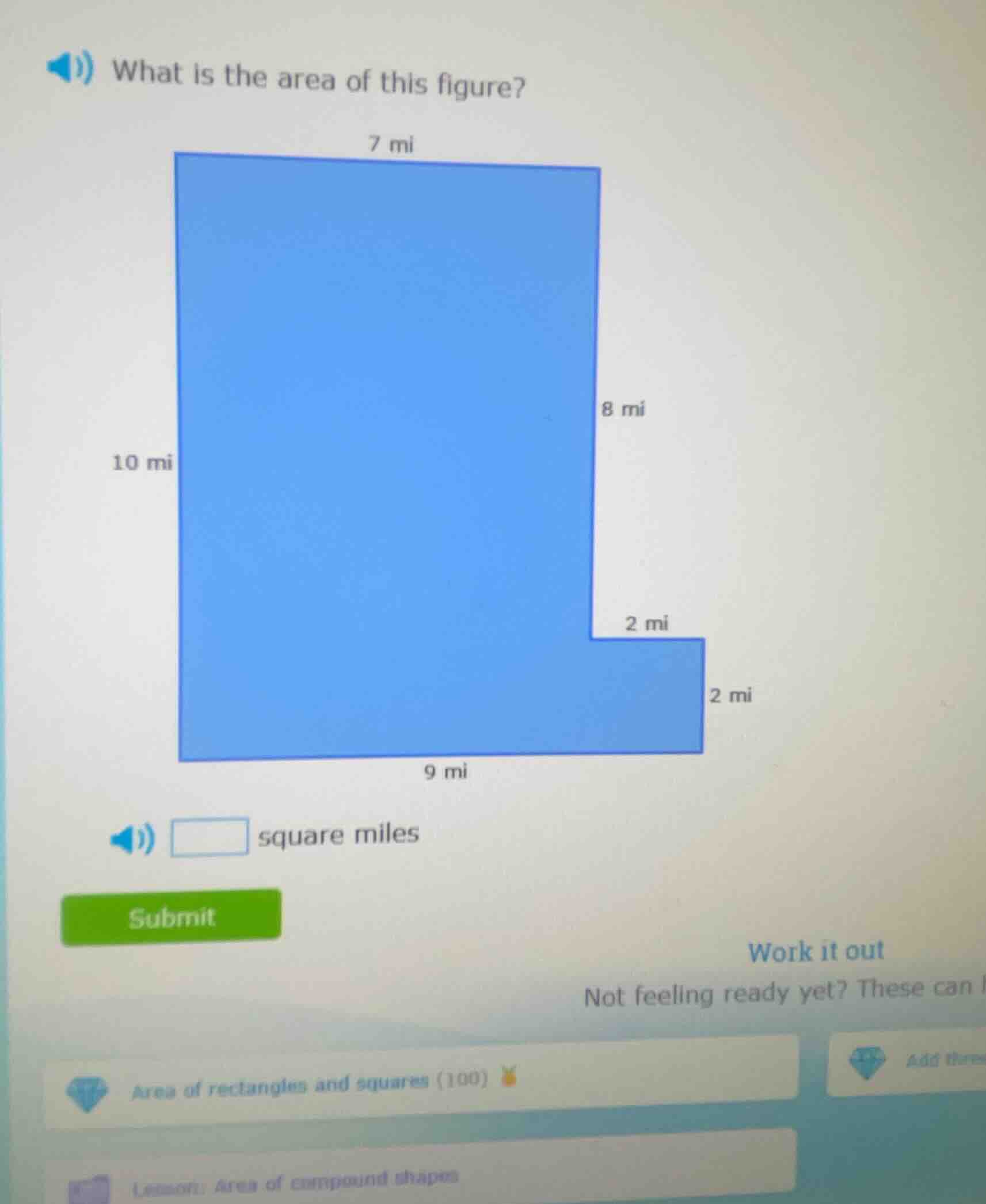
what is the area of this figure?
7 mi
8 mi
10 mi
2 mi
2 mi
9 mi
square miles
Step1: Split the figure into two rectangles
We can split the blue figure into a large rectangle and a small rectangle. The large rectangle has a width of 7 mi and a height of 10 mi? Wait, no, looking at the dimensions: the total height is 10 mi, the right part has a height of 8 mi, so the remaining height for the small rectangle's vertical side? Wait, actually, another way: the bottom part: the total length is 9 mi, the top part is 7 mi, so the small rectangle's length is \(9 - 7=2\) mi, and its height is 2 mi. The large rectangle: length 7 mi, height 10 mi? Wait, no, the height of the large rectangle: the total height is 10 mi, and the small rectangle is 2 mi tall, but wait, the right side has 8 mi and then 2 mi, so total height is \(8 + 2=10\) mi. So the large rectangle is 7 mi (width) by 10 mi (height)? No, that can't be, because the total length is 9 mi. Wait, maybe better to split into two rectangles: one is 7 mi (width) by 10 mi (height), but no, the right side has a notch? Wait, no, the figure is an L - shape. Let's split it into two rectangles:
First rectangle: width = 7 mi, height = 10 mi? No, because the bottom part extends 2 mi to the right. Wait, actually, the correct split is:
Rectangle 1: length = 7 mi, height = 8 mi (since the right side has 8 mi).
Rectangle 2: length = 9 mi, height = 2 mi (the bottom part, but wait, no, the bottom part's length is 9 mi, but the top part is 7 mi, so the overlapping? Wait, no, let's calculate the area by subtracting or adding.
Alternative approach: The total area can be calculated as the area of the big rectangle (if we consider the full length 9 mi and full height 10 mi) minus the area of the missing rectangle. Wait, the missing rectangle would have length \(9 - 7 = 2\) mi and height \(10 - 2=8\) mi? No, that's not right.
Wait, let's look at the dimensions again:
- The top - horizontal side: 7 mi.
- The bottom - horizontal side: 9 mi.
- The left - vertical side: 10 mi.
- The right - vertical side: 8 mi (upper part) and 2 mi (lower part), so total right - vertical side: \(8 + 2=10\) mi, which matches the left - vertical side.
- The lower - right horizontal side: 2 mi.
- The lower - right vertical side: 2 mi.
So, let's split the figure into two rectangles:
- Rectangle A: width = 7 mi, height = 10 mi. But wait, the bottom part extends 2 mi to the right. No, that's not correct. Wait, another way:
Rectangle 1: width = 7 mi, height = 8 mi (the upper part, from the top down to 8 mi height).
Rectangle 2: width = 9 mi, height = 2 mi (the bottom part, from height 8 mi to 10 mi, so height 2 mi).
Now, calculate the area of Rectangle 1: \(A_1=7\times8 = 56\) square miles.
Calculate the area of Rectangle 2: \(A_2 = 9\times2=18\) square miles.
Wait, no, that can't be, because the bottom part's width is 9 mi, but the top part is 7 mi, so the overlapping? Wait, no, the bottom part's width is 9 mi, and the height is 2 mi, and the top part's width is 7 mi and height is 8 mi. When we add them, the total area is \(A_1+A_2=56 + 18=74\) square miles? Wait, but let's check with another split.
Another split: Rectangle 1: width = 7 mi, height = 10 mi (area \(7\times10 = 70\) square miles). Rectangle 2: width = 2 mi (since \(9 - 7 = 2\)), height = 2 mi (area \(2\times2 = 4\) square miles). Then total area \(70+4 = 74\) square miles. Yes, that makes sense. Because the figure is a large rectangle of 7 mi (width) by 10 mi (height) plus a small rectangle of 2 mi (width) by 2 mi (height) attached to the bottom right.
So:
Step1: Calculate the area of the large rectangle
The large rectangle…

Snap & solve any problem in the app
Get step-by-step solutions on Sovi AI
Photo-based solutions with guided steps
Explore more problems and detailed explanations
74