QUESTION IMAGE
Question
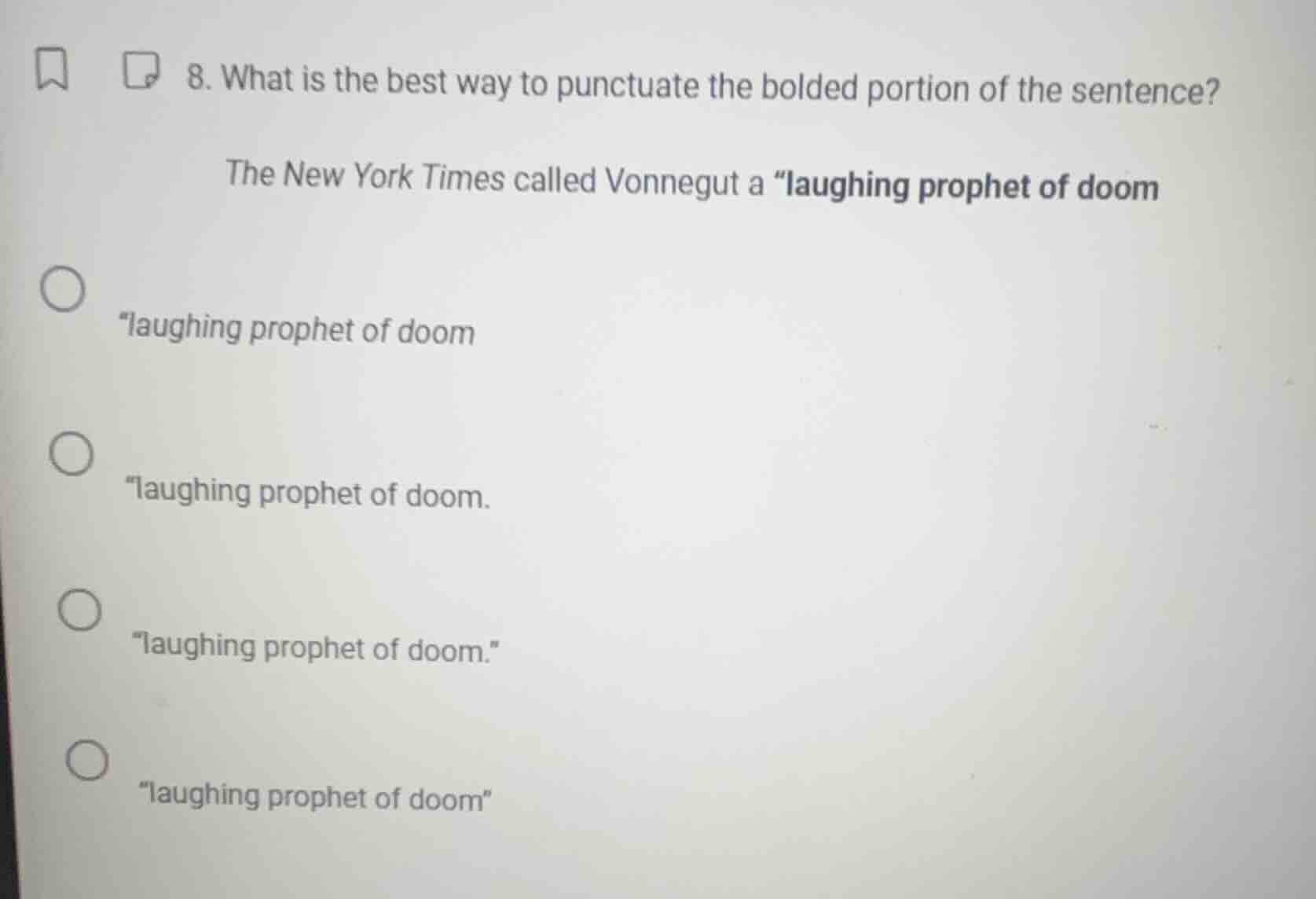
- what is the best way to punctuate the bolded portion of the sentence? the new york times called vonnegut a “laughing prophet of doom “laughing prophet of doom “laughing prophet of doom. “laughing prophet of doom.” “laughing prophet of doom”
To punctuate a quoted phrase correctly, we need to close the quotation marks and place the period (if the quote is a complete part of the sentence) inside the closing quotation mark. The bolded portion is a quoted title/description, so we need to end the quote with a closing quotation mark, and since the quote is a noun phrase (not a complete sentence on its own, but in the context of the sentence "called Vonnegut a...", the quote is a direct quote of the description, so we place the period inside the closing quote? Wait, no—wait, the original sentence is "The New York Times called Vonnegut a 'laughing prophet of doom'". Wait, no, the options: let's analyze. The first part of the sentence has an opening quote: "laughing prophet of doom. Wait, the original sentence starts with "a "laughing...", so we need to close the quote. The correct punctuation for a quoted phrase (a direct quote of the description) is to have the closing quotation mark, and since the quote is a part of the sentence (not a standalone sentence), but in American English, periods go inside the quotation marks. Wait, but the quote here is a noun phrase, not a complete sentence. Wait, no—when you have a quoted phrase that is part of a sentence, and the quote is a direct quote (like the exact words), the closing quotation mark should come after the period if the quote is a complete sentence, but if it's a phrase, the period (if the sentence ends with the quote) would be inside? Wait, no, let's look at the options. The original sentence is "The New York Times called Vonnegut a 'laughing prophet of doom'". Wait, the options:
- Option 1: "laughing prophet of doom (no closing quote, wrong)
- Option 2: "laughing prophet of doom. (period outside closing quote, wrong in American English)
- Option 3: "laughing prophet of doom." (period inside closing quote, but is the quote a complete sentence? No, it's a description. Wait, no—the sentence structure is "called Vonnegut a [quote]". The quote is a noun phrase, so the quote itself doesn't have a period, but the sentence's structure: wait, no, the original sentence is "The New York Times called Vonnegut a 'laughing prophet of doom'". Wait, maybe I'm overcomplicating. The correct rule is: in American English, when a quote is a part of a sentence and the quote is a direct quote (exact words), the closing quotation mark comes after the period if the quote is a complete sentence, but if the quote is a phrase, and the sentence ends with the quote, the period goes inside. But in this case, the quote is "laughing prophet of doom"—it's a description, not a complete sentence, so the quote should end with a closing quotation mark, and since the sentence's structure is "called Vonnegut a [quote]", the quote is a direct object (the description), so the correct punctuation is "laughing prophet of doom" with the closing quote, and since the quote is a phrase (not a complete sentence), but the period (if the sentence ends here) would be inside? Wait, no, the original sentence doesn't have a period yet—wait, the question is about punctuating the bolded portion. The bolded portion is "laughing prophet of doom". So we need to close the quote. Let's check the options:
Option 3: "laughing prophet of doom." – but the quote is not a complete sentence, so adding a period inside the quote is wrong. Wait, no—maybe the quote is a complete description, and the period is part of the quote? No, that doesn't make sense. Wait, no—let's recall: when you have a quoted phrase that is a direct quote (the exact words), and the quote is a noun phrase (like a title o…

Snap & solve any problem in the app
Get step-by-step solutions on Sovi AI
Photo-based solutions with guided steps
Explore more problems and detailed explanations
C. "laughing prophet of doom." (Wait, no, the options are not labeled with letters, but looking at the options: the third option is "laughing prophet of doom." So the correct answer is the option with "laughing prophet of doom." (the third option, assuming the options are in order: first option is no closing quote, second is period outside, third is period inside closing quote, fourth is no period. So the correct answer is the third option: "laughing prophet of doom."