QUESTION IMAGE
Question
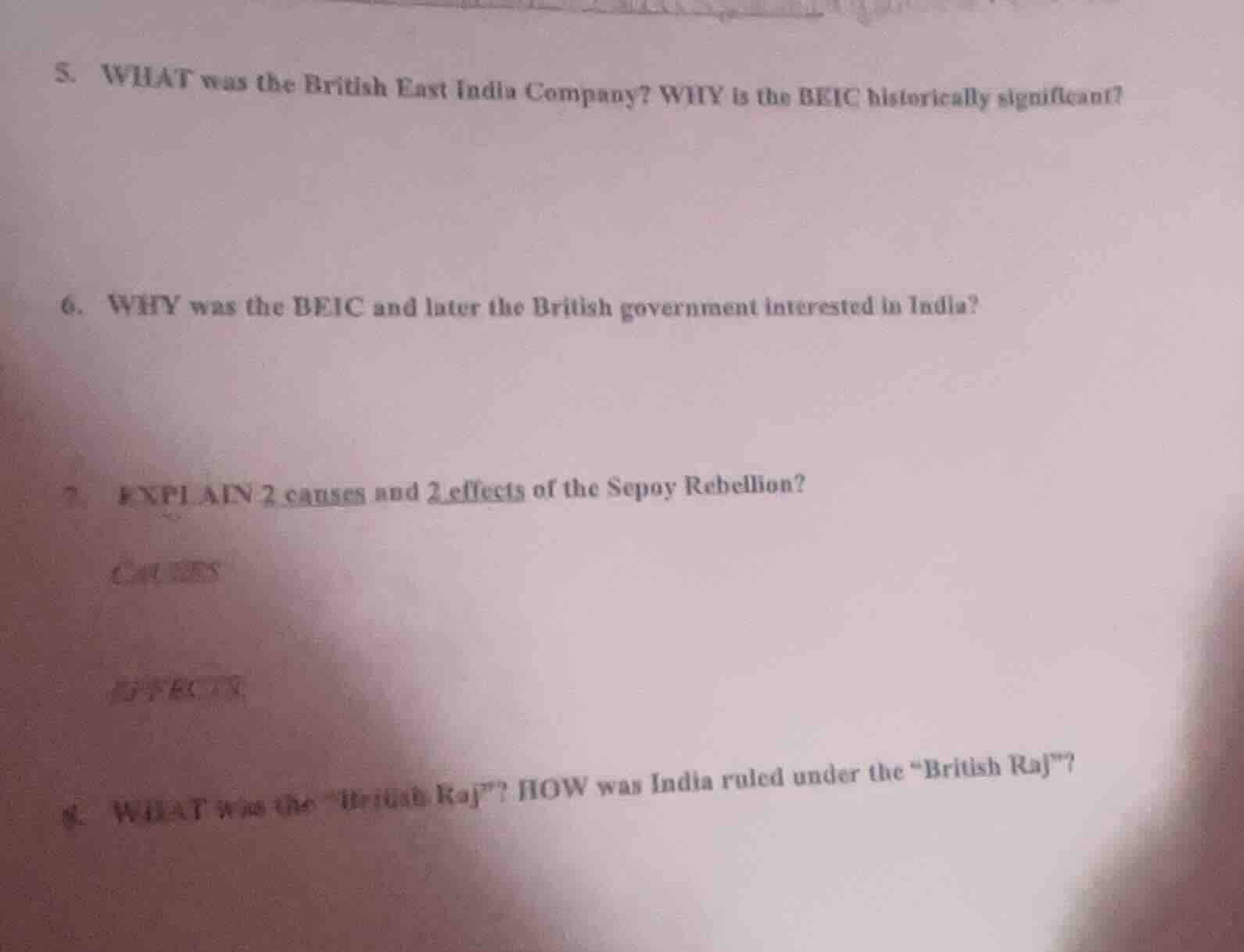
- what was the british east india company? why is the beic historically significant?
- why was the beic and later the british government interested in india?
- explain 2 causes and 2 effects of the sepoy rebellion?
causes
effects
- what was the \british raj\? how was india ruled under the \british raj\?
Response
Question 5
Brief Explanations
- What was the British East India Company?
The British East India Company (BEIC) was a joint - stock company (granted a royal charter in 1600) that was established to conduct trade with the East Indies (later focused on India and East Asia). It had commercial, political, and military powers, acting as a quasi - state entity in regions it operated, with its own army and the ability to make treaties.
- Why is the BEIC historically significant?
- It was crucial in the process of British colonial expansion in Asia. It helped Britain gain control over large parts of India, which became a vital colony for Britain in terms of resources (like spices, textiles, and later raw materials) and a market for British goods.
- Its operations led to the transformation of India's economy, society, and politics, including the introduction of new land revenue systems, the spread of British - style administration, and the undermining of local Indian kingdoms. Also, its eventual dissolution (after the 1857 rebellion) led to the direct rule of India by the British Crown (the British Raj), changing the nature of British colonial rule in India.
Brief Explanations
- Economic Interests: India was rich in resources. It had valuable goods like spices, textiles, and later raw materials (such as cotton, jute) that the BEIC and British government wanted to exploit for trade and profit. India also provided a large market for British - manufactured goods, which was important for Britain's industrial economy.
- Strategic Interests: India's location in Asia was strategically important. Controlling India gave Britain a base to expand its influence in Asia, including access to other Asian markets and the ability to project power in the Indian Ocean region, which was vital for trade routes (like the route to China and other East Asian countries).
Brief Explanations
- Causes:
- Religious/Cultural Grievances: The introduction of the Enfield rifle in the British Indian Army required sepoys (Indian soldiers) to bite off the cartridge tip. Rumors spread that the cartridges were greased with cow (sacred to Hindus) and pig (taboo to Muslims) fat, which offended both religious groups.
- Political Grievances: The British policy of “Doctrine of Lapse” (where Indian states without a male heir were annexed by the British) and the annexation of states like Awadh (Oudh) by the British East India Company led to resentment among Indian rulers and the general population.
- Effects:
- End of BEIC Rule: After the rebellion, the British Crown took over the rule of India from the British East India Company, starting the era of the British Raj (direct British Crown rule).
- Social/Political Changes: There was a shift in British policies towards India. The British became more cautious about interfering with Indian religious and social customs (to avoid further unrest), and there was a reorganization of the Indian Army to have a more balanced ratio of British to Indian soldiers and to reduce the chances of another large - scale mutiny.

Snap & solve any problem in the app
Get step-by-step solutions on Sovi AI
Photo-based solutions with guided steps
Explore more problems and detailed explanations
- What was the BEIC? A joint - stock company (chartered in 1600) with commercial, political, and military powers, key in British expansion in Asia (especially India).
- Why significant? Drove British colonial control of India, transformed India’s economy/society/politics, and led to direct British Crown rule (British Raj) after its end.