QUESTION IMAGE
Question
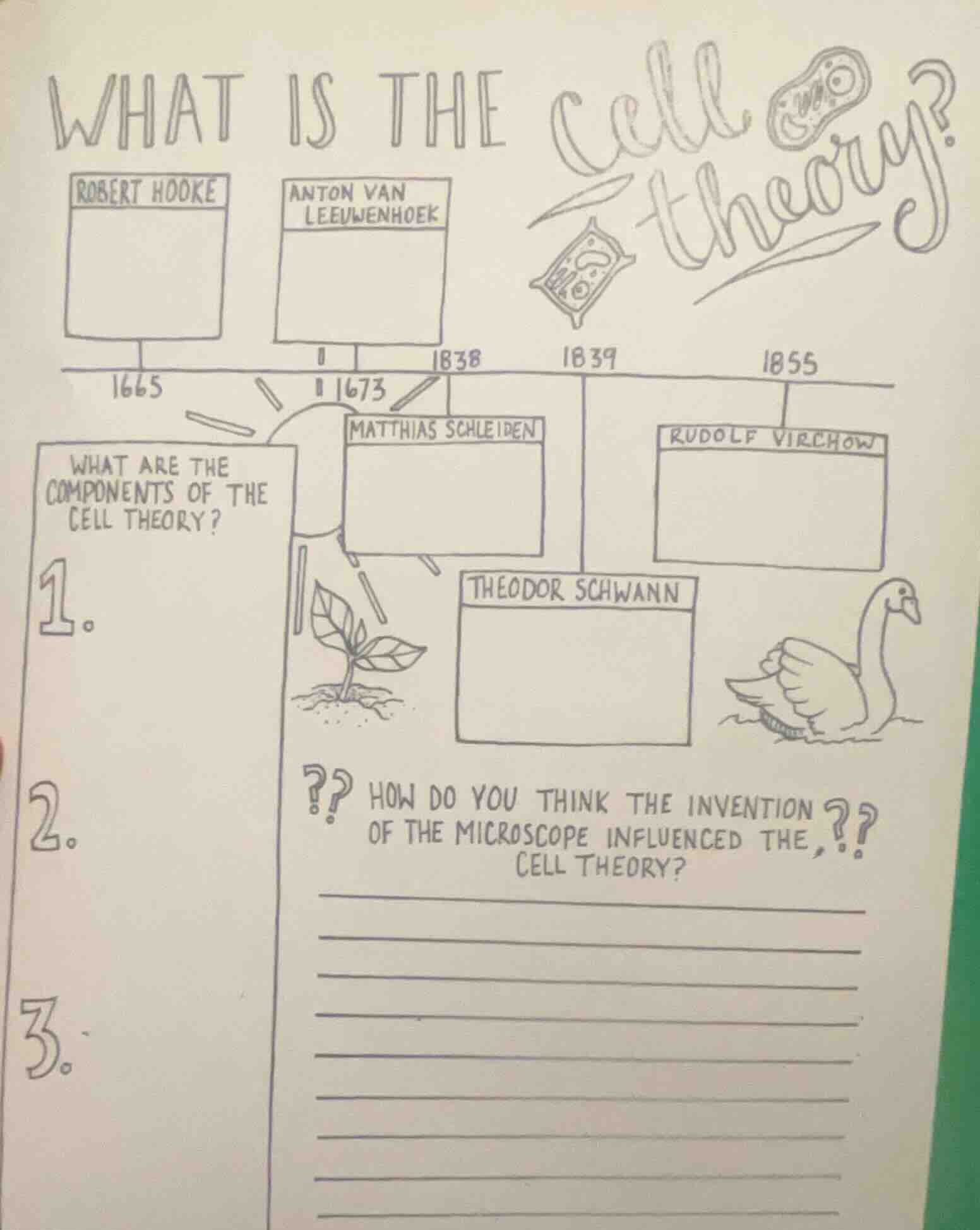
what is the cell theory? robert hooke anton van leeuwenhoek 1665 1673 1838 1839 1855 matthias schleiden rudolf virchow what are the components of the cell theory? 1. theodor schwann 2. ?? how do you think the invention of the microscope influenced the cell theory? 3.
First, fill in the contributions of each scientist:
- Robert Hooke (1665): Coined the term "cell" after observing cork under a microscope.
- Anton van Leeuwenhoek (1673): Observed living single-celled organisms (he called them "animalcules") using a homemade microscope.
- Matthias Schleiden (1838): Proposed that all plants are made of cells.
- Theodor Schwann (1839): Proposed that all animals are made of cells, uniting plant and animal cell observations.
- Rudolf Virchow (1855): Stated that all cells come from pre-existing cells.
For the cell theory components: These are the three core principles derived from the scientists' work.
For the microscope influence: The microscope allowed direct visualization of cells and their structures, which was necessary to form and validate the cell theory, as prior to this, cells were too small to be observed.

Snap & solve any problem in the app
Get step-by-step solutions on Sovi AI
Photo-based solutions with guided steps
Explore more problems and detailed explanations
Scientist Contributions:
- Robert Hooke (1665): Coined the term "cell" from cork observations
- Anton van Leeuwenhoek (1673): Discovered single-celled "animalcules"
- Matthias Schleiden (1838): All plants are composed of cells
- Theodor Schwann (1839): All animals are composed of cells
- Rudolf Virchow (1855): All cells arise from pre-existing cells
Components of Cell Theory:
- All living organisms are composed of one or more cells.
- The cell is the basic unit of structure and function in all living things.
- All cells come from pre-existing, living cells.
Microscope Influence:
The invention of the microscope was critical to the development of cell theory because it enabled scientists to observe cells and their activities directly for the first time. Before microscopes, cells were too small to be seen, so there was no way to confirm the existence of cells or study their role in living organisms. The ability to visualize cells allowed researchers like Hooke, Leeuwenhoek, Schleiden, Schwann, and Virchow to gather empirical evidence that formed the foundational principles of cell theory.