QUESTION IMAGE
Question
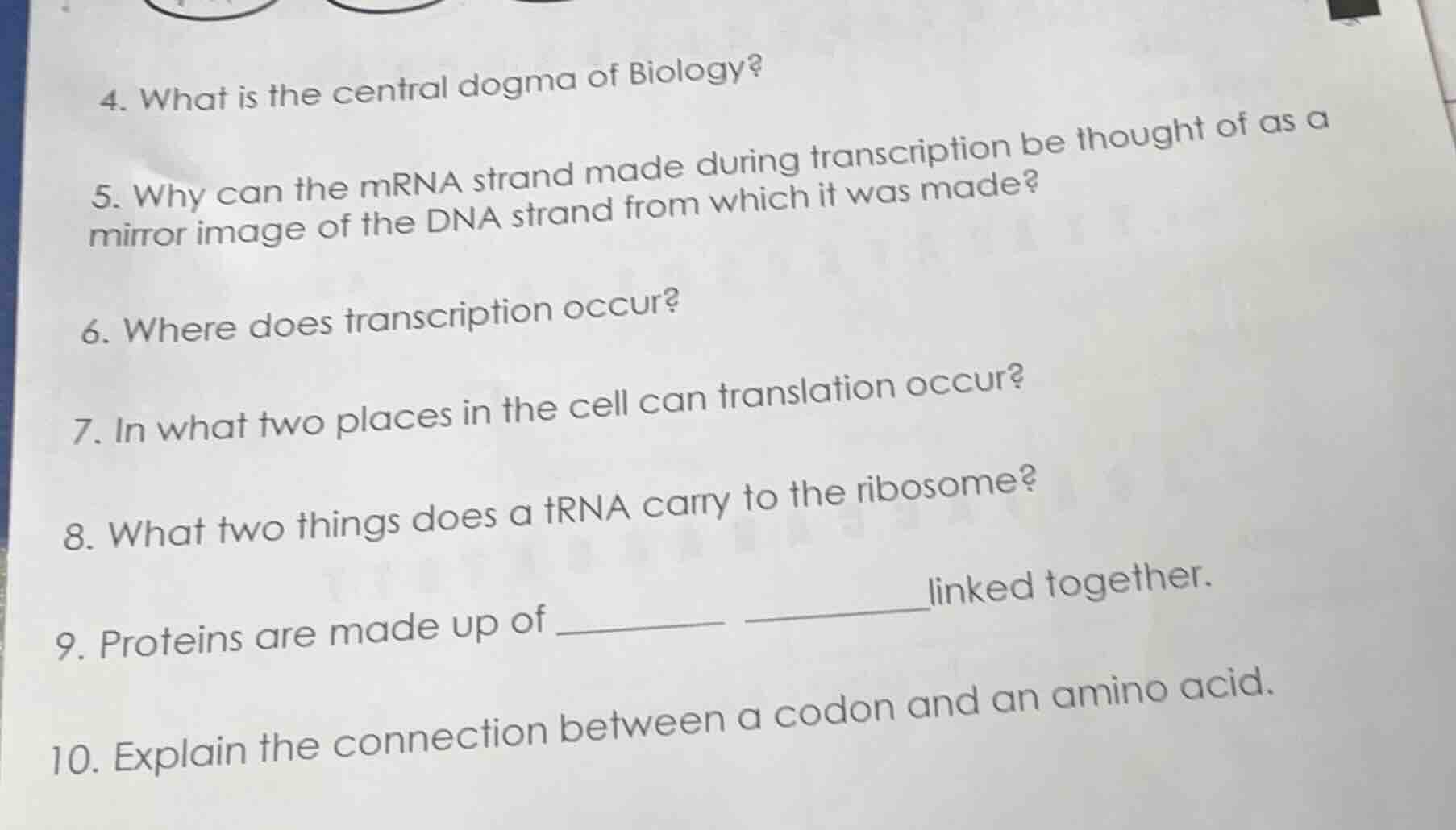
- what is the central dogma of biology?
- why can the mrna strand made during transcription be thought of as a mirror image of the dna strand from which it was made?
- where does transcription occur?
- in what two places in the cell can translation occur?
- what two things does a trna carry to the ribosome?
- proteins are made up of ____ ____ linked together.
- explain the connection between a codon and an amino acid.
Brief Explanations
- Defines the core flow of genetic information in biological systems.
- Explains complementary base pairing between DNA and mRNA.
- Notes the cellular location of DNA for eukaryotes/prokaryotes.
- Identifies sites of protein synthesis machinery in cells.
- Lists the key cargo of transfer RNA during translation.
- States the fundamental building blocks of proteins.
- Describes the genetic code's mapping rule.

Snap & solve any problem in the app
Get step-by-step solutions on Sovi AI
Photo-based solutions with guided steps
Explore more problems and detailed explanations
- The central dogma of Biology is that genetic information flows from DNA to RNA to protein: DNA is transcribed into mRNA, and mRNA is translated into a polypeptide (protein). In some cases, reverse transcription (RNA to DNA) can occur in certain viruses.
- mRNA is a mirror image because its nucleotides are complementary to the DNA template strand: adenine (A) in DNA pairs with uracil (U) in mRNA, thymine (T) in DNA pairs with A in mRNA, cytosine (C) pairs with guanine (G), and G pairs with C, creating a strand that matches the non-template DNA strand's sequence (with U replacing T).
- In eukaryotic cells, transcription occurs in the nucleus (for nuclear DNA); in prokaryotic cells, it occurs in the cytoplasm (since they have no nucleus).
- Translation can occur on free ribosomes in the cytoplasm, and on ribosomes attached to the rough endoplasmic reticulum (rough ER).
- A tRNA carries a specific amino acid, and an anticodon that is complementary to an mRNA codon.
- amino acids, peptide bonds
- A codon is a sequence of 3 nucleotides on mRNA. Each specific codon corresponds to one amino acid (or a stop signal) per the genetic code. tRNA molecules with complementary anticodons recognize specific codons and deliver the matching amino acid, linking the codon sequence directly to the amino acid sequence of a protein.