QUESTION IMAGE
Question
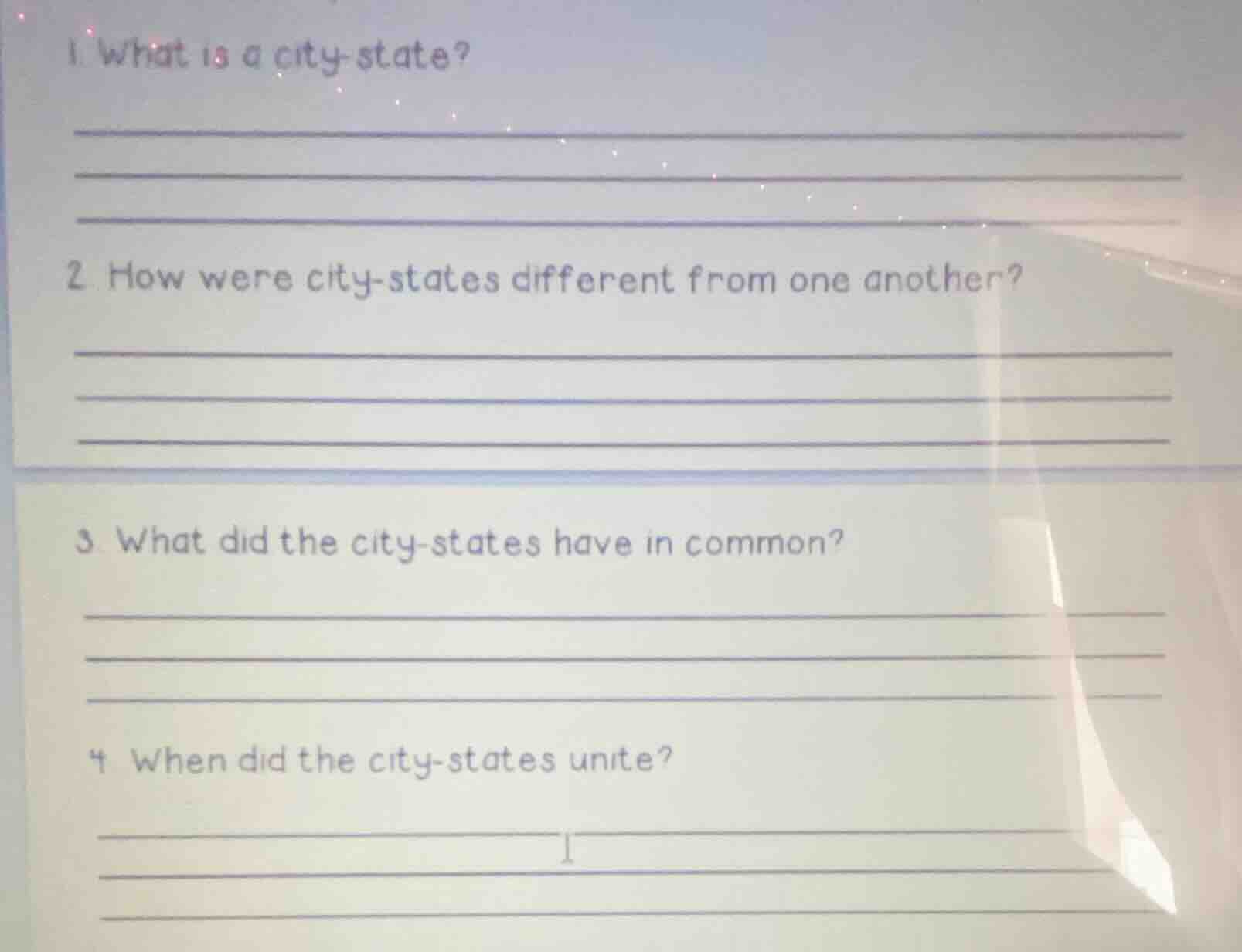
- what is a city - state?
- how were city - states different from one another?
- what did the city - states have in common?
- when did the city - states unite?
Brief Explanations
- A city-state is an independent political entity that consists of a single city and its surrounding territory, functioning as a self-governing sovereign state.
- City-states differed in their systems of government (e.g., democracy, oligarchy, monarchy), social structures, economic focuses (e.g., trade, agriculture), and military strengths.
- City-states typically shared a common cultural identity, including language, religious beliefs and practices, and core cultural traditions (especially relevant to ancient Greek city-states, the most common frame of reference for this term).
- For ancient Greek city-states, they united temporarily during crises like the Persian Wars (5th century BCE), but formal, permanent unification did not happen until the establishment of modern Greece in 1830 CE.

Snap & solve any problem in the app
Get step-by-step solutions on Sovi AI
Photo-based solutions with guided steps
Explore more problems and detailed explanations
- A city-state is a self-governing sovereign entity made up of a single city and its surrounding territory.
- City-states differed in government systems, social structures, economic focuses, and military power.
- City-states often shared a common language, religion, and cultural traditions.
- Ancient Greek city-states united temporarily in the 5th century BCE (during the Persian Wars); permanent unification for Greek city-states occurred in 1830 CE with the formation of modern Greece.