QUESTION IMAGE
Question
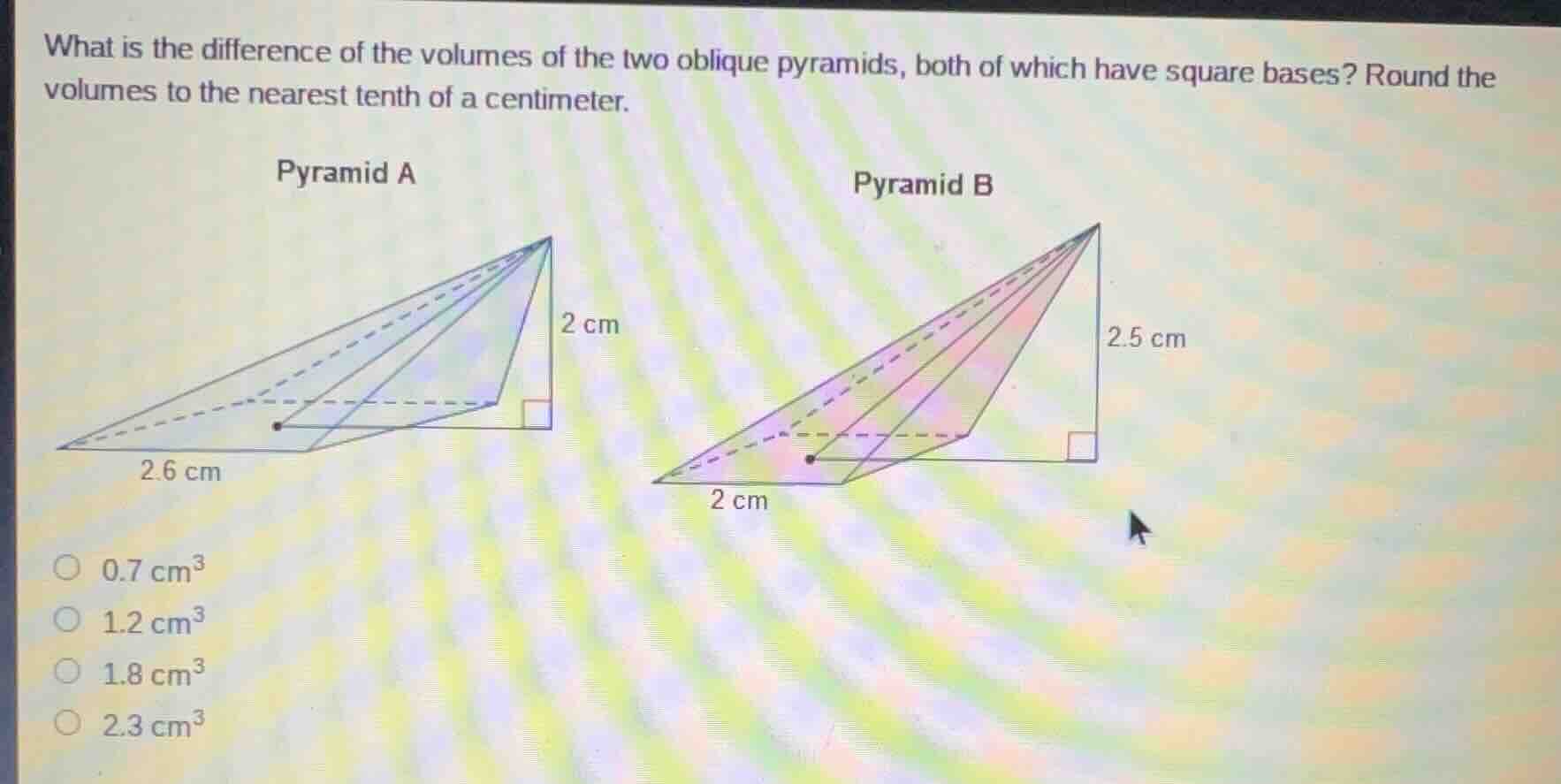
what is the difference of the volumes of the two oblique pyramids, both of which have square bases? round the volumes to the nearest tenth of a centimeter. pyramid a pyramid b 2 cm 2.5 cm 2.6 cm 2 cm 0.7 cm³ 1.2 cm³ 1.8 cm³ 2.3 cm³
Step1: Recall the volume formula for a pyramid
The volume \( V \) of a pyramid is given by \( V=\frac{1}{3}Bh \), where \( B \) is the area of the base and \( h \) is the height. For a square base, \( B = s^2 \), where \( s \) is the side length of the square base.
Step2: Calculate the volume of Pyramid A
For Pyramid A: The base is a square with side length \( s = 2.6\space\text{cm} \), and the height \( h_A=2\space\text{cm} \).
First, find the base area \( B_A=(2.6)^2 = 6.76\space\text{cm}^2 \).
Then, the volume \( V_A=\frac{1}{3}B_Ah_A=\frac{1}{3}\times6.76\times2 \).
Calculate \( \frac{1}{3}\times6.76\times2=\frac{13.52}{3}\approx4.5\space\text{cm}^3 \) (rounded to the nearest tenth? Wait, no, let's calculate more accurately: \( 13.52\div3\approx4.5067 \)).
Step3: Calculate the volume of Pyramid B
For Pyramid B: The base is a square with side length \( s = 2\space\text{cm} \), and the height \( h_B = 2.5\space\text{cm} \).
First, find the base area \( B_B=(2)^2=4\space\text{cm}^2 \).
Then, the volume \( V_B=\frac{1}{3}B_Bh_B=\frac{1}{3}\times4\times2.5 \).
Calculate \( \frac{1}{3}\times10=\frac{10}{3}\approx3.3\space\text{cm}^3 \) (more accurately, \( 10\div3\approx3.3333 \)).
Step4: Find the difference in volumes
The difference \( \Delta V=V_A - V_B \).
Substitute the values: \( \Delta V=\frac{13.52}{3}-\frac{10}{3}=\frac{13.52 - 10}{3}=\frac{3.52}{3}\approx1.2\space\text{cm}^3 \)? Wait, wait, I think I made a mistake in Pyramid A's base. Wait, looking at the diagram again: Wait, Pyramid A's base side? Wait, maybe I misread the diagram. Wait, the first pyramid: the base square has side 2.6? Wait, no, maybe the base of Pyramid A: Wait, the horizontal length is 2.6, but is that the side of the square? Wait, maybe I messed up. Wait, let's re - examine:
Wait, maybe Pyramid A: base square with side 2.6? No, wait, the diagram for Pyramid A: the base is a square, and the length given is 2.6 cm (the side of the square), and height 2 cm. Pyramid B: base square with side 2 cm, height 2.5 cm.
Wait, no, maybe I made a mistake in Pyramid A's volume. Let's recalculate:
Pyramid A: \( V_A=\frac{1}{3}\times(2.6)^2\times2=\frac{1}{3}\times6.76\times2=\frac{13.52}{3}\approx4.5067 \)
Pyramid B: \( V_B=\frac{1}{3}\times(2)^2\times2.5=\frac{1}{3}\times4\times2.5=\frac{10}{3}\approx3.3333 \)
Difference: \( 4.5067-3.3333 = 1.1734\approx1.2\space\text{cm}^3 \)
Wait, but let's check again. Wait, maybe the base of Pyramid A is 2.6? Wait, no, maybe the problem is that I misread the base. Wait, the first pyramid: the base square has side 2.6? Let's check the formula again. Volume of pyramid: \( V=\frac{1}{3}Bh \), where \( B \) is base area, \( h \) is height (perpendicular height, which is given as 2 cm for A and 2.5 cm for B).
Wait, another way: Maybe Pyramid A's base side is 2.6? Let's recalculate \( V_A=\frac{1}{3}\times2.6\times2.6\times2=\frac{1}{3}\times13.52\approx4.5067 \)
Pyramid B: \( \frac{1}{3}\times2\times2\times2.5=\frac{10}{3}\approx3.3333 \)
Difference: \( 4.5067 - 3.3333=1.1734\approx1.2\space\text{cm}^3 \)

Snap & solve any problem in the app
Get step-by-step solutions on Sovi AI
Photo-based solutions with guided steps
Explore more problems and detailed explanations
1.2 \( \text{cm}^3 \) (corresponding to the option "1.2 \( \text{cm}^3 \)")