QUESTION IMAGE
Question
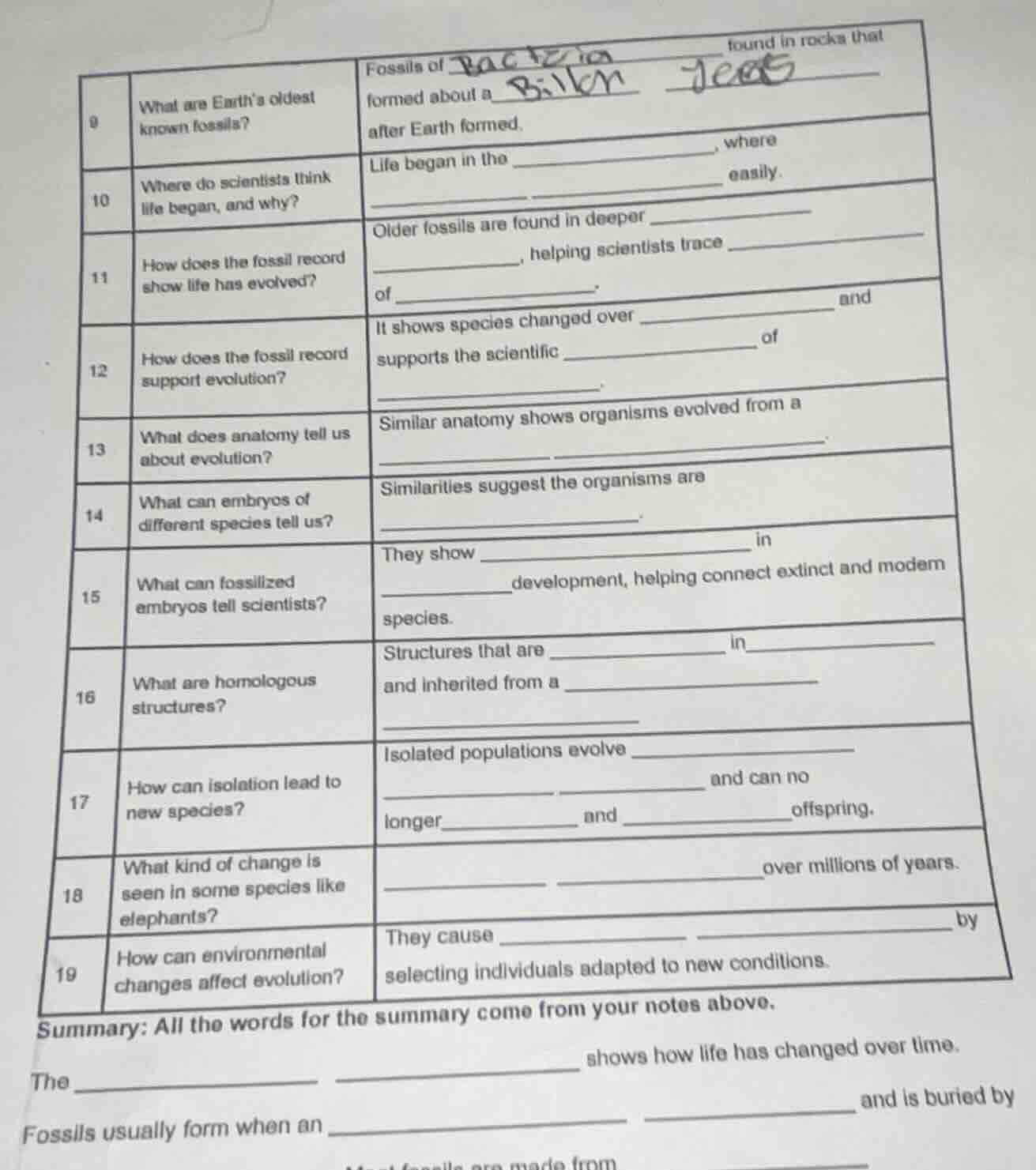
9 what are earth’s oldest known fossils? fossils of ____ found in rocks that formed about a __ __ after earth formed. 10 where do scientists think life began, and why? life began in the __, where __ __ easily. 11 how does the fossil record show life has evolved? older fossils are found in deeper __ __, helping scientists trace __ of __. 12 how does the fossil record support evolution? it shows species changed over __ and supports the scientific __ of __. 13 what does anatomy tell us about evolution? similar anatomy shows organisms evolved from a __ __. 14 what can embryos of different species tell us? similarities suggest the organisms are __. 15 what can fossilized embryos tell scientists? they show __ in __ development, helping connect extinct and modern species. 16 what are homologous structures? structures that are __ in __ and inherited from a __ __. 17 how can isolation lead to new species? isolated populations evolve __ __ and can no longer __ and __ offspring. 18 what kind of change is seen in some species like elephants? __ __ over millions of years. 19 how can environmental changes affect evolution? they cause __ __ by selecting individuals adapted to new conditions. summary: all the words for the summary come from your notes above. the __ __ shows how life has changed over time. fossils usually form when an __ ____ and is buried by
To solve these fill - in - the - blank questions related to evolution and fossils, we can use our knowledge of biology (a sub - field of Natural Science) concepts:
Question 9
Earth's oldest known fossils are fossils of bacteria (specifically cyanobacteria - like organisms) found in rocks that formed about a billion years after Earth formed.
Question 10
Scientists think life began in the ocean (or “primordial ocean”), where organic molecules could form easily. The early Earth's atmosphere and ocean conditions were conducive to the formation of the building blocks of life, and the ocean provided a protected environment with a rich chemical mix.
Question 11
Older fossils are found in deeper rock layers, helping scientists trace the history of life. As sediment accumulates over time, older organisms that died earlier get buried deeper, and by studying the sequence of fossils in rock layers, we can see how life has changed.
Question 12
The fossil record shows species changed over time and supports the scientific theory of evolution. The fossil record provides a chronological sequence of organisms, showing the appearance, change, and extinction of species, which is strong evidence for evolution.
Question 13
Similar anatomy shows organisms evolved from a common ancestor. For example, the forelimbs of mammals (like human arms, bat wings, and whale flippers) have the same basic bone structure, indicating a shared evolutionary origin.
Question 14
Similarities in embryos of different species suggest the organisms are related (share a common ancestor). Embryonic development patterns, such as the presence of gill slits in vertebrate embryos, indicate evolutionary relationships.
Question 15
Fossilized embryos show changes in embryonic development, helping connect extinct and modern species. By studying fossilized embryos, we can see how the developmental processes of ancient organisms compare to those of today's organisms.
Question 16
Homologous structures are structures that are similar in structure and inherited from a common ancestor. These structures may have different functions in different organisms but share a similar underlying design.
Question 17
Isolated populations evolve different traits, genetically diverge and can no longer mate and produce fertile offspring. When populations are isolated (geographically, reproductively, etc.), different selection pressures and genetic drift lead to changes that can result in new species.
Question 18
In some species like elephants, we see gradual (or “slow”) change over millions of years. Evolution in many large organisms occurs over long time scales with relatively slow - paced changes in traits.
Question 19
Environmental changes cause natural selection by selecting individuals adapted to new conditions. When the environment changes (e.g., climate change, new predators, or new food sources), organisms with traits that help them survive and reproduce in the new environment are more likely to pass on their genes.
Summary
The fossil record shows how life has changed over time. Fossils usually form when an organism dies, is covered by sediment and is buried by... (the rest of the summary would follow the same biological principles of fossil formation, which involves the organism being quickly buried to prevent decay, and then undergoing processes like mineralization).

Snap & solve any problem in the app
Get step-by-step solutions on Sovi AI
Photo-based solutions with guided steps
Explore more problems and detailed explanations
s (filled in order for each question):
- bacteria; billion years
- ocean; organic molecules; form
- rock layers; history; life
- time; theory; evolution
- common ancestor
- related
- changes; embryonic
- similar; structure; common ancestor
- different traits; genetically diverge; mate; produce fertile
- gradual change (or "slow change")
- natural selection
Summary: fossil record; organism dies; is covered by sediment