QUESTION IMAGE
Question
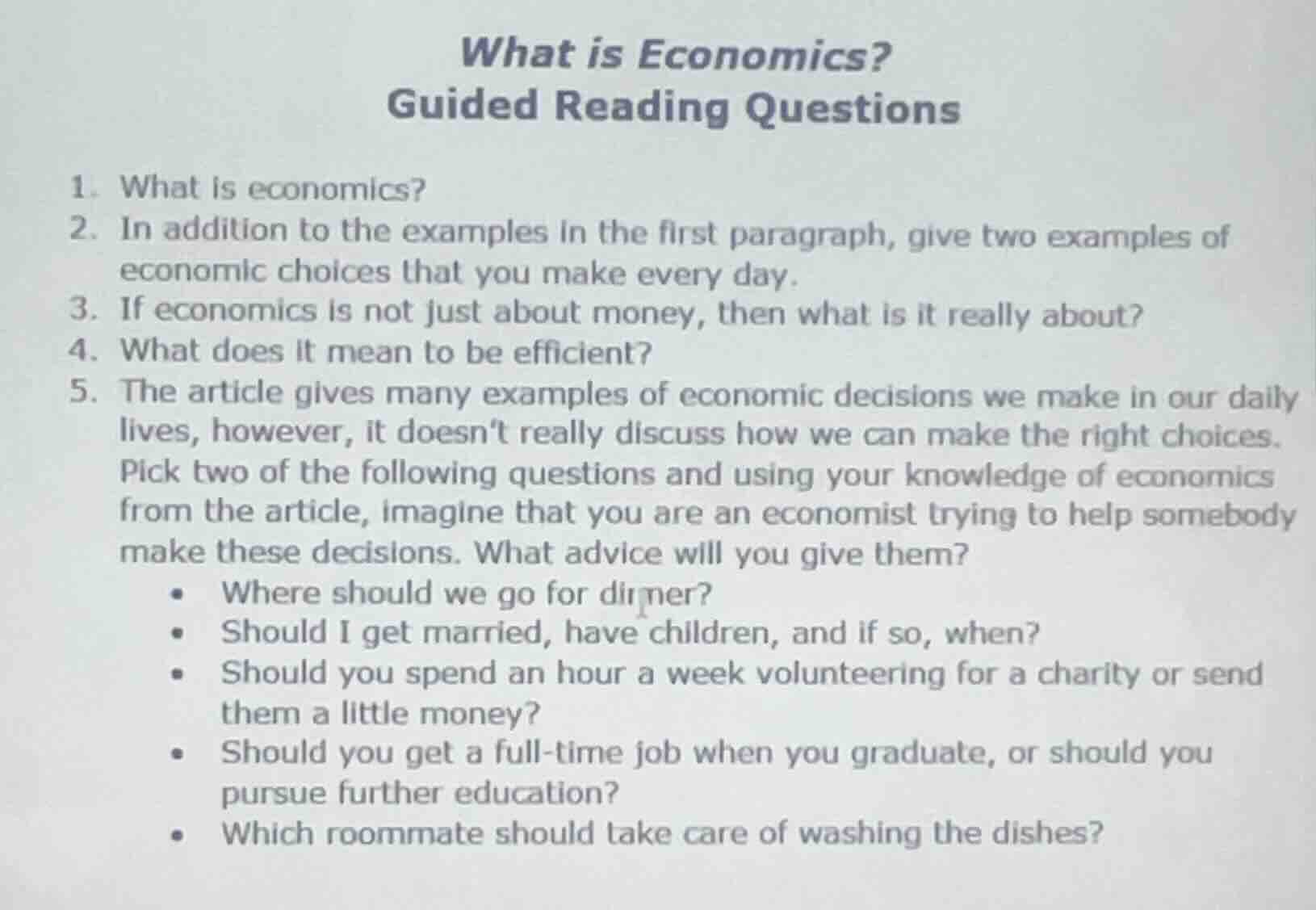
what is economics?
guided reading questions
- what is economics?
- in addition to the examples in the first paragraph, give two examples of
economic choices that you make every day.
- if economics is not just about money, then what is it really about?
- what does it mean to be efficient?
- the article gives many examples of economic decisions we make in our daily
lives, however, it doesnt really discuss how we can make the right choices.
pick two of the following questions and using your knowledge of economics
from the article, imagine that you are an economist trying to help somebody
make these decisions. what advice will you give them?
- where should we go for dinner?
- should i get married, have children, and if so, when?
- should you spend an hour a week volunteering for a charity or send
them a little money?
- should you get a full - time job when you graduate, or should you
pursue further education?
- which roommate should take care of washing the dishes?
Brief Explanations
- Economics is the social science that studies how individuals, businesses, governments, and societies allocate scarce resources to satisfy unlimited wants and needs, and the trade-offs, choices, and incentives involved in that process.
- Daily economic choices involve deciding how to use limited resources like time/money: choosing between making coffee at home or buying it, and picking between taking public transit or driving to work.
- Economics is fundamentally about making choices and managing trade-offs when resources are scarce, prioritizing which wants/needs to fulfill since not all can be met.
- Being efficient means allocating and using resources in a way that maximizes the production of goods and services without wasting resources; it means you cannot produce more of one good without giving up the production of another good that is valued more highly (productive efficiency), or distributing resources such that no one can be made better off without making someone else worse off (allocative efficiency).
- For the two selected questions:
- Should you get a full-time job when you graduate, or pursue further education?: Advise comparing the immediate opportunity cost of forgoing a full-time salary during further education against the long-term expected increase in earnings and career opportunities from additional qualifications. Also consider non-monetary factors like personal career goals and the time commitment required.
- Should you spend an hour a week volunteering for a charity or send them a little money?: Advise comparing the value of your time (what you could earn working that hour instead, if you donate the earnings) against the direct impact your volunteer labor has on the charity. If your hourly wage is higher than the cost of hiring someone to do the volunteer task, donating the money is more efficient; if your labor provides unique value the charity can't easily replace, volunteering may be better.

Snap & solve any problem in the app
Get step-by-step solutions on Sovi AI
Photo-based solutions with guided steps
Explore more problems and detailed explanations
- Economics is the study of how scarce resources are allocated to satisfy unlimited wants, focusing on choices and trade-offs.
- Example 1: Choosing to make breakfast at home instead of buying it. Example 2: Deciding to use a streaming service instead of buying physical media.
- Economics is about making choices and managing trade-offs with scarce resources to fulfill wants and needs.
- Efficiency means using resources to maximize value without waste; no better allocation exists without trade-offs.
5.
- For full-time job vs. further education: Compare short-term salary loss to long-term career/earning gains, plus personal goals.
- For volunteering vs. donating money: Compare your hourly earning potential to the unique impact of your volunteer labor.