QUESTION IMAGE
Question
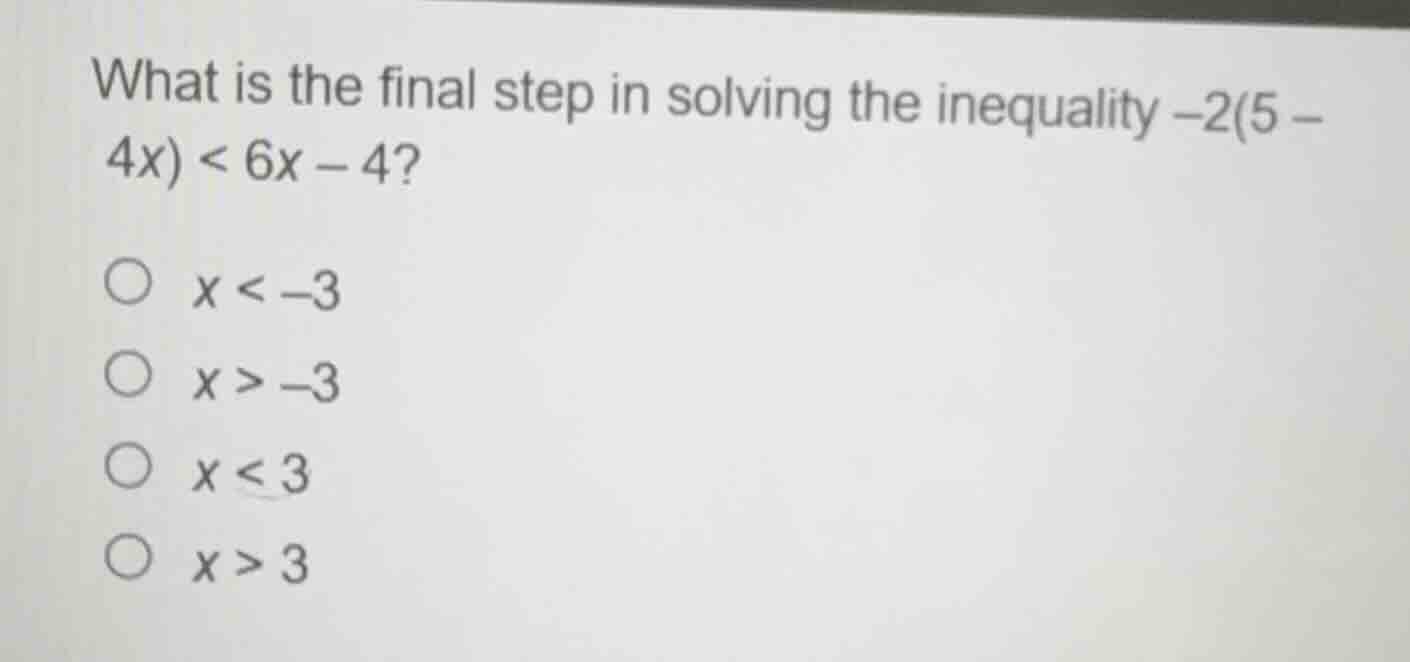
what is the final step in solving the inequality $-2(5 - 4x) < 6x - 4$?\
\\(\bigcirc\\) $x < -3$\
\\(\bigcirc\\) $x > -3$\
\\(\bigcirc\\) $x < 3$\
\\(\bigcirc\\) $x > 3$
Step1: Expand the left side
Using the distributive property \(a(b - c)=ab - ac\), we expand \(-2(5 - 4x)\) to get \(-10 + 8x\). So the inequality becomes \(-10 + 8x<6x - 4\).
Step2: Subtract \(6x\) from both sides
Subtracting \(6x\) from both sides to get the \(x\) terms on one side: \(-10 + 8x-6x<6x - 4-6x\), which simplifies to \(-10 + 2x<-4\).
Step3: Add 10 to both sides
Adding 10 to both sides to isolate the term with \(x\): \(-10 + 2x + 10<-4 + 10\), which simplifies to \(2x<6\).
Step4: Divide both sides by 2
Dividing both sides by 2 (since 2 is positive, the inequality sign remains the same): \(\frac{2x}{2}<\frac{6}{2}\), which gives \(x < 3\)? Wait, no, wait, let's check again. Wait, in step 2, when we have \(-10 + 8x<6x - 4\), subtract \(6x\) from both sides: \(8x-6x-10< - 4\), so \(2x-10 < - 4\). Then add 10 to both sides: \(2x<6\), divide by 2: \(x < 3\)? But wait, let's re - do the expansion correctly. Wait, the original inequality is \(-2(5 - 4x)<6x - 4\). Expanding the left side: \(-10+8x<6x - 4\). Subtract \(6x\) from both sides: \(8x - 6x-10<6x - 6x-4\), so \(2x-10 < - 4\). Then add 10 to both sides: \(2x<6\), divide by 2: \(x < 3\). But wait, let's check the options. Wait, maybe I made a mistake. Wait, no, let's check the calculation again. Wait, \(-2(5 - 4x)=-10 + 8x\). So \(-10 + 8x<6x - 4\). Subtract \(6x\) from both sides: \(2x-10 < - 4\). Add 10 to both sides: \(2x<6\). Divide by 2: \(x < 3\). So the final step gives \(x < 3\), which is option C (the third option: \(x < 3\)). Wait, but let's check the options again. The options are \(x < - 3\), \(x > - 3\), \(x < 3\), \(x > 3\). So the correct final step is \(x < 3\), so the answer is the option with \(x < 3\).
Wait, no, wait, I think I messed up the sign. Wait, let's start over.
Original inequality: \(-2(5 - 4x)<6x - 4\)
Step 1: Expand left side: \(-10 + 8x<6x - 4\)
Step 2: Subtract \(6x\) from both sides: \(8x-6x-10< - 4\) => \(2x-10 < - 4\)
Step 3: Add 10 to both sides: \(2x<6\)
Step 4: Divide both sides by 2: \(x < 3\). Yes, that's correct. So the final step is dividing by 2 to get \(x < 3\), so the answer is the option \(x < 3\) (the third option: \(x < 3\)).

Snap & solve any problem in the app
Get step-by-step solutions on Sovi AI
Photo-based solutions with guided steps
Explore more problems and detailed explanations
C. \(x < 3\)