QUESTION IMAGE
Question
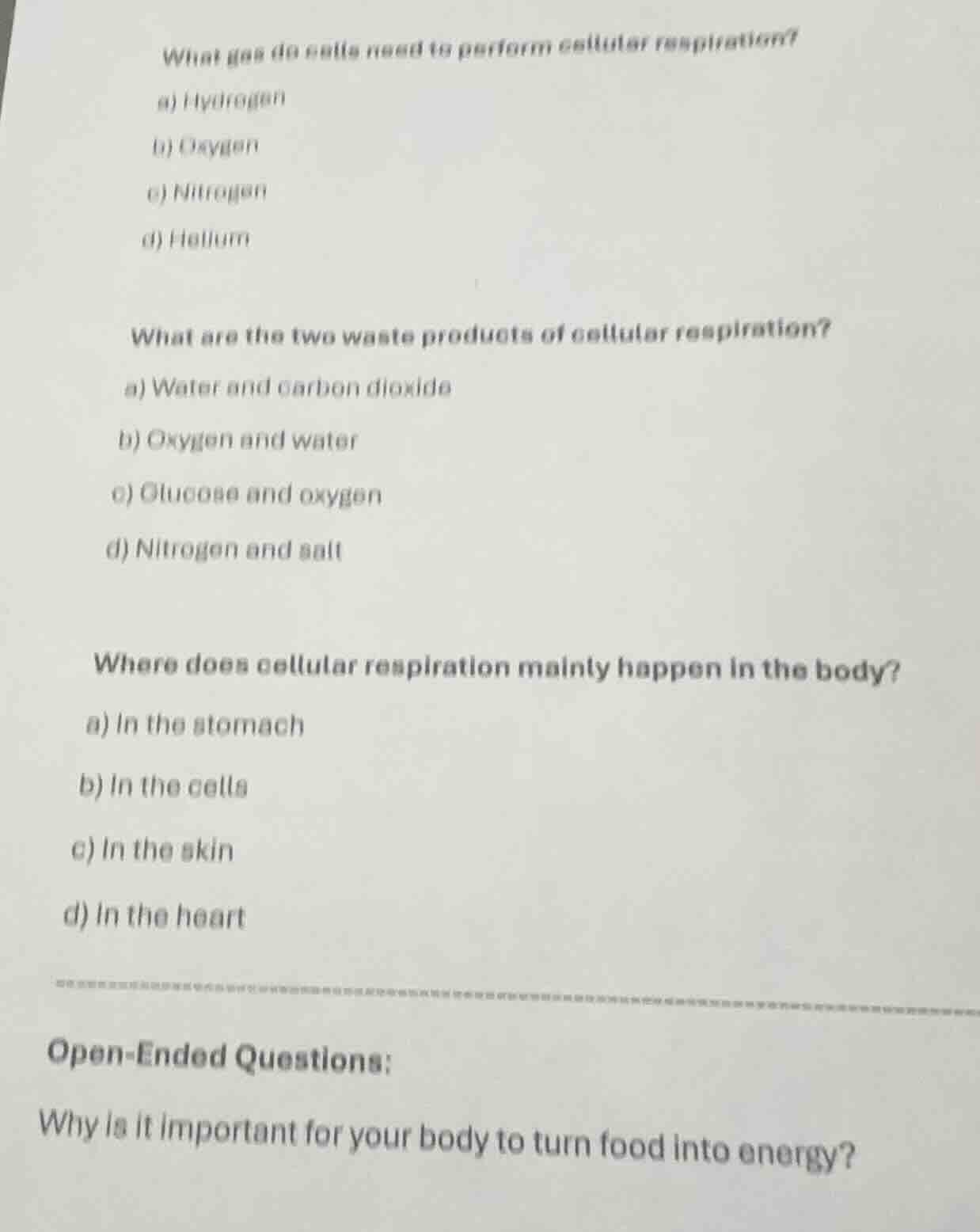
what gas do cells need to perform cellular respiration?
a) hydrogen
b) oxygen
c) nitrogen
d) helium
what are the two waste products of cellular respiration?
a) water and carbon dioxide
b) oxygen and water
c) glucose and oxygen
d) nitrogen and salt
where does cellular respiration mainly happen in the body?
a) in the stomach
b) in the cells
c) in the skin
d) in the heart
open - ended questions:
why is it important for your body to turn food into energy?
Multiple - Choice Questions
Question 1: What gas do cells need to perform cellular respiration?
Cellular respiration is the process by which cells break down glucose to release energy. The equation for aerobic cellular respiration is $C_{6}H_{12}O_{6}+6O_{2}
ightarrow6CO_{2}+6H_{2}O + Energy$. From this equation, we can see that oxygen ($O_{2}$) is required for the process. Hydrogen, nitrogen, and helium are not used in cellular respiration.
The chemical equation for aerobic cellular respiration is $C_{6}H_{12}O_{6}+6O_{2}
ightarrow6CO_{2}+6H_{2}O + Energy$. In this process, glucose and oxygen are reactants, and carbon dioxide ($CO_{2}$) and water ($H_{2}O$) are produced as waste products (along with energy). Oxygen is a reactant, glucose is a reactant, and nitrogen and salt are not involved in cellular respiration as waste products.
Cellular respiration is a process that occurs within the cells of an organism. The mitochondria within the cells are the main sites of cellular respiration, but the overall process is centered around the cells. The stomach is for digestion, the skin is for protection and other functions, and the heart is for pumping blood, none of which are the main sites of cellular respiration.

Snap & solve any problem in the app
Get step-by-step solutions on Sovi AI
Photo-based solutions with guided steps
Explore more problems and detailed explanations
b) Oxygen