QUESTION IMAGE
Question
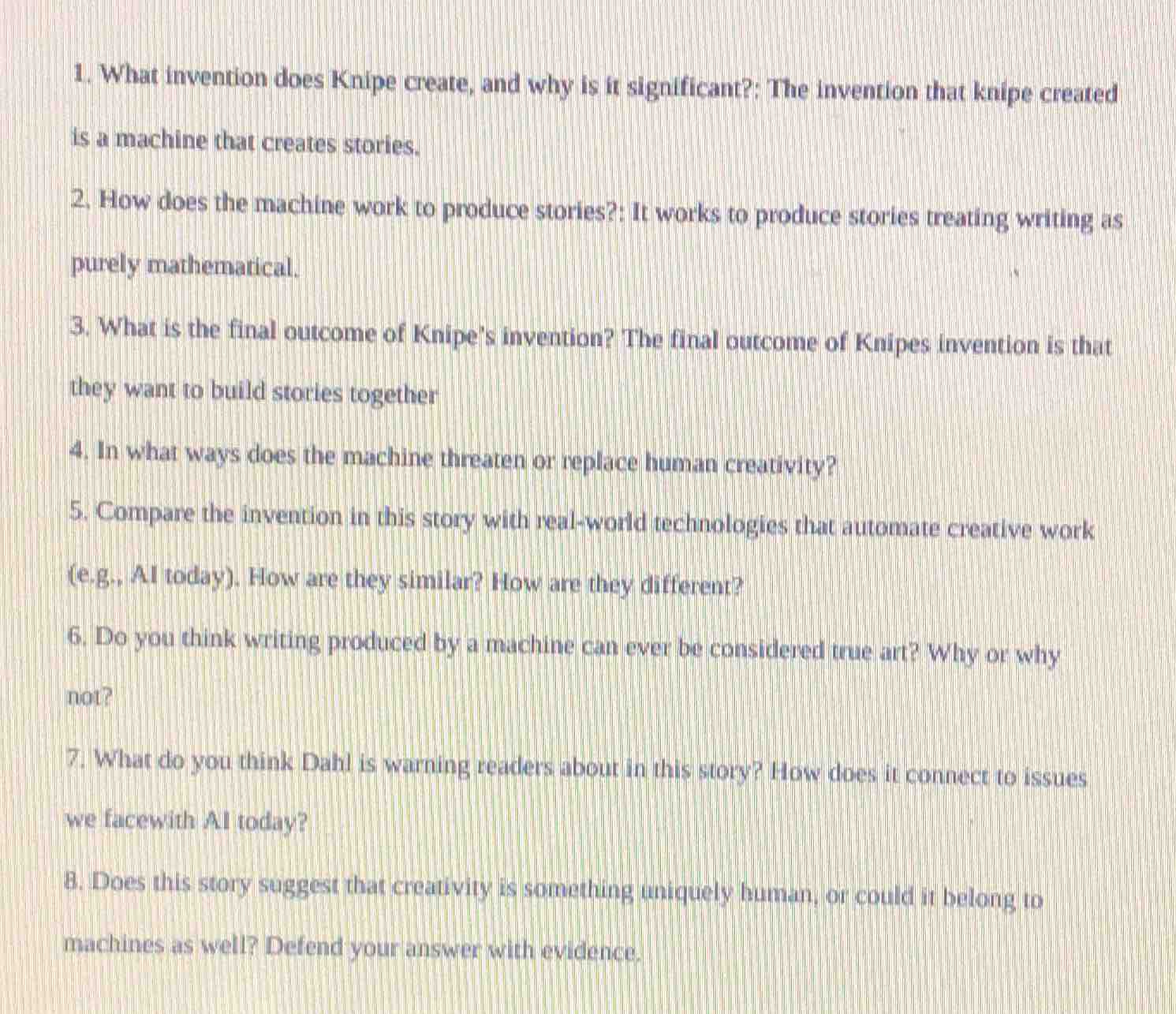
- what invention does knipe create, and why is it significant?: the invention that knipe created is a machine that creates stories.
- how does the machine work to produce stories?: it works to produce stories treating writing as purely mathematical.
- what is the final outcome of knipe’s invention? the final outcome of knipes invention is that they want to build stories together
- in what ways does the machine threaten or replace human creativity?
- compare the invention in this story with real - world technologies that automate creative work (e.g., ai today). how are they similar? how are they different?
- do you think writing produced by a machine can ever be considered true art? why or why not?
- what do you think dahl is warning readers about in this story? how does it connect to issues we face with ai today?
- does this story suggest that creativity is something uniquely human, or could it belong to machines as well? defend your answer with evidence.
To answer these questions, we'll address each one in order, using the provided text and relevant analysis:
Question 4: In what ways does the machine threaten or replace human creativity?
The machine treats writing as purely mathematical, potentially reducing creativity to a formulaic process. By automating story - creation, it could make humans reliant on it, diminishing their incentive to engage in creative writing themselves. It might also overshadow the unique, emotional, and experiential elements that human creativity brings, as it lacks human - like consciousness and personal experiences.
- Similarities: Both the story's machine and real - world AI for creative work aim to automate creative tasks (like story - writing for the machine, and content generation for AI). They use algorithms or mathematical - like processes to produce output.
- Differences: The story's machine is a more simplistic concept focused on story - creation through a mathematical approach. Real - world AI has access to vast datasets, can learn from diverse sources, and has more complex capabilities like understanding context, style, and even generating in multiple creative domains (art, music, writing). Also, real - world AI is often more interactive and can adapt to user feedback, while the story's machine is described in a more basic, less adaptive way.
- For considering it as art: If art is defined by its ability to evoke emotion or convey a message, machine - generated writing can achieve this. For example, some AI - generated poems or stories have resonated with people. Also, the process of creating machine - generated writing can involve human - designed algorithms and datasets, so there is a human element in its creation.
- Against considering it as art: True art is often seen as a product of human creativity, emotion, and personal experience. Machines lack consciousness, emotions, and personal experiences. So, their writing is a product of algorithms rather than true creative expression. For example, a human writer's work is influenced by their life, feelings, and unique perspective, which a machine cannot replicate.

Snap & solve any problem in the app
Get step-by-step solutions on Sovi AI
Photo-based solutions with guided steps
Explore more problems and detailed explanations
The machine threatens or replaces human creativity by treating writing as a purely mathematical process, which can reduce creative writing to a formulaic activity. It may also make humans dependent on it for story - creation, thus reducing human motivation to engage in creative writing. Additionally, it lacks the human - unique elements like emotional depth and personal experience that are integral to human creativity, and by automating the creative process, it could overshadow these human - generated creative aspects.