QUESTION IMAGE
Question
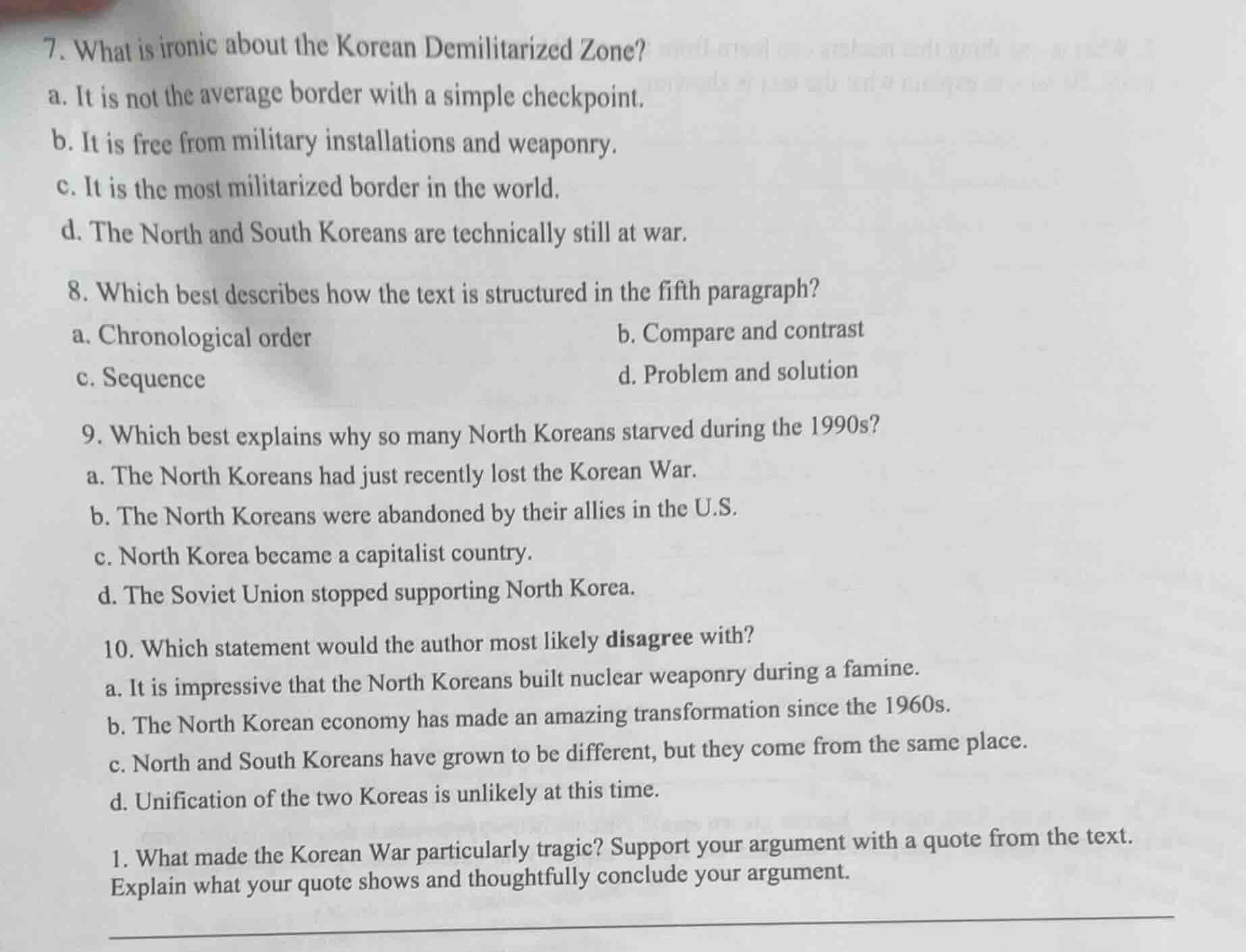
- what is ironic about the korean demilitarized zone?
a. it is not the average border with a simple checkpoint.
b. it is free from military installations and weaponry.
c. it is the most militarized border in the world.
d. the north and south koreans are technically still at war.
- which best describes how the text is structured in the fifth paragraph?
a. chronological order
b. compare and contrast
c. sequence
d. problem and solution
- which best explains why so many north koreans starved during the 1990s?
a. the north koreans had just recently lost the korean war.
b. the north koreans were abandoned by their allies in the u.s.
c. north korea became a capitalist country.
d. the soviet union stopped supporting north korea.
- which statement would the author most likely disagree with?
a. it is impressive that the north koreans built nuclear weaponry during a famine.
b. the north korean economy has made an amazing transformation since the 1960s.
c. north and south koreans have grown to be different, but they come from the same place.
d. unification of the two koreas is unlikely at this time.
- what made the korean war particularly tragic? support your argument with a quote from the text. explain what your quote shows and thoughtfully conclude your argument.
Question 7:
Irony lies in the contradiction between the zone's name ("Demilitarized Zone") and its actual status as the world's most heavily militarized border.
Question 8:
Note: Without the fifth paragraph text, this cannot be answered accurately. If assuming a common structure for Korean-related texts, no definitive choice can be made. For the purpose of this response, if we assume a compare/contrast structure (common in texts about North and South Korea), but this is a speculative assumption.
Question 9:
In the 1990s, the collapse of the Soviet Union ended critical economic and food aid to North Korea, which was a primary cause of the widespread famine.
Question 10:
North Korea's economy has struggled significantly since the 1960s, with ongoing issues like food shortages and limited development, so the author would disagree with the claim of an amazing transformation.
Question 1 (Essay):
Note: Without the associated text, a direct quote cannot be provided. However, the Korean War was tragic because it split a single, culturally unified nation into two hostile states, leading to decades of separation, family division, and ongoing military tension. A hypothetical supporting quote could be: "Over 10 million Korean families were separated by the war's dividing line, never to see one another again." This quote illustrates the human cost of the war, as it tore apart communities and families that had shared a common identity. The tragedy is amplified by the fact that the division remains in place today, with the two Koreas still in a state of unresolved conflict, ensuring the war's trauma persists across generations.

Snap & solve any problem in the app
Get step-by-step solutions on Sovi AI
Photo-based solutions with guided steps
Explore more problems and detailed explanations
- c. It is the most militarized border in the world.
- (Cannot be definitively answered without the fifth paragraph text; if speculative, no valid answer can be provided)
- d. The Soviet Union stopped supporting North Korea.
- b. The North Korean economy has made an amazing transformation since the 1960s.
- (Full answer requires the source text for a valid quote; the core tragic element is the permanent division of a unified Korean nation, causing intergenerational family separation and ongoing conflict. A sample structured answer would include a text quote, explanation of its connection to the tragedy, and a concluding statement on the war's lasting harm.)