QUESTION IMAGE
Question
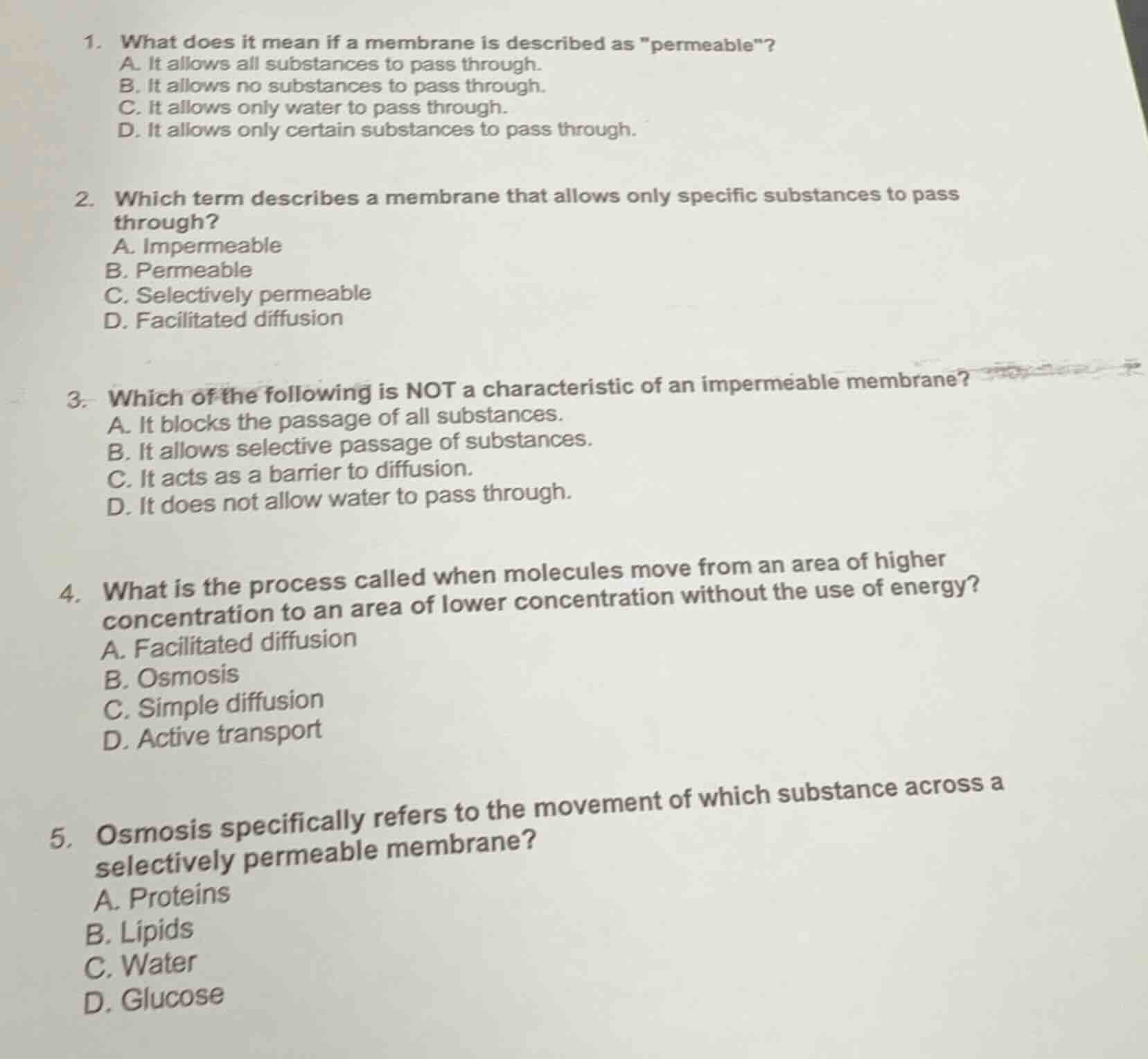
- what does it mean if a membrane is described as \permeable\?
a. it allows all substances to pass through.
b. it allows no substances to pass through.
c. it allows only water to pass through.
d. it allows only certain substances to pass through.
- which term describes a membrane that allows only specific substances to pass through?
a. impermeable
b. permeable
c. selectively permeable
d. facilitated diffusion
- which of the following is not a characteristic of an impermeable membrane?
a. it blocks the passage of all substances.
b. it allows selective passage of substances.
c. it acts as a barrier to diffusion.
d. it does not allow water to pass through.
- what is the process called when molecules move from an area of higher concentration to an area of lower concentration without the use of energy?
a. facilitated diffusion
b. osmosis
c. simple diffusion
d. active transport
- osmosis specifically refers to the movement of which substance across a selectively permeable membrane?
a. proteins
b. lipids
c. water
d. glucose
Question 1
To determine the meaning of a "permeable" membrane, we recall the definition: a permeable membrane allows all substances to pass through. Option A states this, while B is impermeable, C is for a membrane allowing only water (like in osmosis but not permeable), and D is selectively permeable.
A selectively permeable membrane allows only specific substances to pass. Impermeable (A) blocks all, permeable (B) allows all, and facilitated diffusion (D) is a transport process, not a membrane type. So C matches.
An impermeable membrane blocks all substances. Option B (allows selective passage) is a characteristic of selectively permeable, not impermeable. A, C, D fit impermeable’s traits.

Snap & solve any problem in the app
Get step-by-step solutions on Sovi AI
Photo-based solutions with guided steps
Explore more problems and detailed explanations
A. It allows all substances to pass through.