QUESTION IMAGE
Question
7.
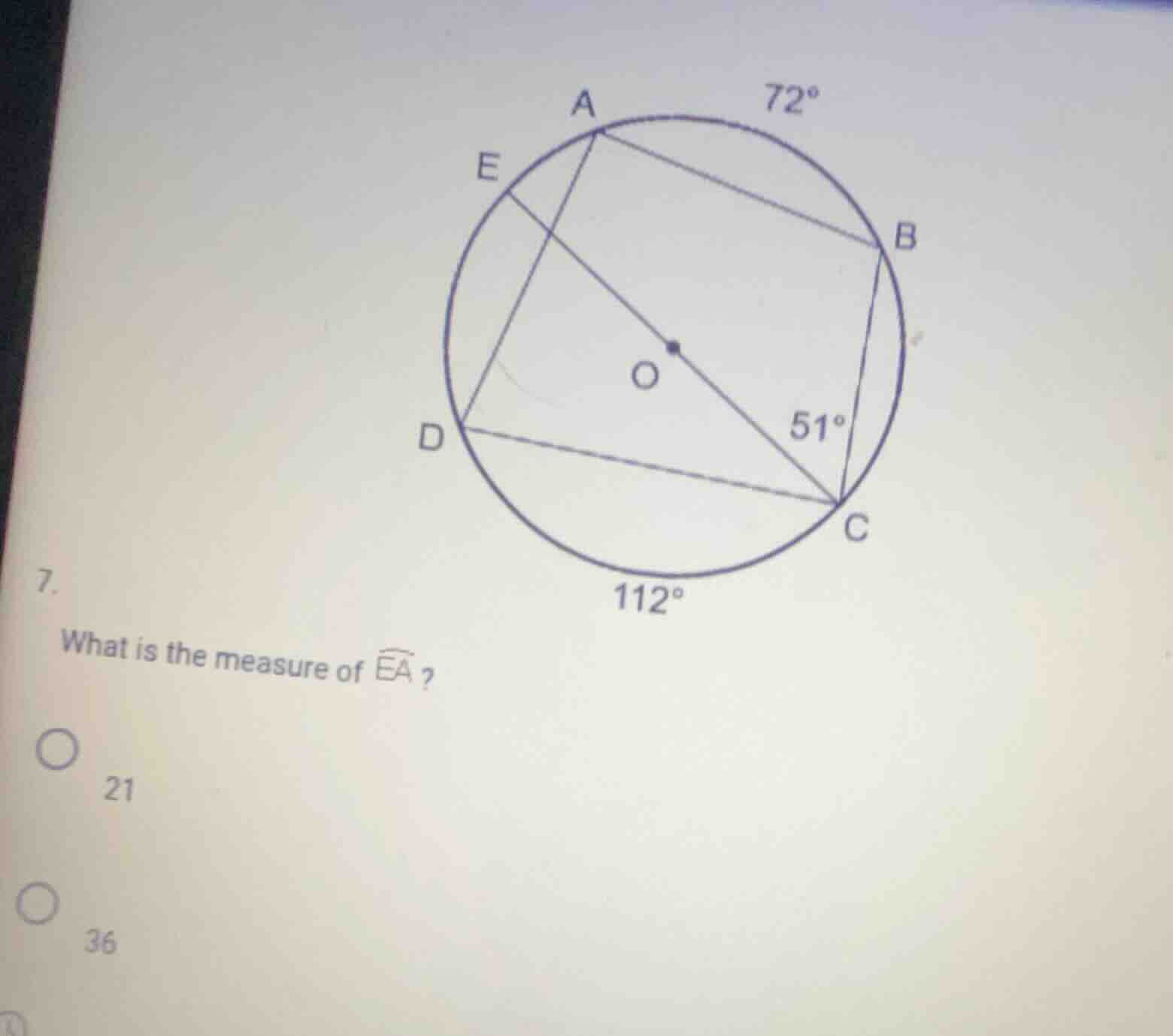
what is the measure of $widehat{ea}$?
$circ$ 21
$circ$ 36
Step1: Recall the total degrees in a circle
A circle has \( 360^\circ \). Also, since \( AC \) is a diameter (as \( O \) is the center and \( AC \) passes through \( O \)), the arc \( ABC \) and arc \( ADC \) should relate, but first, let's find the measure of arc \( AB \) and arc \( BC \), arc \( CD \), then find arc \( EA \). Wait, first, let's note the given arcs: arc \( AB = 72^\circ \), arc \( CD = 112^\circ \), and angle \( \angle BCA = 51^\circ \). Wait, maybe we can use inscribed angles or the fact that the total circumference is \( 360^\circ \). Wait, also, since \( AC \) is a diameter, the arc \( AC \) is \( 180^\circ \)? Wait, no, if \( O \) is the center, then \( AC \) is a diameter, so the arc \( AC \) is \( 180^\circ \). Wait, maybe first find arc \( BC \). The inscribed angle \( \angle BAC \) or \( \angle BCA \)? Wait, angle \( \angle BCA = 51^\circ \), which is an inscribed angle. The inscribed angle theorem says that an inscribed angle is half the measure of its intercepted arc. So angle \( \angle BCA \) intercepts arc \( AB \)? No, angle \( \angle BCA \) is at point \( C \), between \( B \) and \( A \), so it intercepts arc \( AB \)? Wait, no, angle \( \angle BCA \) is formed by chords \( BC \) and \( AC \), so it intercepts arc \( AB \). Wait, no, the intercepted arc is the arc that is opposite the angle, i.e., the arc that is not containing the angle's vertex. So angle \( \angle BCA \) intercepts arc \( AB \). Wait, but the measure of an inscribed angle is half the measure of its intercepted arc. So \( \angle BCA = \frac{1}{2} \) arc \( AB \)? But arc \( AB \) is given as \( 72^\circ \), so \( \frac{1}{2} \times 72^\circ = 36^\circ \), but the angle is \( 51^\circ \). Hmm, maybe I made a mistake. Wait, maybe \( AC \) is a diameter, so arc \( AC \) is \( 180^\circ \). So arc \( AB + arc BC = 180^\circ \)? Wait, arc \( AB = 72^\circ \), so arc \( BC = 180^\circ - 72^\circ = 108^\circ \)? No, that contradicts the angle. Wait, maybe the diagram is different. Wait, let's try to sum all arcs: arc \( AB + arc BC + arc CD + arc DE + arc EA = 360^\circ \). Wait, no, the circle is \( 360^\circ \), so arc \( AB + arc BC + arc CD + arc DE + arc EA = 360^\circ \). Wait, but we know arc \( AB = 72^\circ \), arc \( CD = 112^\circ \), and we need to find arc \( EA \). Wait, maybe first find arc \( BC \) and arc \( DE \). Wait, another approach: since \( AC \) is a diameter (because \( O \) is the center, so \( AC \) passes through \( O \)), so arc \( AC = 180^\circ \). So arc \( AB + arc BC = 180^\circ \). Arc \( AB = 72^\circ \), so arc \( BC = 180^\circ - 72^\circ = 108^\circ \)? But then angle \( \angle BCA = 51^\circ \), which should be half of arc \( AB \)? Wait, no, maybe I messed up. Wait, let's check the total arcs. The circle is \( 360^\circ \), so arc \( AB + arc BC + arc CD + arc DE + arc EA = 360^\circ \). We know arc \( AB = 72^\circ \), arc \( CD = 112^\circ \), and we need to find arc \( EA \). Also, maybe arc \( DE + arc EA + arc AB + arc BC + arc CD = 360^\circ \). Wait, but we need to find arc \( BC \) and arc \( DE \). Wait, maybe arc \( BC \) can be found using the inscribed angle. Wait, angle \( \angle BCA = 51^\circ \), which is an inscribed angle intercepting arc \( AB \)? No, angle \( \angle BCA \) is at \( C \), so the intercepted arc is \( AB \), so \( \angle BCA = \frac{1}{2} arc AB \), but \( arc AB = 72^\circ \), so \( \angle BCA = 36^\circ \), but the diagram shows \( 51^\circ \). Maybe my initial assumption is wrong. Wait, maybe \( AC \) is not a diameter? Wait, the center is \( O \), so \( AC \)…

Snap & solve any problem in the app
Get step-by-step solutions on Sovi AI
Photo-based solutions with guided steps
Explore more problems and detailed explanations
36