QUESTION IMAGE
Question
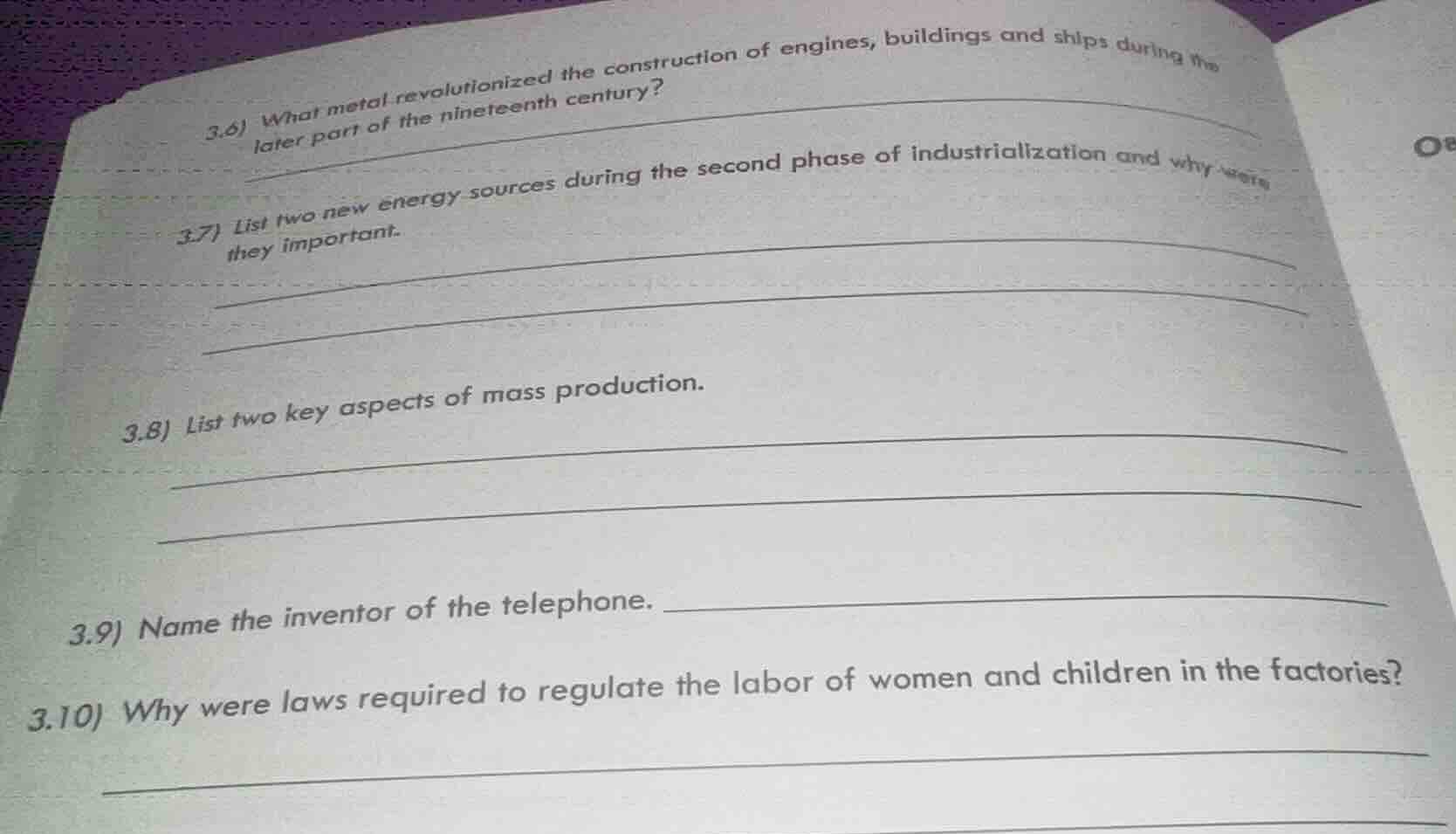
3.6) what metal revolutionized the construction of engines, buildings and ships during the later part of the nineteenth century?
3.7) list two new energy sources during the second phase of industrialization and why were they important.
3.8) list two key aspects of mass production.
3.9) name the inventor of the telephone.
3.10) why were laws required to regulate the labor of women and children in the factories?
3.6)
The metal that revolutionized construction of engines, buildings, and ships in the later 19th century is steel. The Bessemer process (and other steel - making advancements) made steel production cheaper and more efficient. Steel is stronger and more durable than iron, so it was ideal for large - scale construction projects like engines, buildings, and ships.
- Electricity:
- It was important because it powered new inventions like electric lights, motors, and machinery. It enabled the development of new industries (e.g., electrical equipment manufacturing) and improved working conditions in factories (by providing better lighting).
- It also allowed for the development of public utilities, changing daily life (e.g., electric streetlights, home electricity).
- Petroleum (and its product, gasoline):
- It was important as it powered internal combustion engines. This led to the development of the automobile industry and the aviation industry later on. It also provided a more efficient and portable fuel source compared to coal for many applications.
- Assembly Line Production:
- In an assembly line, a product moves from one workstation to another, with each worker performing a specific, repetitive task. This greatly increased the speed of production. For example, Henry Ford's use of the assembly line for cars reduced production time and cost.
- Standardization of Parts:
- Parts were made to be identical (standardized). This meant that parts could be easily replaced, and production was more efficient as there was no need to custom - make parts for each product. It also allowed for mass production as the same machinery and processes could be used for all parts of a certain type.

Snap & solve any problem in the app
Get step-by-step solutions on Sovi AI
Photo-based solutions with guided steps
Explore more problems and detailed explanations
Steel