QUESTION IMAGE
Question
what is the overall equation for photosynthesis?
what is the purpose of photosynthesis? why do plants do it?
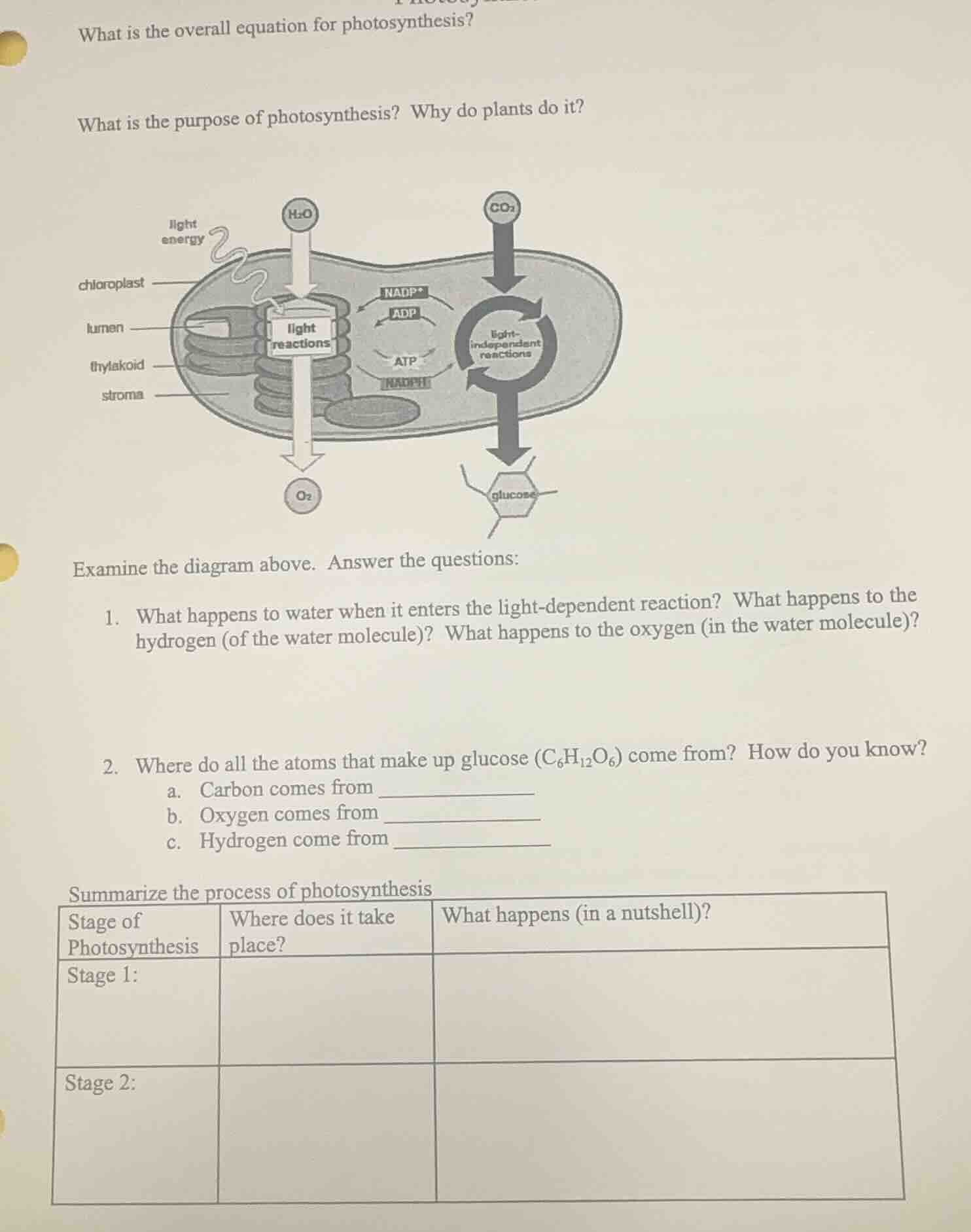
examine the diagram above. answer the questions:
- what happens to water when it enters the light - dependent reaction? what happens to the hydrogen (of the water molecule)? what happens to the oxygen (in the water molecule)?
- where do all the atoms that make up glucose ($c_6h_{12}o_6$) come from? how do you know?
a. carbon comes from
b. oxygen comes from
c. hydrogen come from
summarize the process of photosynthesis
| stage of photosynthesis | where does it take place? | what happens (in a nutshell)? |
|---|---|---|
| stage 2: |
Overall Equation for Photosynthesis
The overall chemical equation for photosynthesis is:
$$6\ce{CO_2} + 6\ce{H_2O} + \text{Light Energy} \xrightarrow{\text{Chlorophyll}} \ce{C_6H_{12}O_6} + 6\ce{O_2}$$
Purpose of Photosynthesis
Plants perform photosynthesis to produce glucose (a carbohydrate), which serves as a source of chemical energy (stored in its bonds) and as a building block for other organic molecules (like cellulose, starch, proteins, etc.). The energy from glucose powers the plant’s metabolic processes (e.g., growth, repair, reproduction).
Question 1: Water in Light - Dependent Reactions
- What happens to water? In the light - dependent reactions (occurring in the thylakoid membranes), water ($\ce{H_2O}$) is split (photolysis).
- What happens to hydrogen? The hydrogen atoms (and their electrons) from water are used to reduce $\text{NADP}^+$ to $\text{NADPH}$ (a carrier of reducing power) and also help generate ATP (via the electron transport chain and chemiosmosis).
- What happens to oxygen? The oxygen atoms from water are released as molecular oxygen ($\ce{O_2}$) into the atmosphere (this is the oxygen we breathe).
Question 2: Atoms in Glucose
a. Carbon: Comes from carbon dioxide ($\ce{CO_2}$). The light - independent reactions (Calvin cycle) use $\ce{CO_2}$ as the source of carbon to build glucose.
b. Oxygen: Comes from carbon dioxide ($\ce{CO_2}$) (and some from water, but most of the oxygen in glucose is from $\ce{CO_2}$; the oxygen from water is released as $\ce{O_2}$).
c. Hydrogen: Comes from water ($\ce{H_2O}$). The hydrogen from split water is used to reduce $\text{NADP}^+$ to $\text{NADPH}$, and this $\text{NADPH}$ then provides the hydrogen (and electrons) needed to build glucose in the Calvin cycle.
Summarize Photosynthesis (Table)
| Stage of Photosynthesis | Where does it take place? | What happens (in a nutshell)? |
|---|---|---|
| Stage 2: Light - Independent Reactions (Calvin Cycle) | Stroma (inside chloroplasts) | $\ce{CO_2}$ is fixed (incorporated into organic molecules). Using ATP (energy) and $\text{NADPH}$ (reducing power) from the light - dependent reactions, glucose ($\ce{C_6H_{12}O_6}$) is synthesized. |

Snap & solve any problem in the app
Get step-by-step solutions on Sovi AI
Photo-based solutions with guided steps
Explore more problems and detailed explanations
Overall Equation for Photosynthesis
The overall chemical equation for photosynthesis is:
$$6\ce{CO_2} + 6\ce{H_2O} + \text{Light Energy} \xrightarrow{\text{Chlorophyll}} \ce{C_6H_{12}O_6} + 6\ce{O_2}$$
Purpose of Photosynthesis
Plants perform photosynthesis to produce glucose (a carbohydrate), which serves as a source of chemical energy (stored in its bonds) and as a building block for other organic molecules (like cellulose, starch, proteins, etc.). The energy from glucose powers the plant’s metabolic processes (e.g., growth, repair, reproduction).
Question 1: Water in Light - Dependent Reactions
- What happens to water? In the light - dependent reactions (occurring in the thylakoid membranes), water ($\ce{H_2O}$) is split (photolysis).
- What happens to hydrogen? The hydrogen atoms (and their electrons) from water are used to reduce $\text{NADP}^+$ to $\text{NADPH}$ (a carrier of reducing power) and also help generate ATP (via the electron transport chain and chemiosmosis).
- What happens to oxygen? The oxygen atoms from water are released as molecular oxygen ($\ce{O_2}$) into the atmosphere (this is the oxygen we breathe).
Question 2: Atoms in Glucose
a. Carbon: Comes from carbon dioxide ($\ce{CO_2}$). The light - independent reactions (Calvin cycle) use $\ce{CO_2}$ as the source of carbon to build glucose.
b. Oxygen: Comes from carbon dioxide ($\ce{CO_2}$) (and some from water, but most of the oxygen in glucose is from $\ce{CO_2}$; the oxygen from water is released as $\ce{O_2}$).
c. Hydrogen: Comes from water ($\ce{H_2O}$). The hydrogen from split water is used to reduce $\text{NADP}^+$ to $\text{NADPH}$, and this $\text{NADPH}$ then provides the hydrogen (and electrons) needed to build glucose in the Calvin cycle.
Summarize Photosynthesis (Table)
| Stage of Photosynthesis | Where does it take place? | What happens (in a nutshell)? |
|---|---|---|
| Stage 2: Light - Independent Reactions (Calvin Cycle) | Stroma (inside chloroplasts) | $\ce{CO_2}$ is fixed (incorporated into organic molecules). Using ATP (energy) and $\text{NADPH}$ (reducing power) from the light - dependent reactions, glucose ($\ce{C_6H_{12}O_6}$) is synthesized. |