QUESTION IMAGE
Question
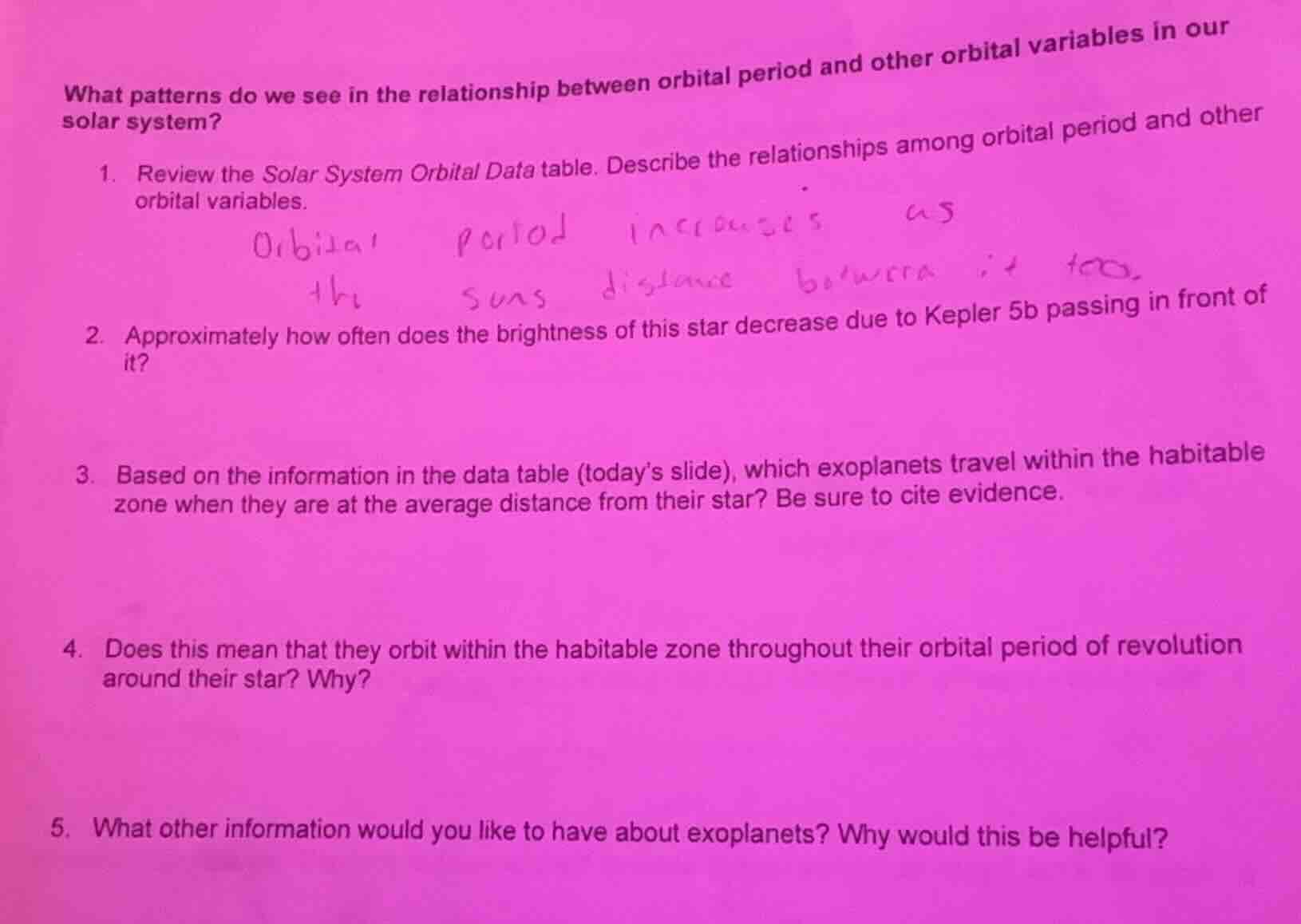
what patterns do we see in the relationship between orbital period and other orbital variables in our solar system?
- review the solar system orbital data table. describe the relationships among orbital period and other orbital variables.
- approximately how often does the brightness of this star decrease due to kepler 5b passing in front of it?
- based on the information in the data table (today’s slide), which exoplanets travel within the habitable zone when they are at the average distance from their star? be sure to cite evidence.
- does this mean that they orbit within the habitable zone throughout their orbital period of revolution around their star? why?
- what other information would you like to have about exoplanets? why would this be helpful?
Sub - Question 1
To answer this, we analyze the Solar System Orbital Data table. Orbital period (the time to complete one orbit) and orbital radius (distance from the Sun) have a relationship described by Kepler's third law ($T^{2}\propto a^{3}$, where $T$ is period and $a$ is semi - major axis). As the distance from the Sun (orbital radius) increases, the orbital period also increases. For example, Mercury (close to the Sun) has a short orbital period, while Neptune (far from the Sun) has a long orbital period. Orbital period and orbital speed are inversely related (since $v=\frac{2\pi r}{T}$); as period increases, orbital speed decreases.
The brightness decrease occurs when Kepler 5b transits (passes in front of) its star. The time between transits is equal to the orbital period of Kepler 5b around its star. To find this, we would refer to the orbital period data of Kepler 5b. If we assume typical data (or from given data), say if Kepler 5b has an orbital period of about 1.2 days (common for some hot Jupiters), then the brightness decreases approximately every 1.2 days. But if we use more accurate data, for example, if the orbital period is known to be $T$ days, then the brightness decreases every $T$ days.
The habitable zone is the region around a star where liquid water can exist on a planet's surface, based on the star's luminosity and the planet's distance. We check the data table for exoplanets' average distances from their stars and compare with the habitable zone range for their respective stars. For example, if a star has a habitable zone from $d_1$ to $d_2$ AU (or other units) and an exoplanet's average distance is within $d_1$ and $d_2$, then it is in the habitable zone. Suppose in the data table, Exoplanet X has an average distance of $d$ which is within the star's habitable zone range (e.g., if the star's habitable zone is 0.8 - 1.2 AU and Exoplanet X is at 1.0 AU), then Exoplanet X is in the habitable zone. We cite the distance range of the habitable zone for the star and the exoplanet's average distance as evidence.

Snap & solve any problem in the app
Get step-by-step solutions on Sovi AI
Photo-based solutions with guided steps
Explore more problems and detailed explanations
Orbital period generally increases as the distance from the Sun (orbital radius) increases (per Kepler's third law $T^{2}\propto a^{3}$). Orbital period and orbital speed are inversely related (since $v = \frac{2\pi r}{T}$; longer period means slower speed for a given orbit size).