QUESTION IMAGE
Question
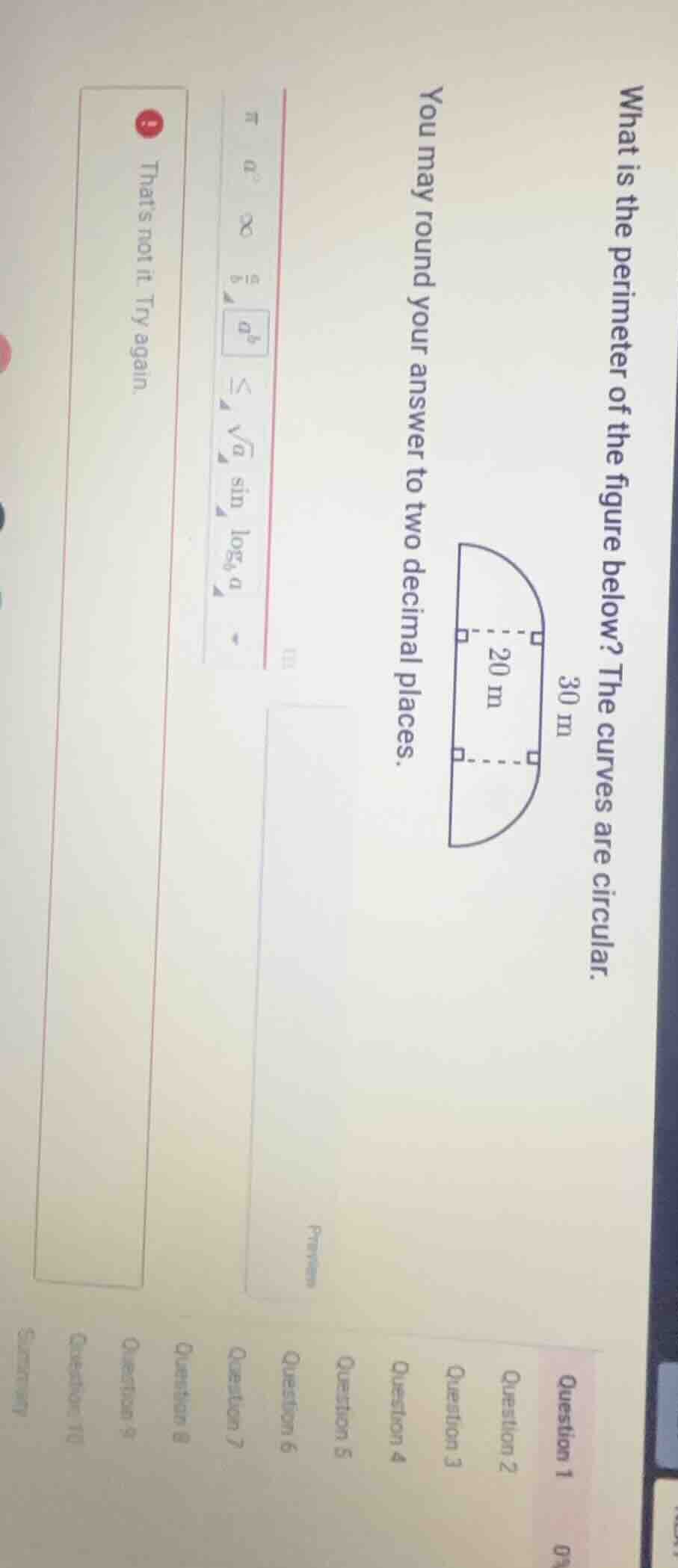
what is the perimeter of the figure below? the curves are circular. 30 m 20 m you may round your answer to two decimal places. thats not it. try again.
Step1: Identify the components of the perimeter
The figure's perimeter consists of two straight sides (each 30 m) and two semicircular arcs (which together make a full circle). The diameter of the circle is 20 m, so the radius \( r = \frac{20}{2}=10 \) m.
Step2: Calculate the length of the circular part
The circumference of a full circle is \( C = 2\pi r \) or \( C=\pi d \) (where \( d \) is the diameter). Here, using \( d = 20 \) m, the circumference is \( \pi\times20 = 20\pi \) m.
Step3: Calculate the length of the straight parts
There are two straight sides, each 30 m, so their total length is \( 2\times30 = 60 \) m.
Step4: Calculate the total perimeter
Add the length of the circular part and the straight parts: \( P = 20\pi+ 60 \).
Now, compute the numerical value: \( 20\pi\approx20\times3.1416 = 62.832 \), then \( P\approx62.832 + 60=122.832 \). Rounding to two decimal places, we get \( 122.83 \) m. Wait, wait, no, wait. Wait, the diameter of each semicircle: wait, looking at the figure, the dashed line is 20 m, so the diameter of each semicircle is 20 m? Wait, no, maybe I misread. Wait, the two semicircles: if we put them together, they form a circle with diameter 20 m? Wait, no, wait the straight sides are 30 m, and the curved parts: let's re - examine. Wait, the figure: two vertical sides (30 m each) and two semicircular arcs (top and bottom). Wait, the diameter of each semicircle is 20 m? Wait, no, the distance between the two vertical sides (the dashed line) is 20 m, so the diameter of the semicircles is 20 m. So the two semicircles (top and bottom) make a full circle with diameter 20 m. So the circumference of the circle is \( \pi d=20\pi \). The two straight sides: each is 30 m, so two of them: \( 30\times2 = 60 \) m. Then total perimeter: \( 20\pi+60 \). Let's calculate \( 20\pi\approx62.83 \), so \( 62.83 + 60 = 122.83 \) m? Wait, but maybe I made a mistake in the diameter. Wait, maybe the radius is 20 m? Wait, the dashed line is 20 m, maybe that's the radius? Wait, the right angles: the dashed line is 20 m, maybe the diameter is 40 m? Wait, no, the figure: let's look again. The user's figure: the dashed line is 20 m, with right angles, so the distance between the two vertical sides (the horizontal dashed line) is 20 m, so the diameter of each semicircle is 20 m. Wait, no, if the dashed line is 20 m, and it's the distance between the two vertical lines, then the diameter of the semicircles (which are on the top and bottom) is 20 m. So the two semicircles (top and bottom) form a circle with diameter 20 m. So circumference is \( \pi d = 20\pi \). The two vertical sides: 30 m each, so \( 30\times2=60 \) m. Then total perimeter: \( 20\pi + 60\approx62.83+60 = 122.83 \) m. But wait, maybe I messed up the diameter. Wait, maybe the 20 m is the radius? Let's check: if the radius is 20 m, then the diameter is 40 m, circumference is \( 40\pi\approx125.66 \), and the straight sides: \( 30\times2 = 60 \), total perimeter \( 125.66+60 = 185.66 \) m. But that seems too big. Wait, the original problem: the user's figure: "the curves are circular". Let's re - interpret. The figure has two straight segments of 30 m each, and two semicircular arcs. The length of the semicircular arc: the formula for the length of a semicircle is \( \frac{1}{2}\pi d \). If there are two semicircles, their total length is \( \pi d \). Now, what is \( d \)? The distance between the two straight segments (the horizontal dashed line) is 20 m, so \( d = 20 \) m. So the length of the two semicircles is \( \pi\times20=20\pi\approx62.83 \) m. The two…

Snap & solve any problem in the app
Get step-by-step solutions on Sovi AI
Photo-based solutions with guided steps
Explore more problems and detailed explanations
\( 122.83 \) meters (rounded to two decimal places)