QUESTION IMAGE
Question
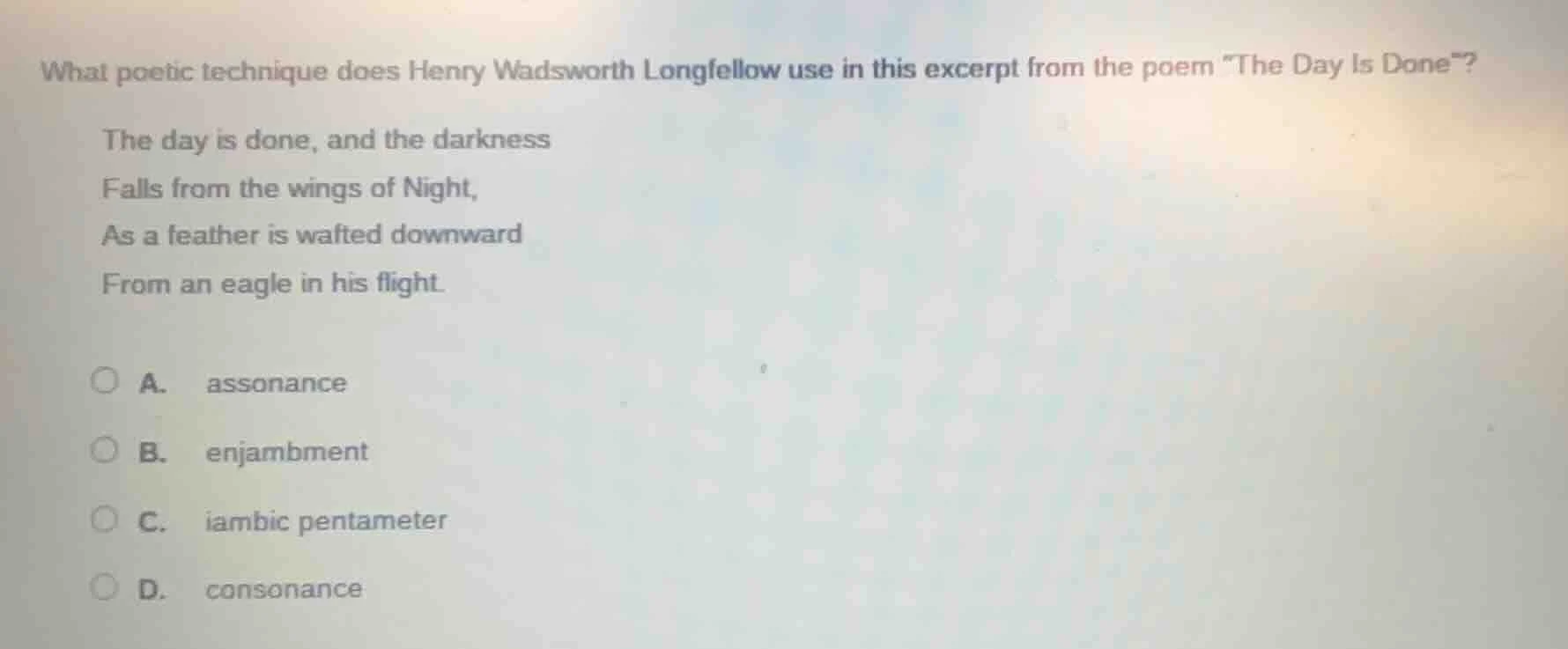
what poetic technique does henry wadsworth longfellow use in this excerpt from the poem \the day is done\?
the day is done, and the darkness
falls from the wings of night,
as a feather is wafted downward
from an eagle in his flight.
a. assonance
b. enjambment
c. iambic pentameter
d. consonance
To determine the poetic technique, we analyze each option:
- Option A (assonance): Assonance is the repetition of vowel sounds. In the excerpt, vowel sounds like the long "a" in "day", "darkness", "wings", "wafted", "eagle", and "flight" (or other vowel repetitions) are not the main technique here.
- Option B (enjambment): Enjambment is when a sentence or phrase runs over a line break without punctuation. The lines here end with punctuation or natural pauses, so enjambment is not present.
- Option C (iambic pentameter): Iambic pentameter has 10 syllables per line with an iambic (unstressed - stressed) rhythm. Let's count syllables: "The day is done, and the darkness" has 8 syllables, so it's not iambic pentameter.
- Option D (consonance): Consonance is the repetition of consonant sounds, especially at the end of words or in stressed syllables. Looking at the end of lines: "done" and "darkness" (not strong), but "Night" and "flight" have the "t" sound, "feather" and "eagle" (not strong), but more importantly, the "f" sound in "falls", "from", "feather", "flight" (e.g., "falls" (f), "from" (f), "feather" (f), "flight" (f)) - wait, no, re - evaluating: Wait, the key is the end sounds. Wait, "done" and "darkness" no, "Night" and "flight" have the "t" consonant at the end. Also, "wings" and "wafted" - no. Wait, maybe I made a mistake. Wait, let's re - check the options. Wait, actually, the correct technique here is consonance? Wait, no, wait. Wait, the lines: "The day is done, and the darkness / Falls from the wings of Night, / As a feather is wafted downward / From an eagle in his flight." Let's check the end of lines: "Night" and "flight" - the "t" sound (consonant). Also, "done" and "darkness" - no. Wait, maybe the answer is D? Wait, no, wait. Wait, let's re - analyze each option:
Wait, assonance is vowel repetition. Let's check vowels: "day" (a), "done" (o), "darkness" (a), "falls" (a), "wings" (i), "night" (i), "feather" (e), "wafted" (a), "downward" (o), "eagle" (e), "flight" (i). Not a strong vowel repetition. Enjambment: lines are not enjambed (they end with punctuation or natural breaks). Iambic pentameter: each line should have 10 syllables with iambic feet. Let's count syllables:
- "The day is done, and the darkness" - 8 syllables (The / day / is / done, / and / the / dark / ness)
- "Falls from the wings of Night," - 7 syllables (Falls / from / the / wings / of / Night,)
- "As a feather is wafted downward" - 9 syllables (As / a / fea / ther / is / waft / ed / down / ward)
- "From an eagle in his flight." - 7 syllables (From / an / ea / gle / in / his / flight.)
So not iambic pentameter. Consonance: repetition of consonant sounds. Let's check the end of lines: "Night" (t) and "flight" (t) - consonant "t" repeated. Also, "done" (n) and "darkness" (s) - no. "Falls" (s) and "from" (m) - no. But "Night" and "flight" have the "t" consonant. So consonance (D) is the correct answer? Wait, maybe. Alternatively, maybe I made a mistake. Wait, let's check the definitions again:
- Consonance: Repetition of consonant sounds, especially at the end of words or in stressed syllables.
- Assonance: Repetition of vowel sounds.
- Enjambment: Line break without punctuation, continuing the thought.
- Iambic pentameter: 10 - syllable lines with iambic rhythm.
Given that the lines "Night" and "flight" end with the same consonant sound (t), and other possible consonant repetitions, the correct answer is D. consonance.

Snap & solve any problem in the app
Get step-by-step solutions on Sovi AI
Photo-based solutions with guided steps
Explore more problems and detailed explanations
D. consonance