QUESTION IMAGE
Question
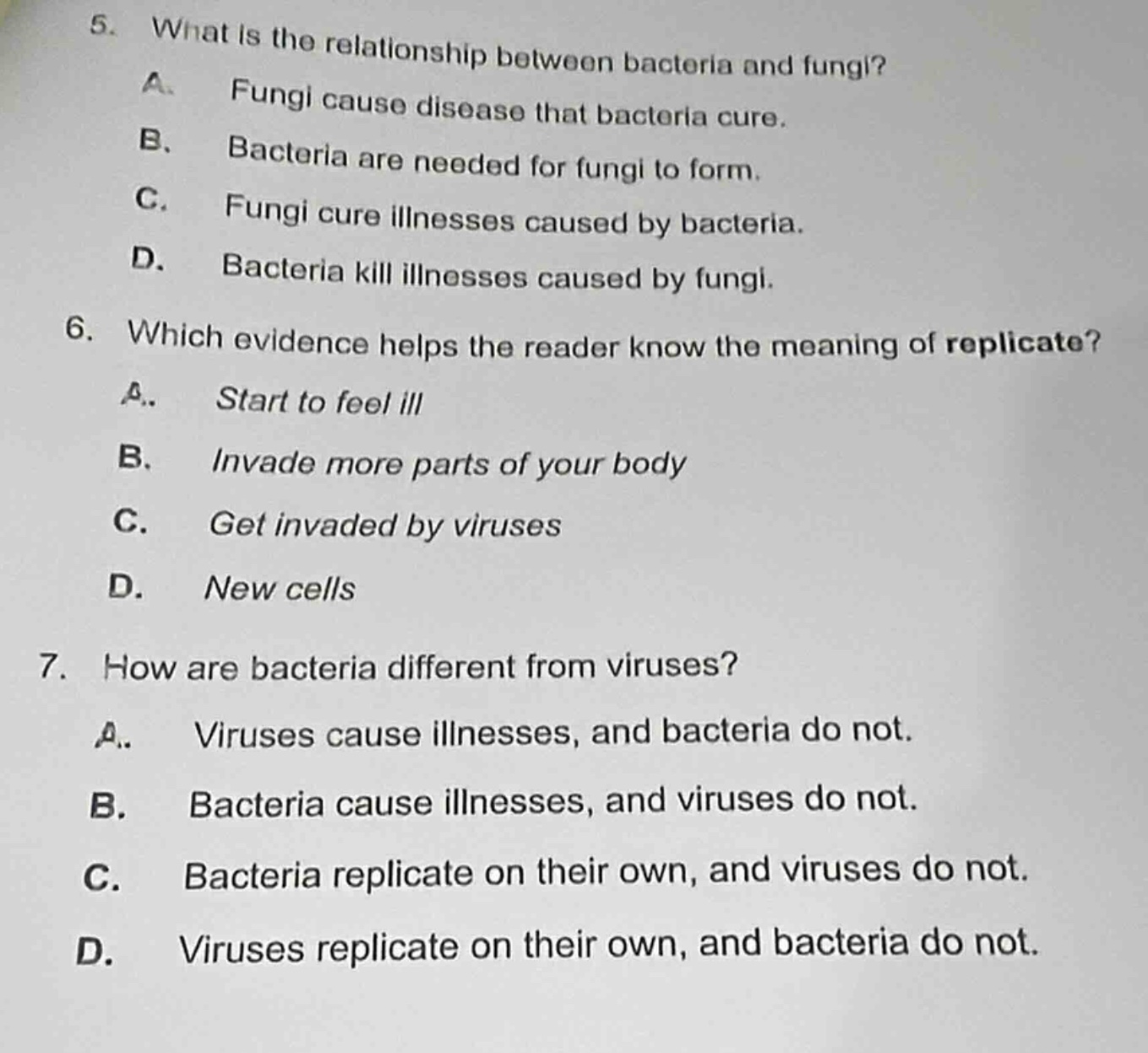
- what is the relationship between bacteria and fungi?
a. fungi cause disease that bacteria cure.
b. bacteria are needed for fungi to form.
c. fungi cure illnesses caused by bacteria.
d. bacteria kill illnesses caused by fungi.
- which evidence helps the reader know the meaning of replicate?
a. start to feel ill
b. invade more parts of your body
c. get invaded by viruses
d. new cells
- how are bacteria different from viruses?
a. viruses cause illnesses, and bacteria do not.
b. bacteria cause illnesses, and viruses do not.
c. bacteria replicate on their own, and viruses do not.
d. viruses replicate on their own, and bacteria do not.
Question 5
To determine the relationship between bacteria and fungi, we analyze each option:
- Option A: Fungi causing diseases that bacteria cure is not a typical or accurate relationship.
- Option B: Bacteria are not required for fungi to form. Fungi have their own life cycles and formation processes independent of bacteria in most cases.
- Option C: Some fungi (like certain antibiotics - producing fungi) can cure illnesses caused by bacteria. For example, Penicillium (a fungus) produces penicillin which is used to treat bacterial infections.
- Option D: Bacteria do not typically kill illnesses caused by fungi. In fact, the reverse (fungi - derived antibiotics killing bacteria) is more common.
To find the evidence for the meaning of "replicate", we analyze each option:
- Option A: "Start to feel ill" is related to the onset of a disease, not replication.
- Option B: "Invade more parts of your body" is about the spread of a pathogen, not replication (replication is about producing more of the pathogen).
- Option C: "Get invaded by viruses" is about the host being infected, not the replication of the virus.
- Option D: "New cells" (or new pathogens) would be the result of replication. If a pathogen replicates, it produces new copies of itself (new cells in the case of bacteria or new viral particles).
To find the difference between bacteria and viruses, we analyze each option:
- Option A: Both viruses and bacteria can cause illnesses. For example, bacteria like Streptococcus cause strep throat, and viruses like influenza virus cause the flu. So this is incorrect.
- Option B: As mentioned above, both can cause illnesses. So this is incorrect.
- Option C: Bacteria are single - celled organisms that can replicate on their own through processes like binary fission. Viruses are non - cellular and need a host cell to replicate (they use the host's cellular machinery to make more viruses). So this is correct.
- Option D: Viruses cannot replicate on their own, while bacteria can. So this is the opposite of the correct statement.

Snap & solve any problem in the app
Get step-by-step solutions on Sovi AI
Photo-based solutions with guided steps
Explore more problems and detailed explanations
C. Fungi cure illnesses caused by bacteria.