QUESTION IMAGE
Question
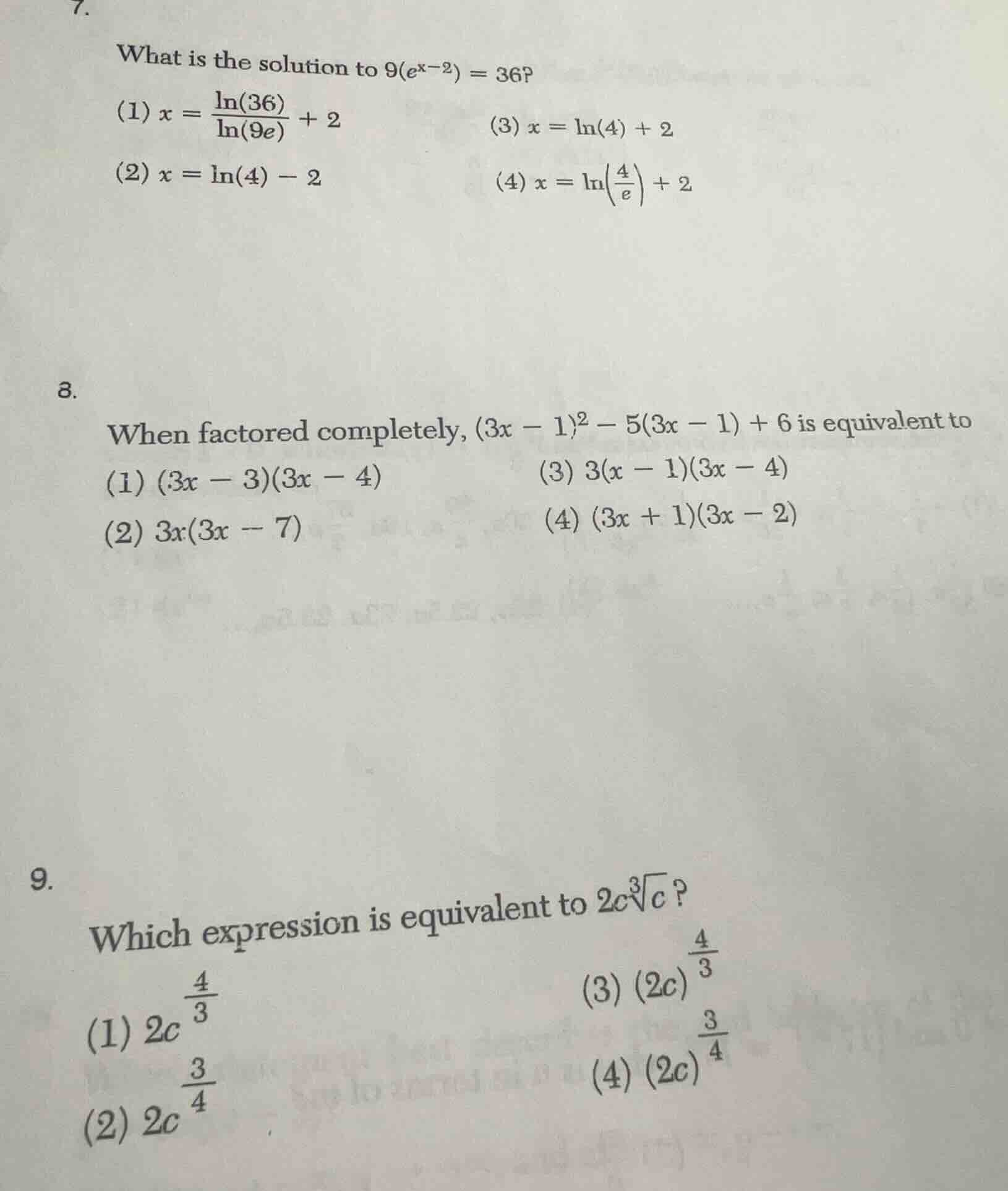
- what is the solution to $9(e^{x - 2}) = 36$? (1) $x = \frac{\ln(36)}{\ln(9e)} + 2$ (3) $x = \ln(4) + 2$ (2) $x = \ln(4) - 2$ (4) $x = \ln\left(\frac{4}{e}\
ight) + 2$ 8. when factored completely, $(3x - 1)^2 - 5(3x - 1) + 6$ is equivalent to (1) $(3x - 3)(3x - 4)$ (3) $3(x - 1)(3x - 4)$ (2) $3x(3x - 7)$ (4) $(3x + 1)(3x - 2)$ 9. which expression is equivalent to $2c\sqrt3{c}$? (1) $2c^{\frac{4}{3}}$ (3) $(2c)^{\frac{4}{3}}$ (2) $2c^{\frac{3}{4}}$ (4) $(2c)^{\frac{3}{4}}$
Question 7
Step1: Isolate the exponential term
Divide both sides by 9:
$\frac{9(e^{x-2})}{9} = \frac{36}{9}$
$e^{x-2} = 4$
Step2: Take natural log of both sides
Use $\ln(e^a)=a$:
$\ln(e^{x-2}) = \ln(4)$
$x-2 = \ln(4)$
Step3: Solve for x
Add 2 to both sides:
$x = \ln(4) + 2$
Step1: Substitute $u=3x-1$
Rewrite the quadratic expression:
$u^2 - 5u + 6$
Step2: Factor the quadratic
Find two terms that multiply to 6 and add to -5:
$(u-2)(u-3)$
Step3: Substitute back $u=3x-1$
Replace u and simplify each factor:
$(3x-1-2)(3x-1-3) = (3x-3)(3x-4)$
Step4: Simplify first factor
Factor out 3 from the first term:
$3(x-1)(3x-4)$
Step1: Rewrite cube root as exponent
Use $\sqrt[3]{c}=c^{\frac{1}{3}}$:
$2c \cdot c^{\frac{1}{3}}$
Step2: Combine like terms
Use exponent rule $a^m \cdot a^n = a^{m+n}$:
$2c^{1+\frac{1}{3}} = 2c^{\frac{4}{3}}$

Snap & solve any problem in the app
Get step-by-step solutions on Sovi AI
Photo-based solutions with guided steps
Explore more problems and detailed explanations
(3) $x = \ln(4) + 2$
---