QUESTION IMAGE
Question
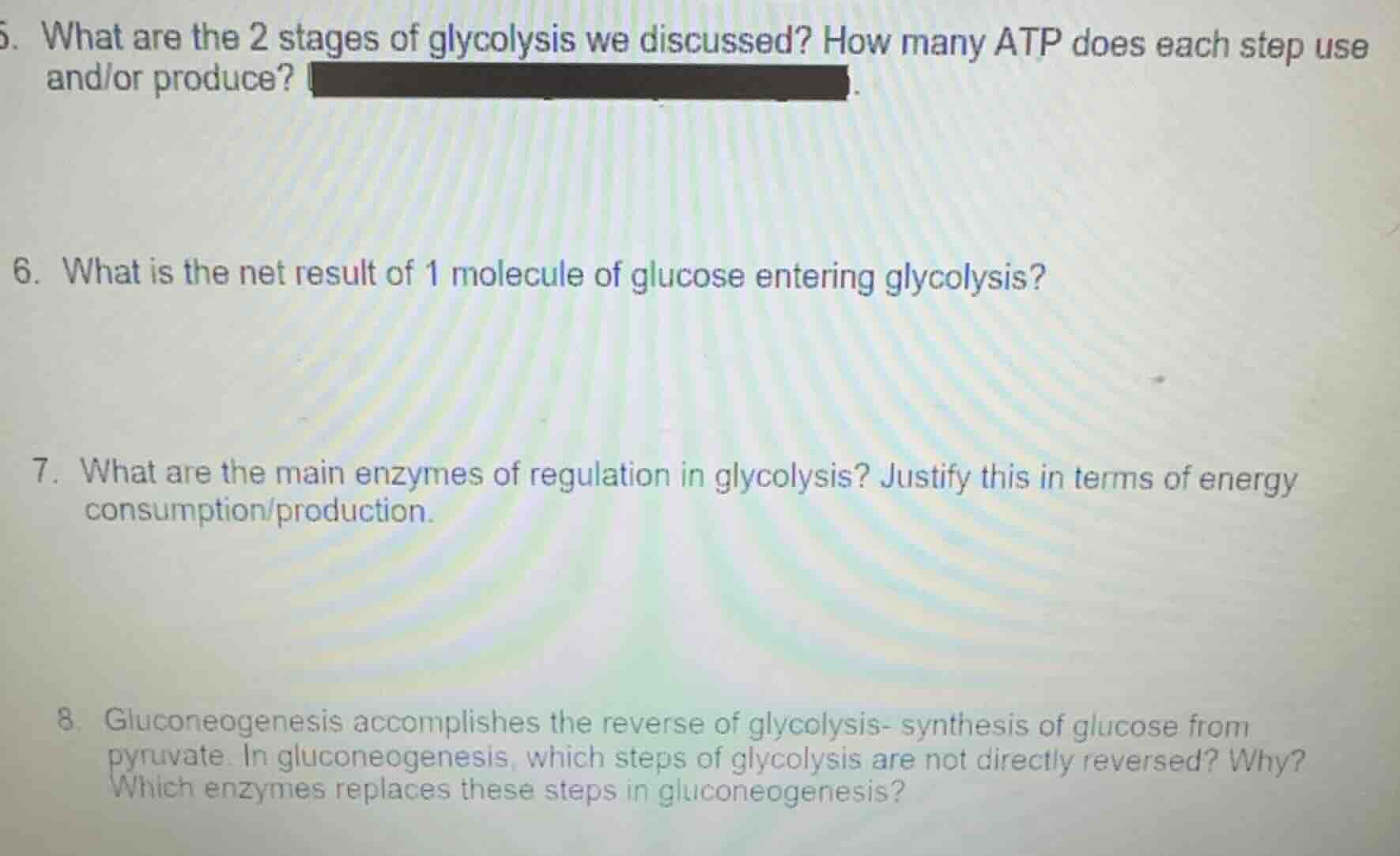
- what are the 2 stages of glycolysis we discussed? how many atp does each step use and/or produce?
- what is the net result of 1 molecule of glucose entering glycolysis?
- what are the main enzymes of regulation in glycolysis? justify this in terms of energy consumption/production.
- gluconeogenesis accomplishes the reverse of glycolysis- synthesis of glucose from pyruvate. in gluconeogenesis, which steps of glycolysis are not directly reversed? why? which enzymes replaces these steps in gluconeogenesis?
For Question 5:
Glycolysis is split into two core stages. The energy investment stage uses ATP to prime glucose for breakdown, while the energy payoff stage generates ATP and electron carriers.
For Question 6:
The net result accounts for ATP used in the investment stage and ATP/NADH produced in the payoff stage, along with the end product of glycolysis.
For Question 7:
The regulatory enzymes control key irreversible, high-energy steps of glycolysis, matching enzyme activity to cellular energy needs.
For Question 8:
Glycolysis has irreversible, energy-releasing steps that require unique enzymes in gluconeogenesis to drive the reverse, energy-consuming reactions.

Snap & solve any problem in the app
Get step-by-step solutions on Sovi AI
Photo-based solutions with guided steps
Explore more problems and detailed explanations
- Question 5:
- The two stages are:
- Energy Investment Stage: Uses 2 molecules of ATP (1 ATP to convert glucose to glucose-6-phosphate, 1 ATP to convert fructose-6-phosphate to fructose-1,6-bisphosphate; total ATP consumed: 2).
- Energy Payoff Stage: Produces 4 molecules of ATP (via substrate-level phosphorylation) and 2 molecules of NADH. Net ATP for this stage alone is 4.
- Question 6:
For 1 molecule of glucose entering glycolysis, the net result is: 2 molecules of pyruvate, 2 molecules of NADH, and 2 molecules of ATP (calculated as 4 ATP produced - 2 ATP invested).
- Question 7:
The main regulatory enzymes are hexokinase, phosphofructokinase-1 (PFK-1), and pyruvate kinase:
- Hexokinase: Regulates the first irreversible step, preventing glucose from exiting the cell; inhibited by glucose-6-phosphate when energy is abundant.
- PFK-1: The key rate-limiting enzyme; it controls the commitment of glucose to full glycolysis. It is inhibited by ATP and citrate (high energy signals) and activated by AMP/ADP (low energy signals).
- Pyruvate kinase: Regulates the final irreversible step; inhibited by ATP and activated by fructose-1,6-bisphosphate, matching pyruvate production to cellular energy demand.
- Question 8:
- The irreversible steps of glycolysis that are not directly reversed in gluconeogenesis are:
- Glucose → Glucose-6-phosphate (catalyzed by hexokinase)
- Fructose-6-phosphate → Fructose-1,6-bisphosphate (catalyzed by PFK-1)
- Phosphoenolpyruvate → Pyruvate (catalyzed by pyruvate kinase)
- These steps cannot be reversed directly because they are highly exergonic (release large amounts of free energy) and have a very negative ΔG, making their spontaneous reversal thermodynamically unfavorable.
- The replacement enzymes in gluconeogenesis are:
- Glucose-6-phosphatase (reverses hexokinase's reaction)
- Fructose-1,6-bisphosphatase (reverses PFK-1's reaction)
- Pyruvate carboxylase and phosphoenolpyruvate carboxykinase (PEPCK) (together reverse pyruvate kinase's reaction, first converting pyruvate to oxaloacetate, then to phosphoenolpyruvate)