QUESTION IMAGE
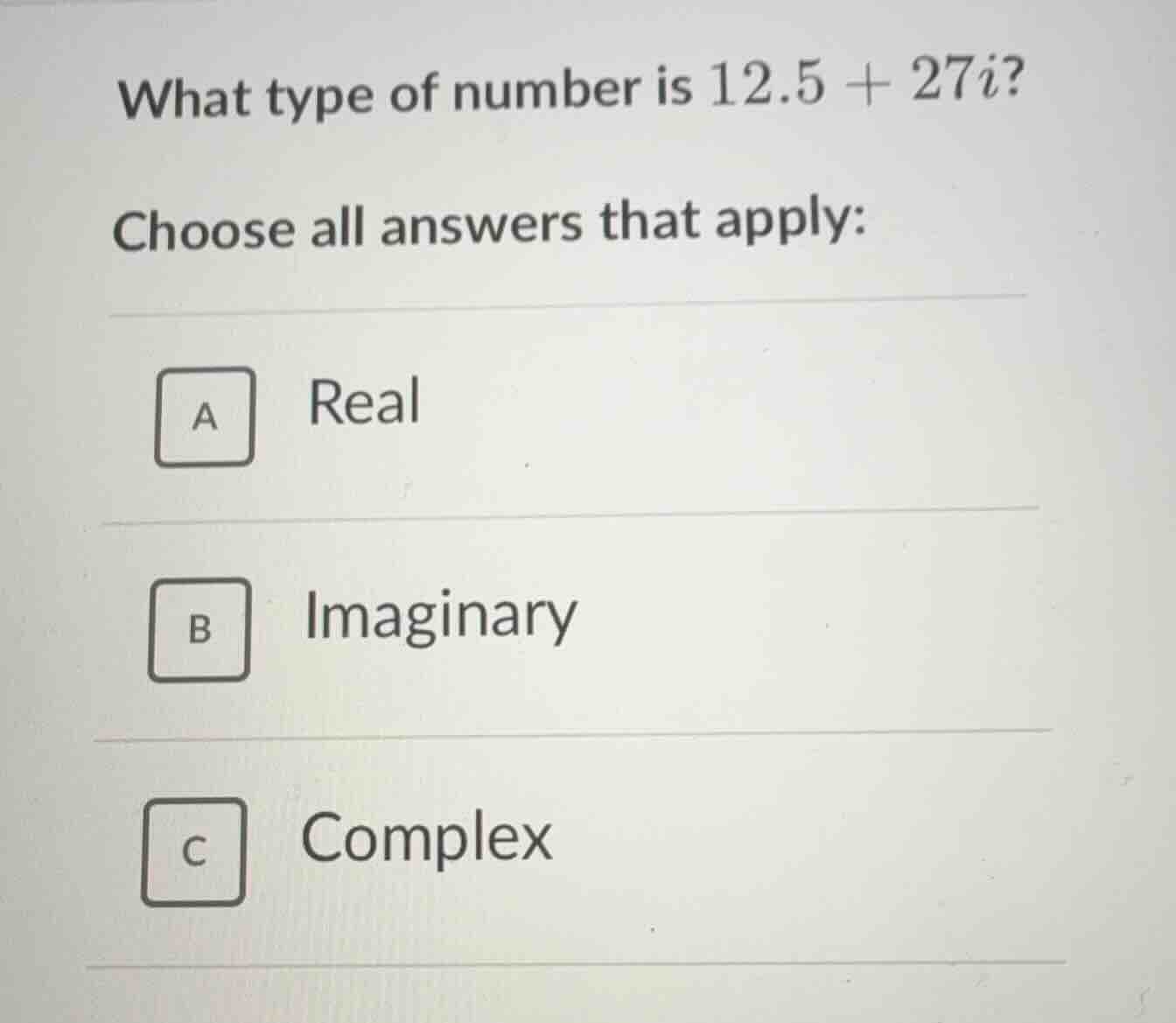
Question
what type of number is $12.5 + 27i$? choose all answers that apply: a real b imaginary c complex
- Recall the definitions:
- A real number is a number that can be represented on the number line, and it does not involve the imaginary unit \(i\). The number \(12.5 + 27i\) has an imaginary part (\(27i\)), so it is not a real number (so option A is incorrect).
- An imaginary number is typically in the form \(bi\) where \(b\) is a real number and \(b
eq0\). The given number \(12.5 + 27i\) has a real part (\(12.5\)) and an imaginary part (\(27i\)), so it is not a pure imaginary number (so option B is incorrect in the sense of a pure imaginary number, but we will see about complex).
- A complex number is defined as a number of the form \(a + bi\), where \(a\) and \(b\) are real numbers and \(i=\sqrt{- 1}\). In the number \(12.5+27i\), \(a = 12.5\) (real) and \(b = 27\) (real), so it fits the form of a complex number. Also, all imaginary numbers (pure or non - pure) and real numbers are subsets of complex numbers. Since the number has both real and imaginary parts, it is a complex number. Also, since it has an imaginary part (\(27i\)), it is an imaginary - related number (but the term "imaginary" here can be a bit confusing as pure imaginary is \(bi\), but in the context of complex numbers, numbers with \(bi\) (where \(b
eq0\)) are part of complex numbers. So the number \(12.5 + 27i\) is a complex number (option C is correct) and since it has an imaginary component, it can be considered an imaginary - type number in the context of complex numbers (but the strict definition of imaginary is \(bi\), but in the options given, the number is complex and also, since it has an imaginary part, it is an imaginary - related number. Wait, actually, the standard definitions:
- Real numbers: \(a+0i\) where \(a\in\mathbb{R}\)
- Imaginary numbers: \(0 + bi\) where \(b\in\mathbb{R},b
eq0\)
- Complex numbers: \(a + bi\) where \(a,b\in\mathbb{R}\)
So \(12.5+27i\) is a complex number (because \(a = 12.5,b = 27\in\mathbb{R}\)). Also, since \(b = 27
eq0\), it is a non - real, non - pure - imaginary complex number. So the correct options are B and C? Wait, no. Wait, the term "imaginary number" can sometimes be used informally to refer to any number with an \(i\) component. Let's re - evaluate:
- The number \(12.5+27i\) has an imaginary part (\(27i\)), so it is an imaginary - valued number (in the sense that it involves the imaginary unit). And by definition, it is a complex number. So:
- Option A: Real? No, because it has an imaginary part.
- Option B: Imaginary? In the broad sense, since it has an imaginary component (\(27i\)), yes (because complex numbers with \(b
eq0\) are sometimes called imaginary - complex numbers).
- Option C: Complex? Yes, because it is of the form \(a + bi\) with \(a = 12.5,b = 27\in\mathbb{R}\)
So the correct options are B and C? Wait, no. Wait, the strict definition of an imaginary number is \(bi\) (pure imaginary). But in common language in math problems like this, the term "imaginary" is sometimes used to mean "has an imaginary part". So let's check:
- The number \(12.5+27i\):
- It is not real (A is out).
- It is not a pure imaginary number (since it has a real part), but if the option "Imaginary" is meant to include numbers with an imaginary component (not just pure), then B is correct. And it is definitely a complex number (C is correct).
So the correct options are B and C. Wait, but let's check again. The standard definitions:
- Complex numbers: All numbers of the form \(a + bi,a,b\in\mathbb{R}\). So \(12.5+27i\) is compl…

Snap & solve any problem in the app
Get step-by-step solutions on Sovi AI
Photo-based solutions with guided steps
Explore more problems and detailed explanations
B. Imaginary, C. Complex