QUESTION IMAGE
Question
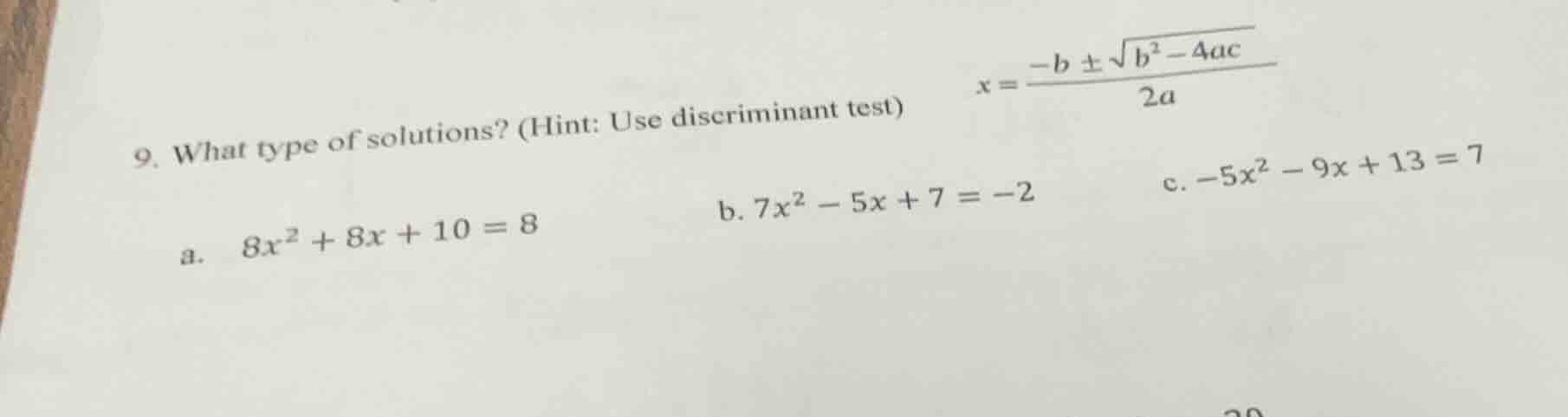
- what type of solutions? (hint: use discriminant test)
$x = \frac{-b \pm \sqrt{b^2 - 4ac}}{2a}$
a. $8x^2 + 8x + 10 = 8$
b. $7x^2 - 5x + 7 = -2$
c. $-5x^2 - 9x + 13 = 7$
For each quadratic equation, we first rewrite it in standard form $ax^2+bx+c=0$, then calculate the discriminant $\Delta = b^2-4ac$. The rules are:
- $\Delta>0$: Two distinct real solutions
- $\Delta=0$: One real repeated solution
- $\Delta<0$: Two complex conjugate solutions
---
Part a
Step1: Rewrite to standard form
$8x^2 + 8x + 10 - 8 = 0$
$8x^2 + 8x + 2 = 0$
Step2: Identify $a,b,c$
$a=8$, $b=8$, $c=2$
Step3: Calculate discriminant
$\Delta = 8^2 - 4(8)(2) = 64 - 64 = 0$
Step4: Classify solutions
$\Delta=0$, so one real repeated solution
---
Part b
Step1: Rewrite to standard form
$7x^2 - 5x + 7 + 2 = 0$
$7x^2 - 5x + 9 = 0$
Step2: Identify $a,b,c$
$a=7$, $b=-5$, $c=9$
Step3: Calculate discriminant
$\Delta = (-5)^2 - 4(7)(9) = 25 - 252 = -227$
Step4: Classify solutions
$\Delta<0$, so two complex conjugate solutions
---
Part c
Step1: Rewrite to standard form
$-5x^2 - 9x + 13 - 7 = 0$
$-5x^2 - 9x + 6 = 0$
Step2: Identify $a,b,c$
$a=-5$, $b=-9$, $c=6$
Step3: Calculate discriminant
$\Delta = (-9)^2 - 4(-5)(6) = 81 + 120 = 201$
Step4: Classify solutions
$\Delta>0$, so two distinct real solutions

Snap & solve any problem in the app
Get step-by-step solutions on Sovi AI
Photo-based solutions with guided steps
Explore more problems and detailed explanations
a. One real repeated solution
b. Two complex conjugate solutions
c. Two distinct real solutions