QUESTION IMAGE
Question
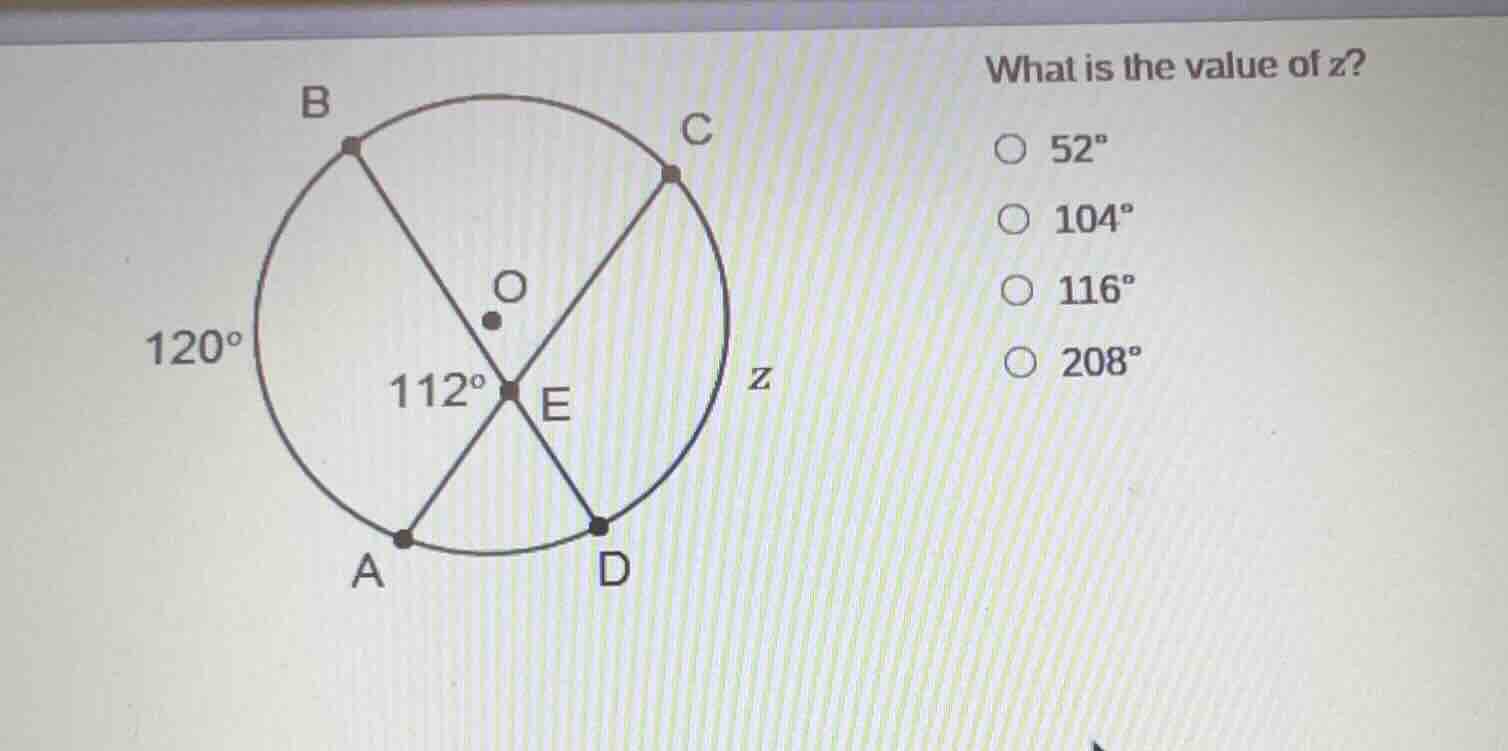
what is the value of z? 52° 104° 116° 208° (with a circle diagram labeled with points a, b, c, d, e, o, arc ab is 120°, angle at e is 112°, and arc cd is z)
Step1: Recall circle's total degrees
A circle has \(360^\circ\). Let the arcs be \(120^\circ\), \(112^\circ\) (central angle, so arc \(AB\) or \(CD\)? Wait, central angle equals arc measure. Wait, the arcs: we have arc \(AB = 120^\circ\)? Wait, no, the angle at \(E\) is \(112^\circ\), so the arc opposite? Wait, the sum of all arcs in a circle is \(360^\circ\). Let's denote the arcs: let arc \(BC\) and arc \(AD\) be related? Wait, no, the given arcs: one arc is \(120^\circ\), the central angle at \(E\) is \(112^\circ\), so the arc corresponding to that central angle is \(112^\circ\)? Wait, no, central angle equals the measure of its intercepted arc. So if angle \(AEB\) is \(112^\circ\), then arc \(AB\) is equal to arc \(CD\)? Wait, maybe better to sum all arcs: \(120^\circ + 112^\circ + z + \text{arc } AD = 360^\circ\)? Wait, no, actually, vertical angles: the angle at \(E\) is \(112^\circ\), so the opposite angle is also \(112^\circ\), and the adjacent angles are supplementary? Wait, no, in a circle, the sum of all arcs is \(360^\circ\). Let's list the arcs:
- Arc \(AB\): \(120^\circ\) (given)
- Arc \(CD\): let's say the central angle for arc \(CD\) is equal to the central angle for arc \(AB\)? No, wait, the angle at \(E\) is \(112^\circ\), which is a vertical angle, so the arc opposite to \(112^\circ\) is equal? Wait, maybe the arcs are: \(120^\circ\), \(z\), and two arcs related to the \(112^\circ\) angle. Wait, actually, the sum of all arcs in a circle is \(360^\circ\). So we have four arcs? Wait, no, the circle is divided into four arcs by the two chords \(AC\) and \(BD\) intersecting at \(E\). So the arcs are: arc \(AB\), arc \(BC\), arc \(CD\), arc \(DA\). The measure of an inscribed angle (or central angle) relates to the arc. But the given angle at \(E\) is \(112^\circ\), which is an angle formed by two intersecting chords, so the measure of the angle is equal to half the sum of the measures of the intercepted arcs. Wait, no: the measure of an angle formed by two intersecting chords is equal to half the sum of the measures of the intercepted arcs. So angle \(AEB = \frac{1}{2}(\text{arc } AB + \text{arc } CD)\). Wait, we know angle \(AEB = 112^\circ\), and arc \(AB = 120^\circ\). So:
\(112^\circ = \frac{1}{2}(120^\circ + \text{arc } CD)\)
Solving for arc \(CD\):
Multiply both sides by 2: \(224^\circ = 120^\circ + \text{arc } CD\)
Subtract \(120^\circ\): \(\text{arc } CD = 224^\circ - 120^\circ = 104^\circ\)? No, that's not right. Wait, maybe the formula is that the measure of the angle formed by two intersecting chords is half the sum of the intercepted arcs. So angle \(AEB\) intercepts arc \(AB\) and arc \(CD\), so:
\(m\angle AEB = \frac{1}{2}(m\arc AB + m\arc CD)\)
We know \(m\angle AEB = 112^\circ\) and \(m\arc AB = 120^\circ\), so:
\(112^\circ = \frac{1}{2}(120^\circ + m\arc CD)\)
Multiply both sides by 2: \(224^\circ = 120^\circ + m\arc CD\)
Subtract \(120^\circ\): \(m\arc CD = 224^\circ - 120^\circ = 104^\circ\)? No, that would mean arc \(CD\) is \(104^\circ\), but we need to find \(z\). Wait, maybe \(z\) is arc \(BC\) or arc \(DA\)? Wait, no, the sum of all arcs is \(360^\circ\). Let's list all arcs:
- Arc \(AB\): \(120^\circ\)
- Arc \(CD\): let's say \(x\)
- Arc \(BC\): \(z\)
- Arc \(DA\): \(y\)
We know that the sum of arcs is \(120^\circ + x + z + y = 360^\circ\). Also, the angle at \(E\) is \(112^\circ\), which is equal to \(\frac{1}{2}(m\arc AB + m\arc CD)\) (by the intersecting chords angle theorem: the measure of an angle formed by two intersecting chords is equal to half the sum of the measures of…

Snap & solve any problem in the app
Get step-by-step solutions on Sovi AI
Photo-based solutions with guided steps
Explore more problems and detailed explanations
\(104^\circ\) (Option: 104°)