QUESTION IMAGE
Question
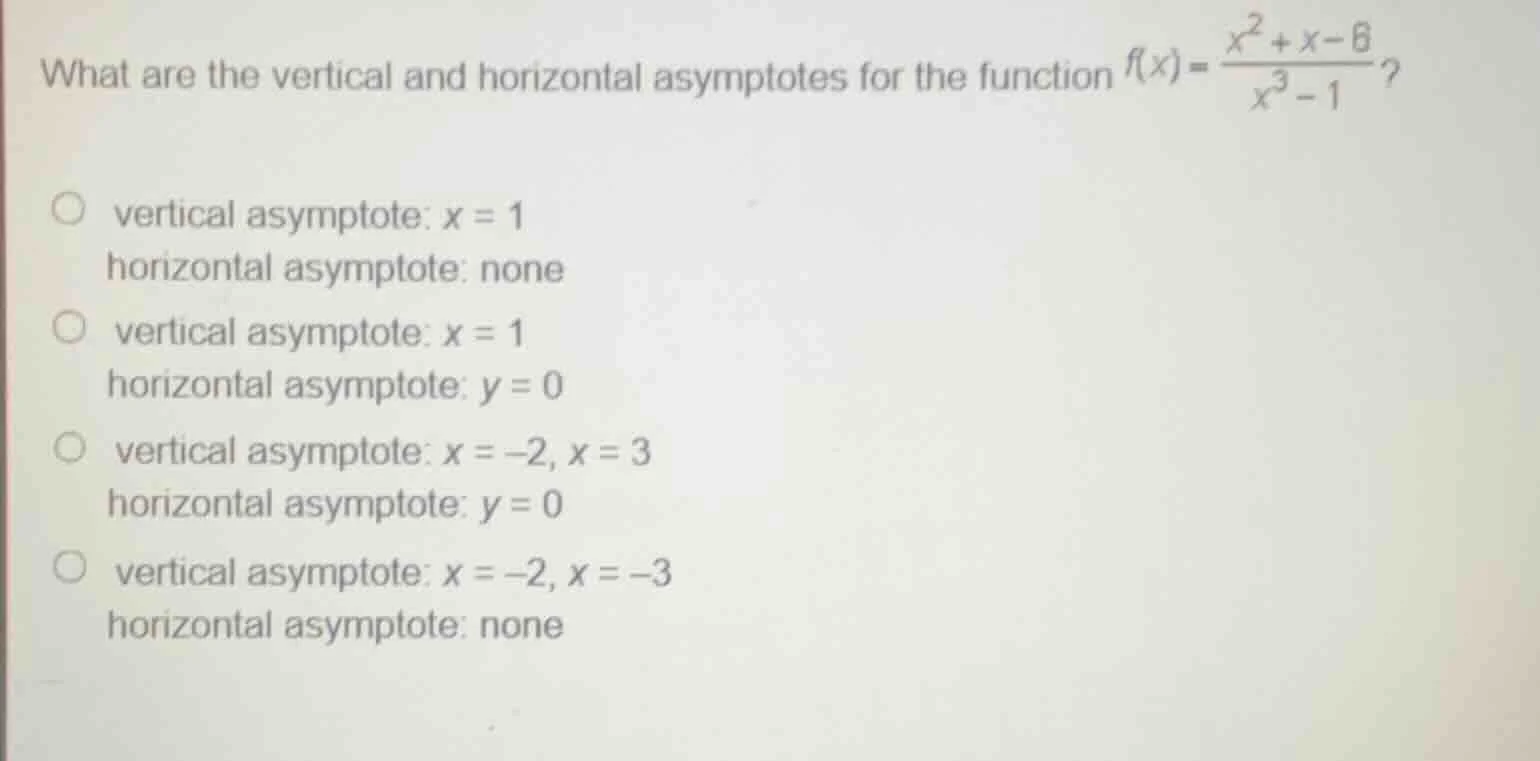
what are the vertical and horizontal asymptotes for the function $f(x)=\frac{x^2 + x - 6}{x^3 - 1}$?
\bigcirc vertical asymptote: $x = 1$
horizontal asymptote: none
\bigcirc vertical asymptote: $x = 1$
horizontal asymptote: $y = 0$
\bigcirc vertical asymptote: $x = -2$, $x = 3$
horizontal asymptote: $y = 0$
\bigcirc vertical asymptote: $x = -2$, $x = -3$
horizontal asymptote: none
Step1: Find vertical asymptotes
First, factor denominator and numerator:
Numerator: $x^2 + x - 6 = (x+3)(x-2)$
Denominator: $x^3 - 1 = (x-1)(x^2+x+1)$
Set denominator to 0: $(x-1)(x^2+x+1)=0$
$x^2+x+1$ has no real roots, so $x=1$ is the only vertical asymptote.
Step2: Find horizontal asymptotes
Compare degrees of numerator and denominator:
Degree of numerator ($n$) = 2, Degree of denominator ($m$) = 3
Since $n < m$, horizontal asymptote is $y=0$.

Snap & solve any problem in the app
Get step-by-step solutions on Sovi AI
Photo-based solutions with guided steps
Explore more problems and detailed explanations
vertical asymptote: $x = 1$
horizontal asymptote: $y = 0$