QUESTION IMAGE
Question
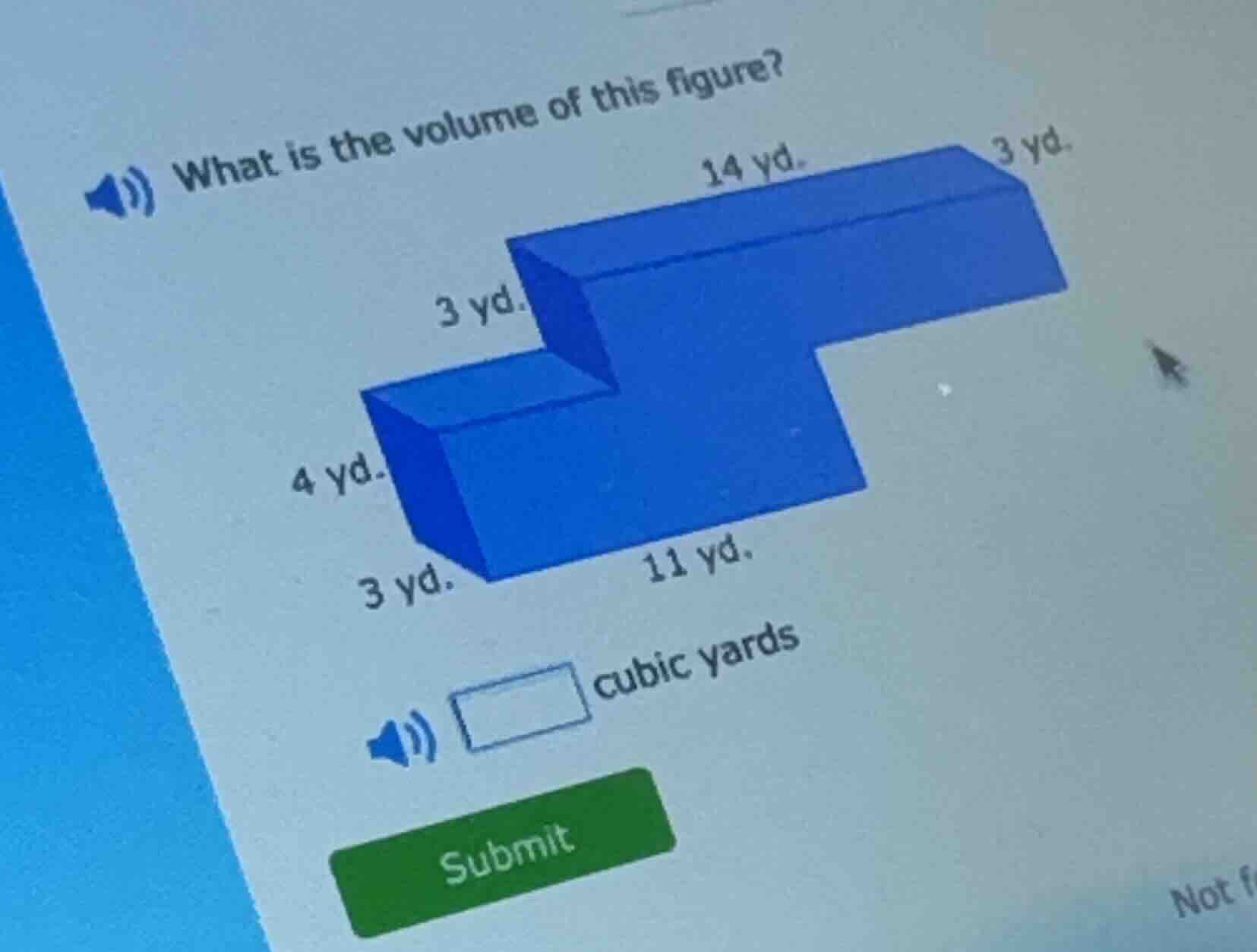
what is the volume of this figure? 3 yd. 14 yd. 3 yd. 4 yd. 3 yd. 11 yd. cubic yards submit
Step1: Divide the figure into two rectangular prisms.
First prism: length = 11 yd, width = 3 yd, height = 4 yd.
Second prism: length = 14 yd, width = 3 yd, height = 3 yd (since total height is 4 + 3 = 7? Wait, no, looking at the figure, the lower part has height 4, width 3, length 11. The upper part has length 14, width 3, height 3 (since the vertical dimension for upper is 3, as given). Wait, maybe better to calculate each part's volume.
Volume of first prism (lower): $V_1 = length \times width \times height = 11 \times 3 \times 4$
Step2: Calculate $V_1$.
$V_1 = 11 \times 3 \times 4 = 132$ cubic yards.
Step3: Calculate volume of second prism (upper).
Length = 14, width = 3, height = 3 (since the upper part's height is 3, as per the diagram: the 3 yd vertical on the upper part). So $V_2 = 14 \times 3 \times 3$
Step4: Calculate $V_2$.
$V_2 = 14 \times 3 \times 3 = 126$ cubic yards.
Step5: Sum the volumes.
Total volume $V = V_1 + V_2 = 132 + 126$
Step6: Calculate the sum.
$132 + 126 = 258$ cubic yards. Wait, wait, maybe I misdivided. Alternatively, maybe the lower part is length 11, width 3, height 4, and the upper part is length 14, width 3, height 3? Wait, no, maybe the figure is a T-shape. Let's re-examine: the base of the lower part is 11 yd (length), 3 yd (width), 4 yd (height). The upper part is 14 yd (length), 3 yd (width), and height 3 yd (since the vertical segment is 3 yd). Wait, but 11 and 14? Maybe the length of the upper part is 14, and the lower part's length is 11, but the width for both is 3? Wait, maybe another way: the total figure can be seen as two rectangles. Wait, perhaps the correct division is: first prism: length = 11, width = 3, height = 4. Second prism: length = 14, width = 3, height = 3. Then sum.
Wait, 1134 = 132, 1433=126, sum is 258. Alternatively, maybe the height of the upper part is 3, and the lower part is 4, so total height for the combined? No, maybe I made a mistake. Wait, let's check again. The diagram shows: lower part has dimensions 11 yd (length), 3 yd (width), 4 yd (height). Upper part has 14 yd (length), 3 yd (width), 3 yd (height). So adding their volumes: 1134 = 132, 1433=126, total 132+126=258. Wait, but maybe the length of the upper part is 14, and the lower part's length is 11, but the width is 3 for both. Alternatively, maybe the width is 3 for both, and the length of the lower is 11, upper is 14, height lower 4, upper 3. So yes, that's correct.
Wait, another approach: maybe the figure is a single prism with a part, but no, it's a composite. So the two prisms:
Prism 1: length = 11, width = 3, height = 4 → V1 = 11×3×4 = 132
Prism 2: length = 14, width = 3, height = 3 → V2 = 14×3×3 = 126
Total V = 132 + 126 = 258.
Wait, but let's check the dimensions again. The lower part: 3 yd (width), 11 yd (length), 4 yd (height). The upper part: 3 yd (width), 14 yd (length), 3 yd (height). Yes, that makes sense. So adding them gives 132 + 126 = 258.

Snap & solve any problem in the app
Get step-by-step solutions on Sovi AI
Photo-based solutions with guided steps
Explore more problems and detailed explanations
258