QUESTION IMAGE
Question
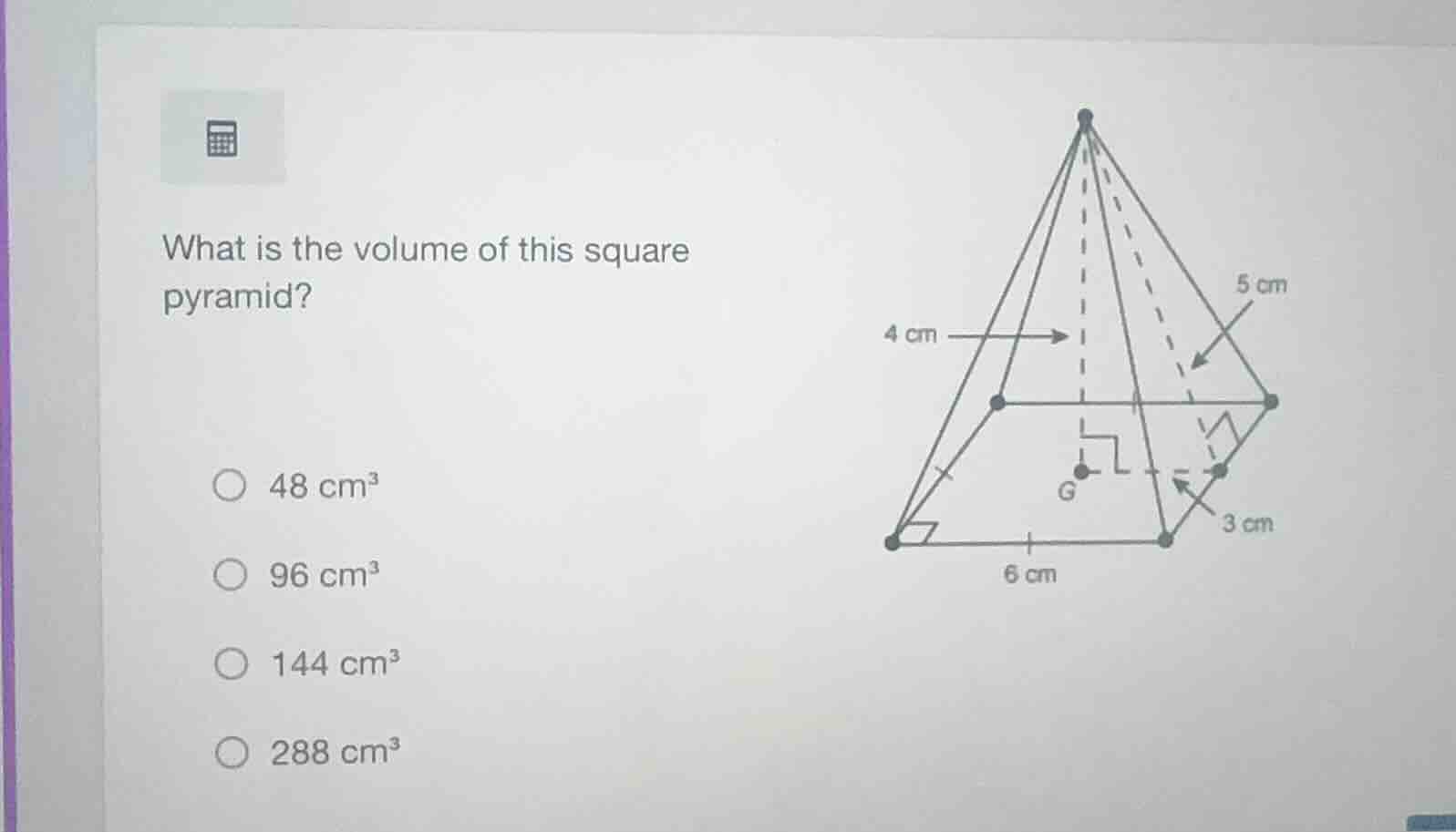
what is the volume of this square pyramid?
48 cm³
96 cm³
144 cm³
288 cm³
Step1: Recall the volume formula for a square pyramid
The volume \( V \) of a square pyramid is given by the formula \( V=\frac{1}{3}Bh \), where \( B \) is the area of the base and \( h \) is the height of the pyramid.
Step2: Calculate the area of the base
The base of the square pyramid is a square. From the diagram, the side length of the square base is \( 6 \, \text{cm} \). The area of a square is \( B = s^2 \), where \( s \) is the side length. So, \( B=(6)^2 = 36 \, \text{cm}^2 \). Wait, no, wait. Wait, looking at the diagram, maybe the base is a rectangle? Wait, no, the problem says square pyramid? Wait, no, maybe the base is a rectangle? Wait, the diagram shows a base with length 6 cm and width 3 cm? Wait, no, maybe I misread. Wait, the square pyramid's base: wait, the formula for a pyramid is \( \frac{1}{3} \times \text{base area} \times \text{height} \). Wait, looking at the diagram, the height of the pyramid (the perpendicular height) is 4 cm? Wait, the slant height or the perpendicular height? Wait, the dashed line is the height, which is 4 cm. The base: let's see, the base has length 6 cm and width 3 cm? Wait, no, maybe the base is a square? Wait, no, the problem says square pyramid, but the diagram shows a base with 6 cm and 3 cm? Wait, maybe it's a rectangular pyramid? Wait, no, the formula is still \( \frac{1}{3} \times \text{length} \times \text{width} \times \text{height} \) for a rectangular pyramid (which is a type of pyramid with rectangular base). Wait, let's check the diagram again. The base has length 6 cm, width 3 cm, and the height of the pyramid (perpendicular height) is 4 cm. So the base area \( B = 6 \times 3 = 18 \, \text{cm}^2 \). Then the volume \( V=\frac{1}{3} \times B \times h=\frac{1}{3} \times 18 \times 4 \). Wait, no, wait, maybe the base is a square? Wait, the problem says square pyramid, so the base should be a square. Wait, maybe the 6 cm is the side of the square, and 3 cm is something else? Wait, no, maybe I made a mistake. Wait, let's re-express. Wait, the formula for the volume of a square pyramid is \( V = \frac{1}{3} s^2 h \), where \( s \) is the side length of the square base and \( h \) is the height of the pyramid. Wait, but in the diagram, there's 6 cm, 3 cm, 4 cm, 5 cm. Wait, maybe the base is a rectangle with length 6 cm and width 3 cm, and the height of the pyramid (the perpendicular height) is 4 cm. So then the volume would be \( \frac{1}{3} \times 6 \times 3 \times 4 \). Let's calculate that: \( 6 \times 3 = 18 \), \( 18 \times 4 = 72 \), \( \frac{1}{3} \times 72 = 24 \). No, that's not one of the options. Wait, maybe the base is a square with side 6 cm? Then base area is \( 6 \times 6 = 36 \), height 4 cm: \( \frac{1}{3} \times 36 \times 4 = 48 \). Ah, 48 is one of the options. Wait, maybe the 3 cm is a red herring? Or maybe I misread the base. Wait, the problem says square pyramid, so the base is a square. So side length of the square is 6 cm? Then base area is \( 6 \times 6 = 36 \). Height of the pyramid is 4 cm (the perpendicular height, the dashed line). Then volume is \( \frac{1}{3} \times 36 \times 4 = 48 \, \text{cm}^3 \). Let's check: \( \frac{1}{3} \times 36 = 12 \), \( 12 \times 4 = 48 \). Yes, that's 48, which is option A.
Wait, maybe the 3 cm is the width, but if it's a square pyramid, the base should be square, so maybe the 3 cm is a mistake, or maybe the base is a rectangle with length 6 and width 6? No, the diagram shows 6 cm and 3 cm. Wait, maybe the height is 4, base length 6, base width 3, so volume is \( \frac{1}{3} \times 6 \times 3 \times 4 = 24 \),…

Snap & solve any problem in the app
Get step-by-step solutions on Sovi AI
Photo-based solutions with guided steps
Explore more problems and detailed explanations
\( 48 \, \text{cm}^3 \) (corresponding to the option with \( 48 \, \text{cm}^3 \))